Introduction
Curly hair can look beautiful and defined on a normal day, but humid weather can quickly change the way curls behave. Extra moisture in the air can make curls swell, lose definition, become frizzy, or develop stubborn flyaways. Hair may also feel drier and harder to manage, especially when the strands are already prone to dryness.
Curly hair naturally needs careful moisture management because its shape can make it harder for natural scalp oils to travel down the length of each strand. Humidity, sweating, frequent washing, heat styling, and heavy or unsuitable products can make this balance even more difficult.
The solution isn’t to fight humidity by covering your curls with layers of products. A good curly hair care in humid weather routine should focus on gentle cleansing, adequate conditioning, lightweight leave-in care, curl definition, frizz control, and protecting the hair while you sleep.
In this guide, you’ll learn how to build a practical morning, night, and weekly curly hair routine for humid weather, along with ways to maintain curl definition, softness, shine, and moisture while reducing frizz and flyaways. We’ll also cover bonus tips, common mistakes, FAQs, and simple budget-friendly ways to care for your curls.
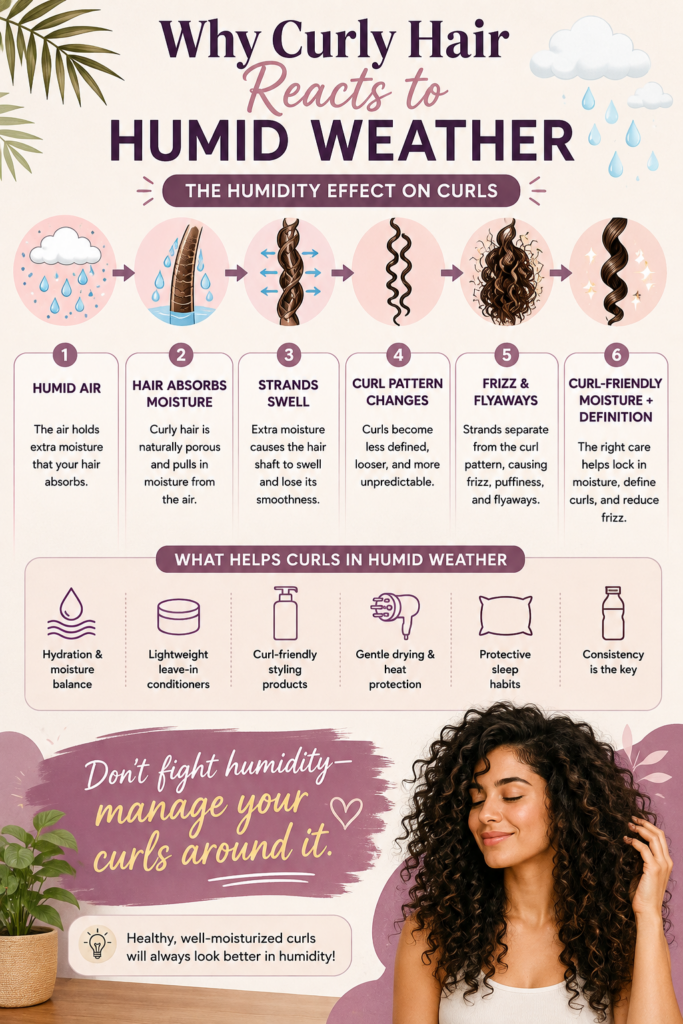
Why Does Curly Hair Become Frizzy in Humid Weather?
Humidity can be particularly challenging for curly hair because curly strands are naturally more prone to dryness and uneven moisture absorption. When the surrounding air contains a lot of moisture, the hair can absorb some of that water, causing the strands to swell and the curl pattern to become less predictable.
Instead of staying smooth and grouped together, individual strands may separate from the curl pattern, creating frizz, puffiness, and flyaways.
If humidity-related frizz is your biggest concern, our Hair Care Routine for Frizzy Hair in Humid Weather offers more practical ways to keep your hair smoother and more manageable.
What Happens to Curly Hair in Humidity?
- 💧 Moisture enters the hair: Humid air can add water to the hair, changing how the strands behave.
- 🌀 Curl definition changes: Curls may become looser, puffier, or less uniform.
- ✨ Frizz increases: Individual strands can lift away from the main curl pattern.
- 🌿 Dryness becomes more noticeable: Curly hair can still feel dry even when the surrounding air is humid.
- 💨 Flyaways appear: Shorter or damaged strands may become more visible as the hair reacts to humidity.
- 🧴 Heavy products can backfire: Too much cream, oil, or styling product may weigh curls down without necessarily controlling humidity-related frizz.
- 🧼 Over-washing can worsen dryness: Frequent cleansing can remove oils that help keep curly hair comfortable and manageable.
Why Curly Hair Needs a Different Approach
Curly hair isn’t simply “dry hair.” The bends and twists in the strand can make it harder for natural scalp oils to move along the full length. This is one reason the ends may need more conditioning than the scalp.
That’s why the goal of curly hair care in humid weather should not be to remove every trace of moisture. Instead, focus on balanced moisture, curl definition, gentle handling, and protection.
A good routine should help your curls stay grouped together rather than trying to make every strand completely smooth.
✨ Glow in Budget Expert Tip
Don’t keep adding oil every time humidity causes frizz. Start with well-conditioned hair and a lightweight curl-friendly leave-in or styling product. Too much oil can make curls heavy while doing little to improve definition.
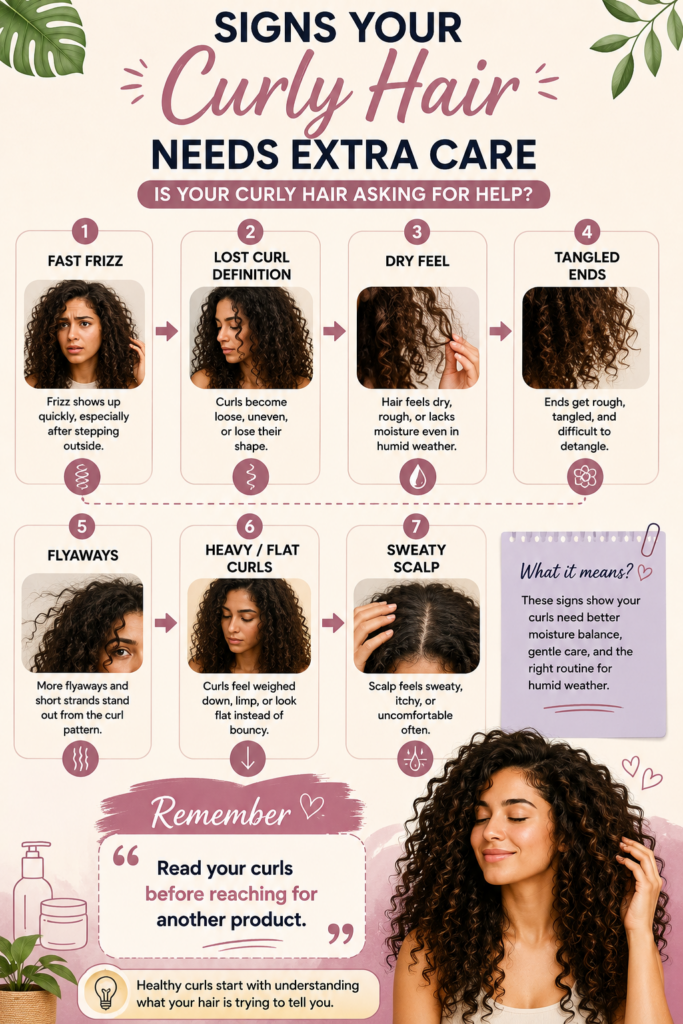
Signs Your Curly Hair Needs a Humid-Weather Routine
Not every curly-hair problem means you need more products. Sometimes, your hair is simply reacting to humidity, moisture imbalance, buildup, or the way it is being handled.
Look for these signs:
- Frizz appears quickly: Your curls look defined initially but become puffy soon after going outside.
- Curls lose their shape: Your curl pattern becomes loose, uneven, or undefined.
- Hair feels dry despite humid weather: Your strands may still need conditioning and moisture even when the air feels damp.
- Ends become rough or tangled: Dry ends can catch on each other and become difficult to detangle.
- Curls feel weighed down: Too much cream, oil, or styling product can make curls limp instead of defined.
- More flyaways appear: Short or damaged strands may separate from your curl pattern.
- Hair becomes difficult to refresh: Your curls may look messy or flat the day after washing.
- Scalp feels sweaty or uncomfortable: Humid weather can increase sweating, making regular scalp cleansing important.
The important thing is to identify what your hair actually needs before adding another product. Frizz caused by dryness may need conditioning, while limp curls caused by buildup may need better cleansing rather than more moisture.
✨ Glow in Budget Expert Tip
If your curls are both frizzy and weighed down, don’t automatically add more styling product. First check whether your hair needs better cleansing, lighter products, or more conditioning at the ends.
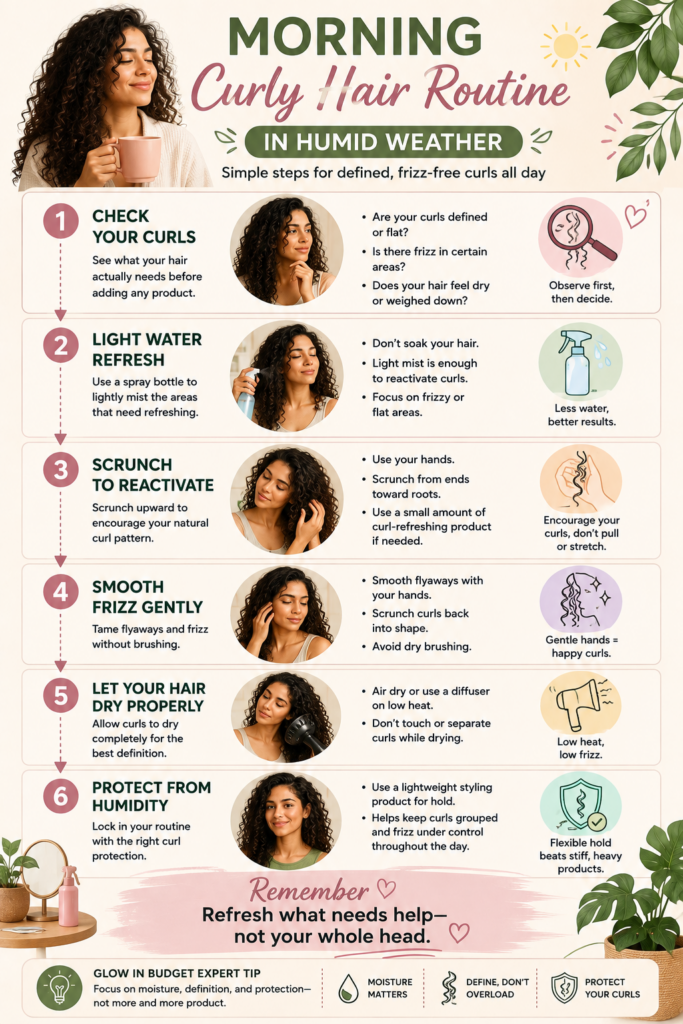
Morning Curly Hair Routine for Humid Weather
A good morning routine should help your curls stay defined without becoming heavy, sticky, or overloaded with product. The goal is to refresh your curl pattern, control frizz, and protect moisture without completely restarting your routine every morning.
Step 1: Check Your Curls First
Before reaching for products, see what your hair actually needs.
- If your curls are still defined, leave them mostly alone.
- If they are slightly flat or frizzy, refresh only those areas.
- If your hair feels coated or greasy, adding more product may make it worse.
Step 2: Lightly Refresh With Water
Use a spray bottle to lightly mist areas that need refreshing.
Avoid completely soaking your hair unless you’re intentionally restyling it. Too much water can disturb the curl pattern and increase drying time.
Step 3: Reactivate Your Curls
Gently scrunch your curls upward with your hands to encourage their natural shape.
For stubborn areas, use a small amount of lightweight curl-refreshing product rather than applying a full layer over your entire head.
Step 4: Control Frizz Without Brushing
Avoid dry-brushing curly hair when you want to preserve definition.
Instead:
- Smooth obvious flyaways gently with your hands.
- Scrunch curls back into shape.
- Use a small amount of lightweight styling product if needed.
- Avoid repeatedly touching your curls throughout the day.
Step 5: Let Your Hair Dry Properly
If you’ve refreshed your curls with water or product, allow them to dry completely before repeatedly touching or rearranging them.
If you use a diffuser, choose a gentle heat and airflow setting that works for your hair.
Step 6: Protect Curls From Humidity
Before heading outside, use a curl-friendly styling product that provides enough hold to keep your curls grouped together.
The goal isn’t to create a stiff layer of product. A flexible hold can help curls stay together and reduce the amount of frizz that develops as the day becomes more humid.
✨ Glow in Budget Expert Tip
Don’t refresh your entire head automatically every morning. Start with the areas that actually need help. This saves product, reduces buildup, and often keeps curls looking more natural.
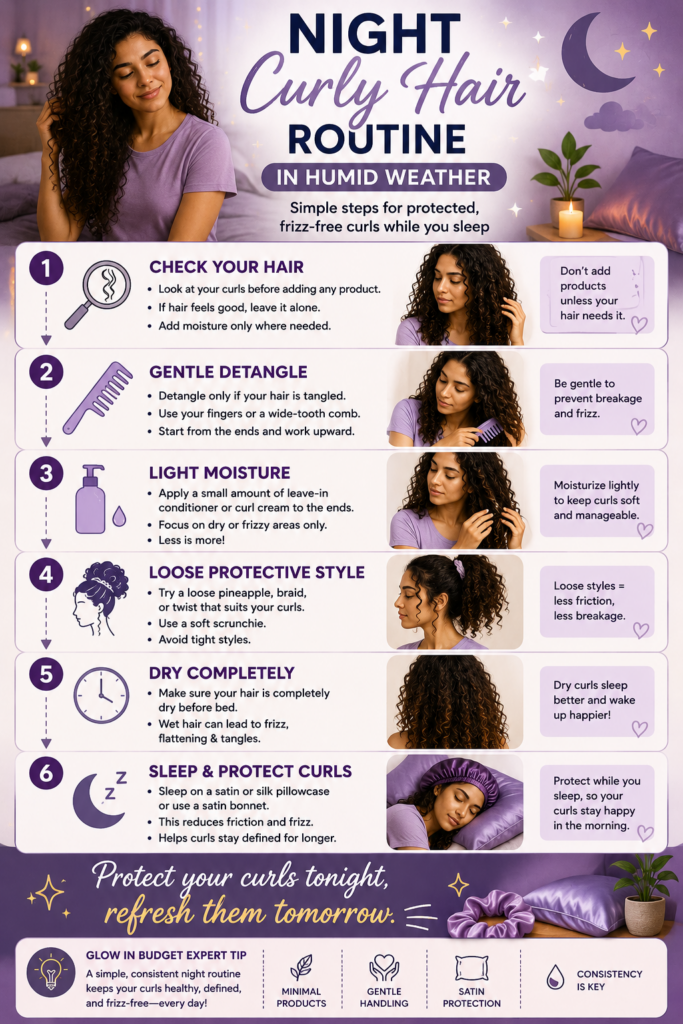
Night Curly Hair Routine for Humid Weather
Your nighttime routine should focus on protecting your curl pattern, reducing friction, and keeping your hair from becoming overly dry or tangled overnight. You don’t need to completely redo your curls before bed—small protective steps are usually enough.
Step 1: Check Your Hair Before Adding Anything
Look at how your curls feel before applying another product.
- If your hair feels soft and defined, leave it alone.
- If the ends feel dry, apply a tiny amount of lightweight leave-in or curl cream to those areas.
- If your hair feels coated or heavy, don’t add more product.
Step 2: Detangle Only When Necessary
If your curls are tangled, gently work through the affected areas rather than brushing the entire head.
Use your fingers or a wide-tooth comb and start from the ends, working upward.
Step 3: Protect Your Curls While Sleeping
Loose protective styling can reduce friction and help preserve your curl pattern.
Try:
- A loose pineapple for longer curls.
- A loose braid if it suits your curl pattern.
- A soft scrunchie instead of a tight elastic.
- A smooth or satin-style pillowcase to reduce friction.
Avoid sleeping with your curls pulled tightly because tension can cause unnecessary breakage.
Step 4: Don’t Sleep With Soaking-Wet Hair
If you refreshed your curls in the evening, allow them to dry properly before going to bed.
Going to sleep with very wet hair can leave curls flattened and may increase tangling and frizz by morning.
Step 5: Protect the Ends
Pay extra attention to the ends if they are dry or prone to tangling.
A small amount of lightweight leave-in conditioner or serum can help reduce friction and make the ends easier to manage the following morning.
Step 6: Keep the Routine Light
Nighttime isn’t the time to layer several products just because your curls look slightly frizzy.
Too much cream, oil, or gel can leave your hair feeling heavy and may contribute to buildup.
✨ Glow in Budget Expert Tip
Protect your curls instead of trying to perfect them before bed. A loose hairstyle, gentle handling, and minimal targeted moisture can often do more than adding several products.
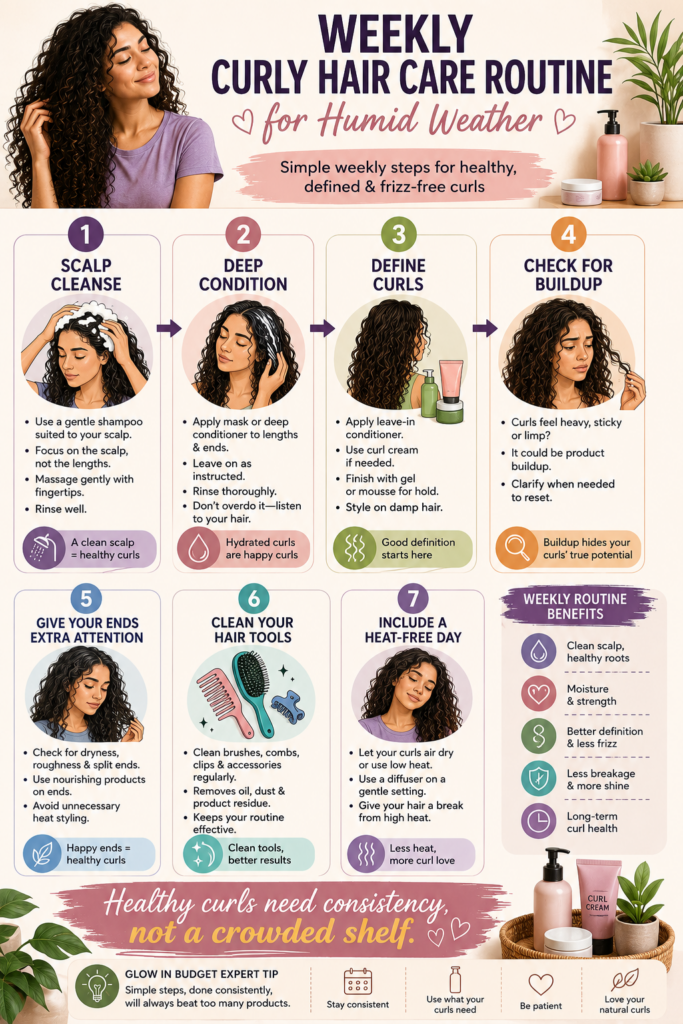
Weekly Curly Hair Care Routine for Humid Weather
A weekly routine gives curly hair the extra conditioning and maintenance it may need without turning every wash day into a complicated process. The goal is to clean the scalp, replenish moisture, maintain curl definition, and prevent unnecessary buildup.
Step 1: Cleanse the Scalp
Choose a gentle shampoo that suits how oily or sweaty your scalp becomes.
The American Academy of Dermatology Association recommends washing curly hair when needed and using a moisturizing shampoo formulated for curly hair.
- Concentrate shampoo mainly on the scalp.
- Massage gently with your fingertips.
- Let the lather rinse through the lengths rather than aggressively scrubbing them.
- Adjust your washing frequency according to your scalp rather than following a rigid schedule.
Step 2: Deep Condition When Needed
Curly hair often benefits from additional conditioning, especially when the lengths feel dry or rough.
- Apply a suitable hair mask or deep conditioner mainly to the lengths and ends.
- Leave it on according to the product instructions.
- Rinse thoroughly.
- Don’t automatically deep-condition more often if your curls already feel soft and balanced.
Step 3: Refresh Curl Definition
After washing and conditioning, apply your usual curl-friendly styling products while the hair is damp.
You can use a combination such as:
- Lightweight leave-in conditioner
- Curl cream, if needed
- Gel or mousse for hold
The exact combination depends on your curl pattern and how much product your hair can tolerate.
Step 4: Check for Buildup
If your curls feel coated, unusually heavy, sticky, or limp, look at your styling routine before adding more moisture.
Too much product can make curls lose their bounce even when the hair isn’t actually dry.
Step 5: Give Your Ends Extra Attention
Check the ends for:
- Roughness
- Split ends
- Excessive tangling
- Dryness
- Increased breakage
Use conditioning products on the areas that need them, and avoid unnecessary heat styling.
Step 6: Clean Your Hair Tools
Your brush, comb, clips, and other frequently used hair accessories can collect oil, dust, loose hair, and styling-product residue.
Clean them regularly so you’re not transferring buildup back onto freshly washed curls.
Step 7: Include a Low-Heat or Heat-Free Day
Whenever practical, allow your curls to air-dry or use gentle drying methods instead of relying on high heat.
If you use a diffuser, keep the heat and airflow at a comfortable setting for your hair and avoid excessive drying.
✨ Glow in Budget Expert Tip
Don’t turn your weekly routine into a product marathon. Start with cleansing and conditioning, then add only the styling or treatment products your curls actually need. A simple routine is easier to maintain and can help prevent buildup.
Best Ingredients for Curly Hair in Humid Weather
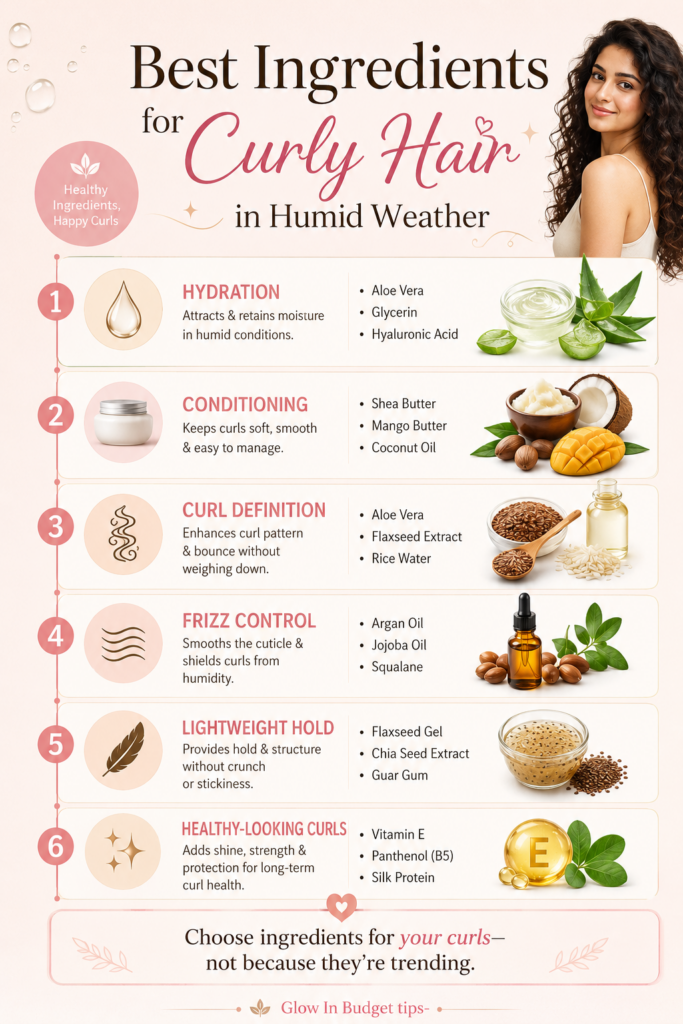
Choosing the right ingredients can make a big difference when managing curly hair in humid conditions. However, more ingredients do not automatically mean better results. The goal is to choose products that support moisture, curl definition, and frizz control without creating unnecessary buildup.
Ingredients That Can Help
- Aloe vera: Can provide lightweight hydration and help hair feel softer.
- Glycerin: A humectant that attracts water. Its performance can vary depending on the humidity and the rest of the formula, so use products containing it based on how your curls respond.
- Panthenol: Often used in hair products to help improve moisture and softness.
- Shea butter: Provides richer conditioning and can be useful for particularly dry curls, but may feel heavy on finer hair.
- Coconut oil: Can help condition some hair types, although not every curly-haired person responds well to it.
- Argan oil: A lightweight-feeling option that can help add smoothness and shine when used sparingly.
- Hydrolyzed proteins: May help improve the feel and strength of damaged or weakened hair, although some curls may become stiff if protein-heavy products are overused.
- Flaxseed-based styling ingredients: Commonly used in curl gels and styling products to provide lightweight hold and help curls stay grouped.
Ingredients to Use According to Your Hair
Not every popular curly-hair ingredient will work equally well for everyone.
For example:
- Fine curls: Usually benefit from lighter formulas that don’t leave heavy residue.
- Thick or coarse curls: May tolerate richer conditioners and creams better.
- Dry curls: Often need more conditioning and moisture.
- Low-porosity hair: May become weighed down by too many heavy layers.
- Damaged curls: May benefit from conditioning and occasional protein-containing products.
Instead of buying a product simply because an ingredient is trending, consider how your hair feels after using it.
What About Humectants in Humid Weather?
Ingredients such as glycerin can attract water, which is why you may hear conflicting advice about using humectants in humid weather.
The reality is more nuanced. The overall product formula, your hair’s condition, and the environmental conditions all influence how your curls respond.
If a product containing a humectant consistently leaves your curls feeling soft and defined, there’s no need to avoid it simply because the weather is humid.
If your curls are especially dry or rough, our Hair Care Routine for Dry Hair in Humid Weather has additional tips for improving moisture and softness.
✨ Glow in Budget Expert Tip
Don’t buy a product just because it contains a “famous” curly-hair ingredient. Check the whole formula, start with a small amount, and judge the product by how your own curls respond.
10 Bonus Tips for Managing Curly Hair in Humid Weather
A few simple habits can make your curls easier to manage in humid weather without requiring a large collection of products.
1. Don’t Touch Your Curls Too Much
Repeatedly touching or rearranging curls can separate the curl clumps and create more frizz.
2. Use Less Product Than You Think You Need
Start with a small amount and add more only if necessary. Too much product can leave curls heavy and flat.
3. Apply Styling Products to Damp Hair
Applying curl products while your hair is damp can help distribute them more evenly and encourage better curl formation.
4. Avoid Dry Brushing
Brushing dry curly hair can disrupt the curl pattern and make the hair look much puffier.
5. Don’t Skip Conditioning
Humid air doesn’t mean your curls don’t need conditioning. Dry, under-conditioned curls can still become rough and frizzy.
6. Protect Your Hair From Excessive Heat
Frequent high-heat styling can contribute to dryness and breakage, making humidity-related frizz more difficult to manage.
7. Sleep With Your Curls Protected
A loose pineapple, gentle protective style, or smooth pillowcase can help reduce overnight friction and tangling.
8. Keep Your Scalp Clean
Sweat and styling-product residue can accumulate more quickly in hot, humid weather. Cleanse according to your scalp’s needs.
9. Trim Damaged Ends When Needed
Split or severely damaged ends won’t become healthy again through products alone. Regular trimming can help maintain a neater appearance.
10. Give Your Hair Time to Dry
Avoid repeatedly touching or disturbing curls while they’re drying. Letting them set properly can help preserve definition.
✨ Glow in Budget Expert Tip
Don’t try to eliminate every bit of frizz. Curly hair naturally has some texture and movement. The realistic goal is healthy, defined, manageable curls, not perfectly frizz-free hair in every weather condition.
Common Mistakes to Avoid for Curly Hair in Humid Weather
Humidity can make curly hair challenging, but some common habits can actually make frizz, dryness, and buildup worse. Avoiding these mistakes can make your routine simpler and more effective.
1. Over-Washing Your Hair
Washing your hair too frequently can leave the lengths feeling dry and rough.
Instead, adjust your washing routine according to your scalp’s oiliness, sweat, and buildup.
2. Applying Too Much Product
Layering curl cream, leave-in conditioner, oil, gel, and serum can eventually weigh down your curls.
Start with a small amount and add more only when your hair actually needs it.
3. Brushing Dry Curls
Dry brushing can separate your curl clumps and create significant puffiness.
Detangle gently when your hair is damp and adequately conditioned whenever possible.
4. Using Heavy Oils to Fight Frizz
Oil can help with smoothness, but adding more and more oil isn’t always the answer to humidity-related frizz.
Too much can make curls greasy, flat, or difficult to refresh.
5. Constantly Touching Your Hair
Touching and rearranging curls while they’re drying can disturb the curl pattern and encourage frizz.
Once you’ve styled your curls, give them time to set.
6. Going to Bed With Wet Hair
Sleeping with soaking-wet curls can lead to flattened areas, tangling, and an untidy curl pattern the next morning.
Allow your hair to dry properly before sleeping.
7. Ignoring the Scalp
Focusing only on the curls can cause you to overlook sweat, oil, and product buildup on the scalp.
Keep your scalp clean and comfortable according to its needs.
8. Using High Heat Too Often
Frequent high-heat styling can contribute to dryness and damage, which may make your hair more difficult to manage in humid conditions.
Use heat thoughtfully and choose gentler settings when possible.
9. Changing Products Too Frequently
If you switch products every few days, it becomes difficult to understand what actually works for your curls.
Give a routine enough time to evaluate how your hair responds, unless a product clearly causes irritation or other problems.
10. Expecting Completely Frizz-Free Curls
This is perhaps the biggest mistake.
Curly hair naturally has texture. Humidity can also change curl behavior even when your routine is good. The goal should be healthy, defined, manageable curls—not perfectly smooth hair every single day.
✨ Glow in Budget Expert Tip
When your curls aren’t behaving, don’t immediately add another product. First ask: Is my hair dry, overloaded, tangled, or simply reacting to humidity? Identifying the actual problem can save both your hair and your budget.
Frequently Asked Questions About Curly Hair in Humid Weather
How do I stop my curly hair from getting frizzy in humid weather?
You can’t completely prevent humidity-related frizz, but you can reduce it by keeping curls well-conditioned, using a suitable styling product with hold, avoiding dry brushing, and minimizing unnecessary touching.
Should I wash curly hair more often in humid weather?
Not necessarily. Wash based on your scalp’s oil, sweat, and buildup, rather than humidity alone. If your scalp feels comfortable and clean, you don’t need to add extra wash days simply because the weather is humid.
Should I use oil on curly hair in humid weather?
You can use a small amount if your hair benefits from it, particularly on dry ends. However, oil isn’t a replacement for conditioning or a guaranteed solution for humidity-related frizz. Too much can weigh curls down.
Is it better to apply curl products to wet or dry hair?
Many curl creams, gels, and leave-in products work well when applied to damp or wet hair, because this can help distribute the product and encourage curl clumping. Always follow the directions for the specific product you’re using.
Why do my curls become flat in humid weather?
Flat curls can result from product buildup, heavy styling products, excess moisture, or simply the way your particular curl pattern responds to humidity. Try simplifying your routine before adding another product.
Can I refresh curly hair every morning?
Yes, but you don’t necessarily need to refresh your entire head every day. Lightly mist and reshape only the areas that have lost definition. This can help prevent unnecessary product buildup.
Should I brush curly hair every day?
Dry brushing isn’t usually ideal for maintaining curl definition. If you need to detangle, gently work through damp, conditioned hair using your fingers or a suitable wide-tooth comb.
How should I sleep with curly hair?
A loose protective style, such as a pineapple for longer curls, can help reduce friction and preserve the curl pattern. A smooth pillowcase can also help reduce overnight friction.
Can curly hair still be dry when the weather is humid?
If you also experience oily roots with dry lengths or ends, our Combination Hair Care Routine in Humid Weather explains how to care for both areas without overloading your curls.
Yes. Humid air doesn’t automatically mean your hair is properly conditioned. Curly hair can still have dry, rough, or damaged areas that need targeted moisture and gentle care.
How often should I deep-condition curly hair?
There’s no universal schedule. Start with once a week if your curls need additional conditioning, then adjust based on how your hair responds. If your curls become heavy or limp, you may be using too much conditioning.
✨ Glow in Budget Expert Tip
Don’t judge your entire routine from one humid day. Observe your curls over several wash and refresh cycles. This makes it easier to identify whether the real issue is dryness, buildup, product weight, or simply humidity.
Final Thoughts
Curly hair and humid weather don’t have to be a constant battle. The goal isn’t to eliminate every bit of frizz or force your curls to behave perfectly. Instead, focus on healthy, hydrated, defined, and manageable curls.
A simple routine can make a noticeable difference:
- Cleanse your scalp according to its needs.
- Condition your curls regularly.
- Apply styling products to damp hair when appropriate.
- Refresh only the areas that need attention.
- Protect your curls while sleeping.
- Avoid excessive heat and dry brushing.
- Watch for buildup when curls become heavy or flat.
- Give your ends extra care when they feel dry or rough.
- Don’t keep adding products every time humidity causes frizz.
Most importantly, learn how your own curls respond. Two people with curly hair can have completely different needs depending on curl pattern, thickness, porosity, damage, and scalp condition.
You don’t need an expensive collection of products to maintain beautiful curls. A consistent, targeted routine—and knowing when to use less—can often take you much further.
✨ Glow in Budget Expert Tip
Don’t chase perfectly frizz-free curls. Aim for curls that feel healthy, soft, defined, and easy to manage. A little natural texture is completely normal.
Follow Glow In Budget
Found this guide helpful?
Follow @glowinbudget for more affordable beauty, skincare, hair care, and self-care tips. We regularly share practical routines, expert-backed advice, and budget-friendly solutions to help you look and feel your best—without overspending.