Introduction
This combination hair care routine in humid weather focuses on balancing oily roots with dry lengths and ends. Combination hair can be tricky to manage in humid weather because the scalp and hair lengths often need completely different types of care. Your roots may become oily and flat from sweat and humidity, while the mid-lengths and ends can still feel dry, rough, tangled, or frizzy.
This happens because natural scalp oil doesn’t always travel evenly along the entire length of the hair. Heat, sweating, humidity, frequent washing, styling products, and environmental exposure can make the difference between oily roots and dry ends even more noticeable.
The solution isn’t to treat your whole head as either oily or dry. Instead, a balanced combination hair care routine in humid weather should cleanse the scalp effectively while giving the lengths enough moisture and protection without making the roots greasy.
In this guide, you’ll learn how to manage oily roots and dry ends with a practical morning, night, and weekly routine, including hair washing, conditioning, leave-in care, frizz and flyaway control, softness and shine, bonus tips, common mistakes, and affordable ways to keep combination hair balanced throughout humid weather.
Why Combination Hair Gets Oily at the Roots and Dry at the Ends in Humid Weather
If your scalp becomes particularly oily during humid weather, you may also find our Hair Care Routine for Oily Hair in Humid Weather helpful.
Combination hair can be challenging because your scalp and lengths are experiencing two different problems at the same time. Humid weather can make this contrast even more noticeable.
Your scalp naturally produces sebum, which helps protect the skin and hair. However, that oil doesn’t always travel evenly down longer hair. As a result, the roots may become greasy while the mid-lengths and ends remain dry or rough.
For more detailed advice on managing dry lengths, see our Hair Care Routine for Dry Hair in Humid Weather.
What Makes the Difference More Noticeable?
- Excess scalp oil: Heat and sweating can make oily roots appear greasy faster.
- Humidity: Moisture in the air can contribute to frizz, puffiness, and an unmanageable texture.
- Dry ends: Older sections of hair, particularly the ends, may have less natural oil and can become rougher or more prone to splitting.
- Frequent washing: Washing very aggressively to control oily roots can leave the lengths feeling unnecessarily dry.
- Heavy products: Oils, creams, and rich conditioners can make already-oily roots look flat while still not solving dryness at the ends.
- Heat styling: Frequent blow-drying, straightening, or curling can contribute to dryness and breakage in the lengths.
- Product buildup: Serums, leave-ins, dry shampoo, and styling products can accumulate around the roots and lengths.
The Key to Balancing Combination Hair
The most important principle is targeted care.
Your scalp needs effective cleansing, while your lengths need appropriate conditioning and protection. Instead of applying the same products everywhere, adjust where you apply them.
Scalp: Cleanse and keep lightweight.
Mid-lengths: Condition and protect as needed.
Ends: Give extra attention when they feel dry or rough.
This approach makes a combination hair care routine in humid weather much easier to maintain because you’re addressing the actual needs of each area instead of over-treating one problem.
✨ Glow in Budget Expert Tip
Don’t try to make your entire head of hair oil-free. Clean the scalp properly, then give moisture only where your hair needs it—especially the mid-lengths and ends. This simple approach can prevent oily roots from becoming heavier while protecting dry ends.
Signs You Have Combination Hair in Humid Weather
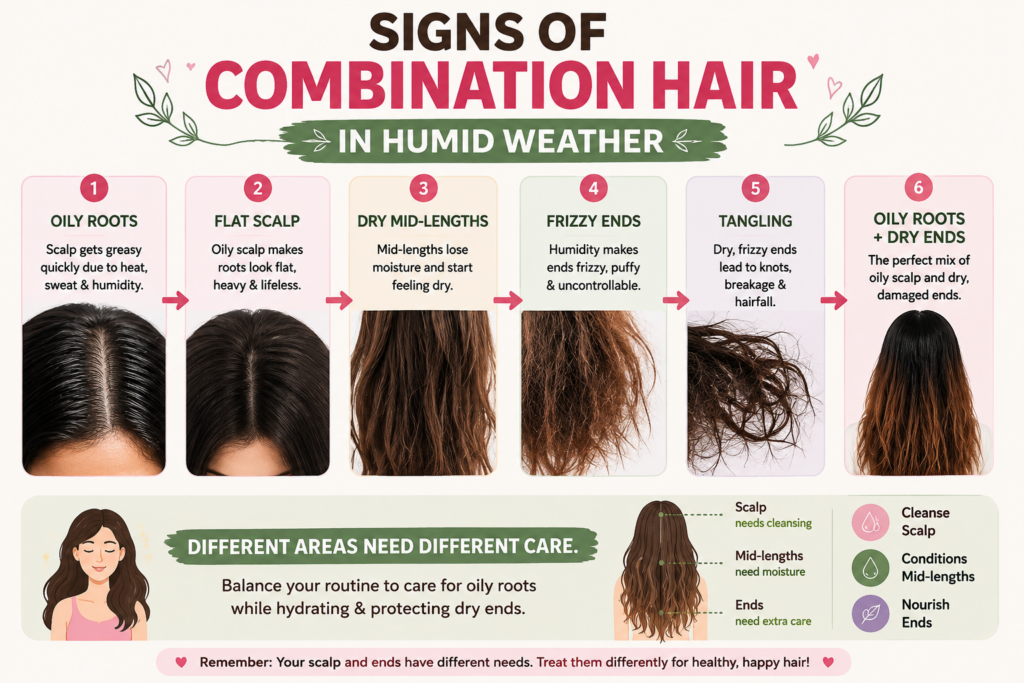
Combination hair is usually easiest to recognize when your roots behave very differently from your lengths and ends. Instead of trying to classify your entire head as simply oily or dry, pay attention to how different areas feel and look throughout the day.
- Oily roots but dry ends: Your scalp becomes greasy while the ends still feel rough, dry, or thirsty.
- Flat roots with frizzy lengths: Humidity and excess oil can weigh down the roots while the lengths become puffy or frizzy.
- Frequent need to wash the scalp: Your roots may look dirty or greasy long before your ends actually need another wash.
- Tangled or rough ends: The ends may knot easily or feel less smooth when you run your fingers through them.
- Greasy hairline with dry mid-lengths: The area around your forehead and scalp can become oily while the rest of the hair remains relatively dry.
- Shine at the roots but dullness at the ends: Excess scalp oil can make the roots look shiny while dry ends appear dull.
- Conditioner makes roots greasy: Applying conditioner too close to the scalp may quickly flatten the roots, while skipping conditioner leaves the ends dry.
- Frizz despite oily roots: Having an oily scalp doesn’t prevent the lengths from reacting to humidity and becoming frizzy or flyaway.
- Different product needs across your hair: Your scalp may need lightweight care while your ends benefit from more conditioning and protection.
A Simple Self-Check
After washing and drying your hair, observe it again later in the day:
Roots: Do they become oily, sticky, or flat?
Mid-lengths: Do they remain comfortable or start feeling dry?
Ends: Do they feel rough, tangled, frizzy, or brittle?
If your answers are oily at the roots + dry or frizzy toward the ends, your routine should focus on balancing these two needs rather than using one heavy product throughout your hair.
✨ Glow in Budget Expert Tip
Use your fingertips to check the roots and your hands to check the ends. Your hair can tell you what it needs—don’t automatically apply the same product from scalp to ends.
Morning Hair Care Routine for Combination Hair in Humid Weather
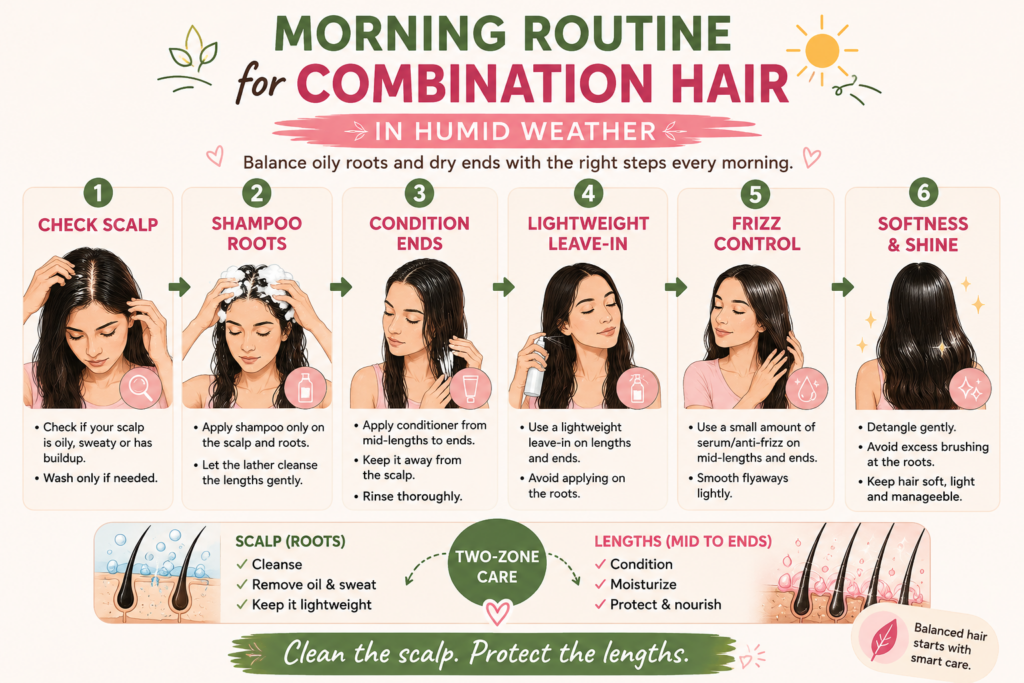
The morning routine should focus on keeping the scalp fresh without stripping the dry lengths. The goal is not to make every part of your hair equally dry or equally moisturized—it is to give each area what it actually needs.
Step 1: Check Your Scalp Before Washing
Before reaching for shampoo, check how your roots feel.
- If your scalp is noticeably oily, sweaty, sticky, or has buildup, wash it.
- If your roots still feel clean and comfortable, you may not need another wash that morning.
Avoid washing simply because your ends look frizzy. Frizz in the lengths doesn’t automatically mean your scalp needs cleansing.
Step 2: Wash the Scalp, Not the Entire Length
When washing, concentrate shampoo on the scalp and roots. Let the lather that runs through the lengths clean them gently rather than repeatedly scrubbing the ends. The American Academy of Dermatology Association also recommends focusing shampoo on the scalp rather than unnecessarily washing the full length of the hair.
This helps remove excess oil and sweat without unnecessarily drying already-dry sections.
Step 3: Condition the Mid-Lengths and Ends
Apply conditioner mainly from the mid-lengths toward the ends.
- Keep conditioner away from the scalp if it makes your roots greasy.
- Give extra attention to the driest areas.
- Leave it on according to the product directions.
- Rinse thoroughly.
You don’t need a heavy conditioner just because your ends are dry. Start with a lightweight formula and increase moisture only when your hair actually needs it.
Step 4: Add Lightweight Leave-In Care
After gently squeezing excess water from your hair, use a small amount of lightweight leave-in conditioner or detangling product on the lengths and ends.
Avoid applying it directly to the roots unless the product is specifically designed for scalp use.
Step 5: Control Frizz and Flyaways
Once your hair is mostly dry, use a small amount of lightweight serum or anti-frizz product on the mid-lengths and ends.
For flyaways, spread a tiny amount between your palms before lightly smoothing the surface of your hair. Using too much product can quickly make combination hair look greasy at the roots.
If humidity is causing persistent frizz, our Hair Care Routine for Frizzy Hair in Humid Weather covers additional ways to keep hair smoother.
Step 6: Maintain Softness and Shine
For naturally soft-looking hair:
- Detangle gently from the ends upward.
- Avoid repeatedly brushing oily roots throughout the day.
- Minimize unnecessary heat styling.
- Use the lowest effective amount of styling product.
- Keep the ends protected when they’re exposed to friction or heat.
The aim is clean, comfortable roots and soft, manageable lengths—not perfectly oil-free hair.
Follow this combination hair care routine in humid weather by keeping cleansing focused on your scalp and conditioning focused on your lengths.
✨ Glow in Budget Expert Tip
Use the “two-zone” rule: keep cleansing products focused on the scalp and conditioning products focused on the lengths. This simple habit can save you from both over-washing your roots and under-moisturizing your ends.
Night Hair Care Routine for Combination Hair in Humid Weather
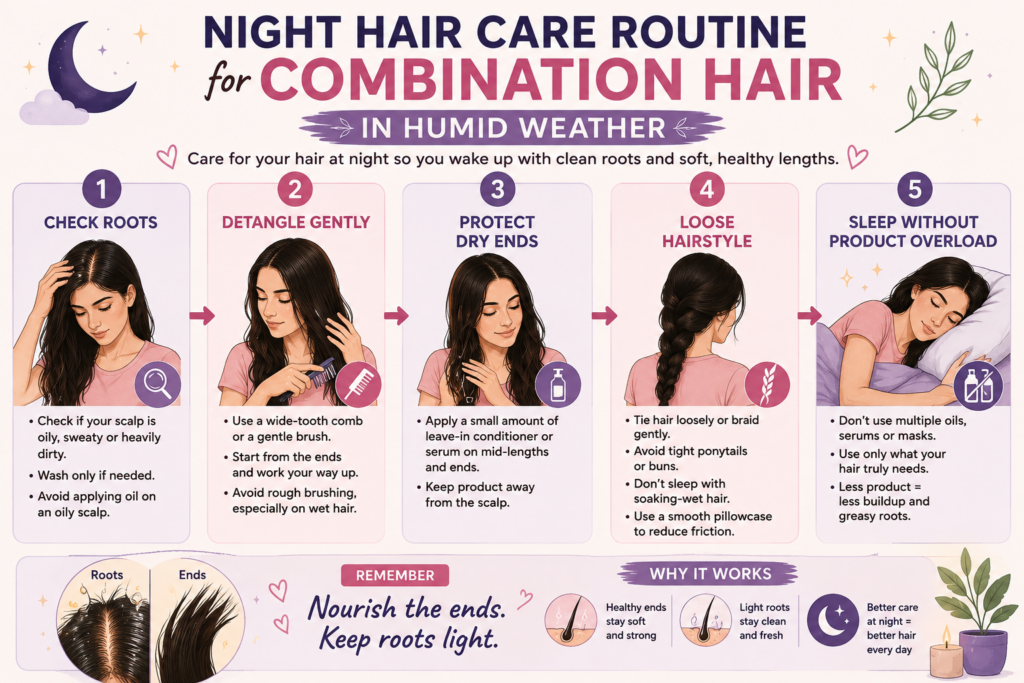
Nighttime is the best opportunity to protect dry lengths without adding unnecessary weight to oily roots. After a humid, sweaty day, focus on keeping the scalp comfortable and preventing the ends from becoming rough, tangled, or frizzy overnight.
Step 1: Check Your Roots
Before applying any product, check your scalp and roots.
- If they feel sweaty or heavily oily, cleanse according to your normal washing schedule.
- If they still feel clean, avoid washing simply because the ends feel dry.
- Don’t apply hair oil to an already-greasy scalp just because it’s nighttime.
Step 2: Detangle Gently
Use a wide-tooth comb or gentle brush and start from the ends, gradually working upward.
Avoid aggressive brushing, especially when the hair is wet, because wet hair can be more vulnerable to breakage.
Step 3: Give Dry Ends Targeted Care
If your ends feel dry, apply a small amount of lightweight leave-in conditioner or serum to the mid-lengths and ends.
Keep the product away from the scalp so you don’t wake up with unnecessarily greasy roots.
Step 4: Protect Your Hair While Sleeping
- Keep your hair loosely tied if you need to secure it.
- Avoid tight ponytails or buns.
- Don’t sleep with soaking-wet hair.
- Consider a smooth pillowcase if your hair tangles or frizzes easily.
- Keep long hair loosely braided if that helps reduce overnight tangling.
Step 5: Don’t Overload Your Hair
Nighttime doesn’t mean you need multiple oils, serums, masks, and leave-in products.
If your hair already feels soft and manageable, leave it alone. Adding more product can create buildup and make your roots look greasy the next morning.
✨ Glow in Budget Expert Tip
Use the smallest amount of leave-in product that gives your ends enough softness. If your roots look greasy the next morning, reduce the amount or move the product farther away from the scalp.
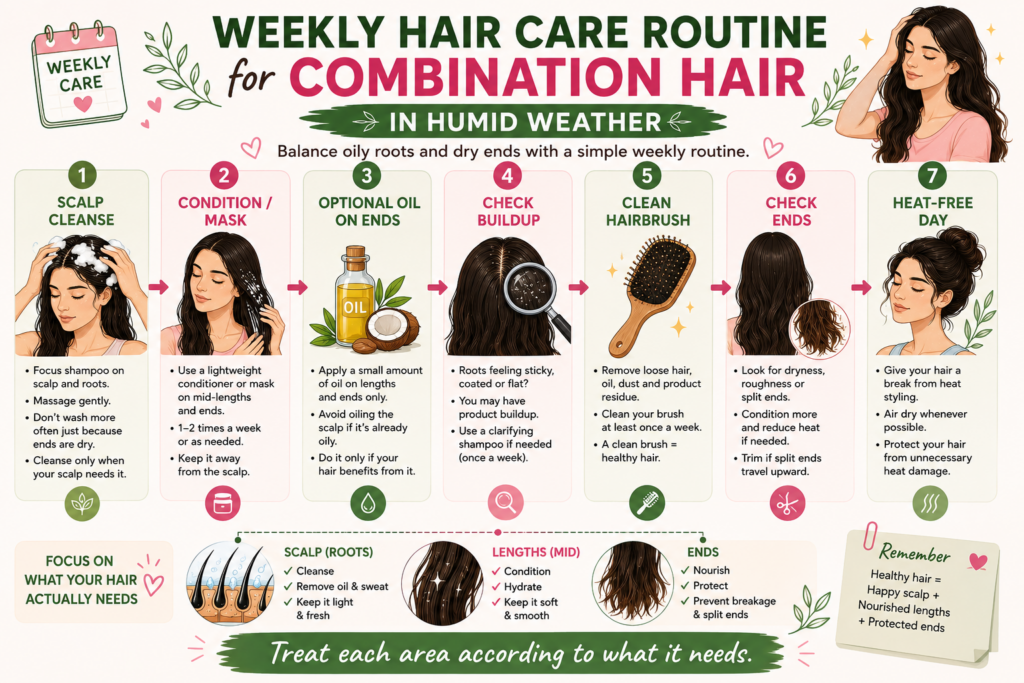
Weekly Hair Care Routine for Combination Hair in Humid Weather
A weekly routine helps keep the oily scalp under control while preventing the dry lengths and ends from becoming rough or over-processed. The key is to avoid treating combination hair with too many products at once.
Step 1: Cleanse According to Your Scalp
Choose your washing frequency based on how quickly your scalp becomes oily or sweaty.
- Focus shampoo on the scalp and roots.
- Avoid aggressive scrubbing.
- Don’t increase washing frequency simply because your ends feel dry.
- If your scalp is comfortable, there’s no need to wash just because it’s your scheduled day.
Step 2: Give the Lengths a Moisture Boost
Once or twice a week, depending on how dry your hair feels, use a lightweight conditioning treatment or hair mask on the mid-lengths and ends.
Avoid applying a rich mask directly to the scalp unless the product is specifically intended for scalp use.
Step 3: Use Oil Only Where It Helps
If occasional pre-wash oiling works well for your hair, concentrate a small amount on the lengths and ends rather than coating an already-oily scalp.
You don’t need to oil your hair simply because it’s part of a traditional routine. If oil makes your roots greasy or difficult to cleanse, skip it.
Step 4: Check for Product Buildup
If your roots feel coated, sticky, unusually flat, or difficult to clean, review how many styling and leave-in products you’re using.
A buildup-prone routine doesn’t need more products—it usually needs simpler product use and proper cleansing.
Step 5: Don’t Forget Your Hairbrush
Clean your brush regularly to remove:
- Loose hair
- Oil
- Dust
- Styling-product residue
A dirty brush can transfer buildup back onto freshly washed hair.
Step 6: Check Your Ends
Once a week, look closely at the ends.
If they feel rough, split, or unusually tangled, increase gentle conditioning and reduce unnecessary heat styling. If split ends continue traveling upward, a trim may eventually be necessary.
Step 7: Include a Heat-Free Day
Whenever possible, give your hair a break from straighteners, curling irons, and frequent high-heat blow-drying.
Let your hair dry naturally when practical, and use protective products whenever heat styling is necessary.
✨ Glow in Budget Expert Tip
Don’t automatically add a new treatment every week. First identify what your hair is actually lacking. Combination hair usually benefits more from targeted care than from layering multiple products.
10 Bonus Tips for Combination Hair in Humid Weather
Managing combination hair becomes easier when you stop trying to control the entire head with one approach. Small changes can help keep oily roots fresh while protecting dry lengths and ends.
- Use Lightweight Products: Choose lightweight conditioners, leave-ins, and serums so your roots don’t become weighed down.
- Condition Only Where Needed: Focus conditioner on the mid-lengths and ends instead of applying it heavily near the scalp.
- Detangle From the Ends: Start at the bottom and gently work upward to reduce unnecessary pulling and breakage.
- Avoid Excessive Oiling: If your scalp is already oily, concentrate occasional oiling on the dry lengths and ends—or skip it if your hair doesn’t benefit from it.
- Rinse Products Thoroughly: Leftover conditioner or mask can contribute to heaviness and buildup.
- Protect Hair From Excess Heat: Limit unnecessary straightening and curling, especially when your ends are already dry.
- Keep Your Hairbrush Clean: Remove loose hair and product residue regularly to avoid transferring buildup back onto clean hair.
- Avoid Tight Hairstyles: Tight ponytails and buns can increase tension and contribute to breakage around fragile areas.
- Use Less Product on Humid Days: Humidity doesn’t mean you need more products. Start with a small amount and add only if necessary.
- Adjust Your Routine: Your hair may need more moisture during some weeks and less during others. Let its condition guide your routine.
✨ Glow in Budget Expert Tip
Don’t build a complicated routine just because your hair has two different needs. Start with shampoo for the scalp, conditioner for the lengths, and one lightweight leave-in if needed. Add more only when your hair shows you it needs it.
Common Mistakes to Avoid With Combination Hair in Humid Weather
Combination hair can become harder to manage when we try to solve the oily scalp by treating the entire head as oily. This can leave the lengths and ends drier while the roots still become greasy.
- Shampooing the Entire Length Aggressively: Focus shampoo on the scalp and let the rinse gently cleanse the lengths.
- Applying Conditioner to the Scalp: Heavy conditioner near oily roots can make hair look flat and greasy faster.
- Using Too Much Hair Oil: More oil doesn’t automatically mean more moisture. Excessive oil can create buildup and make oily roots harder to manage.
- Skipping Conditioner Because Your Roots Are Oily: Your ends can still need moisture even when your scalp produces excess oil.
- Using Heavy Leave-In Products Everywhere: Keep leave-in products mainly on the mid-lengths and ends.
- Washing Too Frequently to Control Dryness: Washing more often won’t fix dry ends and may make them feel rougher.
- Ignoring Dry Ends: Oily roots don’t mean the rest of your hair is properly moisturized.
- Layering Too Many Products: Shampoo, mask, oil, serum, cream, and styling products can quickly create unnecessary buildup.
- Using High Heat Too Often: Heat styling can make already-dry lengths more fragile and prone to frizz.
- Treating Humidity With More Product: When humidity causes frizz, adding several heavy products can make roots greasy without actually solving the problem.
✨ Glow in Budget Expert Tip
Think in zones, not one-size-fits-all care: cleanse the scalp, condition the lengths, and give extra attention to the ends. This is one of the simplest ways to keep combination hair balanced in humid weather.
Frequently Asked Questions (FAQs)
How often should I wash combination hair in humid weather?
Wash based on how quickly your scalp becomes oily, sweaty, or uncomfortable rather than following a fixed schedule. Focus shampoo on the scalp and roots while being gentle with the lengths.
Should I apply conditioner to oily roots?
Usually, it’s better to apply conditioner mainly to the mid-lengths and ends if your roots become greasy easily. This gives the dry areas moisture without unnecessarily weighing down the scalp.
Can I oil combination hair?
Yes, if your hair benefits from oiling. Use a small amount mainly on the lengths and ends, particularly when they feel dry. If oil makes your scalp excessively greasy or causes buildup, reduce the amount or skip it.
Why are my roots oily but my ends dry?
Your scalp naturally produces oil, but that oil may not travel evenly down the length of the hair. Longer or more weather-exposed ends can therefore remain dry even when the roots become greasy.
Can humidity make combination hair frizzy?
Yes. Humid conditions can make the hair lengths absorb moisture from the surrounding air, which may contribute to frizz, puffiness, and flyaways—especially when the ends are already dry or damaged.
Should I use leave-in conditioner on combination hair?
You can, particularly if your lengths are dry or prone to tangling. Apply a small amount to the mid-lengths and ends and avoid the scalp if your roots become oily quickly.
Is dry shampoo suitable for oily roots?
Dry shampoo can temporarily absorb oil and make roots appear fresher, but it shouldn’t replace regular scalp cleansing. Use it according to the product directions and avoid repeatedly layering it without properly washing your scalp.
How can I keep combination hair soft without making it greasy?
Use targeted moisture. Condition the lengths and ends, use lightweight leave-in products, and keep heavier oils and creams away from oily roots.
Should I use a hair mask every week?
Not necessarily. If your ends are dry, a lightweight mask once a week may help. If your hair already feels soft and manageable, you don’t need to add a mask simply because it’s part of a routine.
Can I use serum on oily roots?
It’s generally better to apply serum to the mid-lengths and ends if your scalp gets oily easily. A small amount is usually enough to smooth frizz and add shine.
✨ Glow in Budget Expert Tip
Let your hair’s condition decide how much care it needs. Combination hair doesn’t require the same amount of product everywhere—or every day. Start light and increase moisture only when your lengths actually need it.
If your hair is generally balanced rather than oily at the roots and dry at the ends, you can also explore our Hair Care Routine for Normal Hair in Humid Weather.
Final Thoughts
Combination hair can be challenging in humid weather because oily roots and dry ends need different types of care. Trying to treat both areas the same way can often make one problem better while making the other worse.
The key is to keep your routine balanced:
- Cleanse the scalp and roots based on how oily they become.
- Condition the mid-lengths and ends to maintain softness.
- Use lightweight leave-in products only where needed.
- Control frizz and flyaways without layering heavy products.
- Give extra attention to dry or damaged ends.
- Adjust your routine according to how your hair behaves rather than following a rigid schedule.
You don’t need a shelf full of products to manage combination hair. A simple, targeted routine can help keep your roots fresh, lengths soft, and ends protected throughout humid weather.
Consistency matters more than perfection. Pay attention to what your scalp and lengths are telling you, make small adjustments when needed, and avoid adding products just because they’re marketed for your hair type.
With a consistent combination hair care routine in humid weather, you can keep your roots fresh while protecting dry ends.
✨ Glow in Budget Expert Tip
Remember the two-zone approach: keep your scalp clean and lightweight, while giving your lengths and ends the moisture and protection they actually need. This simple strategy can make combination hair much easier to manage.
Follow Glow In Budget
Found this guide helpful?
Follow @glowinbudget for more affordable beauty, skincare, hair care, and self-care tips. We regularly share practical routines, expert-backed advice, and budget-friendly solutions to help you look and feel your best—without overspending.