Introduction
Does your skincare routine feel more complicated than it needs to be? With so many cleansers, serums, masks, exfoliators, and trending skincare products available, it can be tempting to keep adding more in the hope of getting healthier-looking, glowing skin. But a good skincare routine doesn’t have to involve a bathroom shelf full of products—or a large budget.
A 7-day skincare routine can be a simple way to step back, simplify your habits, and give your skin consistent everyday care. Instead of promising dramatic results in just one week, this guide focuses on practical habits that support your skin: gentle cleansing, hydration, moisturizing, sun protection, and knowing when your skin needs less rather than more. Dermatologists from the American Academy of Dermatology also emphasize that an effective skincare routine can be simple and budget-friendly, with cleansing, moisturizing, and sun protection forming the basic foundation.
The goal of these seven days isn’t to completely transform your skin overnight. Skin takes time to respond to consistent care, and everyone’s skin has different needs. Instead, think of this as a one-week skincare reset of your habits—a chance to remove unnecessary steps, become more consistent, and identify what actually works for your skin.
Throughout this guide, we’ll take you through a practical 7-day skincare routine for a healthy glow on a budget, with a simple task for each day. You’ll also find morning and night routines, affordable skincare tips, common mistakes to avoid, and ways to continue the good habits after the seven days are over.
Most importantly, you don’t need to buy a completely new collection of skincare products to begin. Start with the basics you already have, introduce changes gradually, and pay attention to how your skin responds. A consistent, manageable routine is usually more valuable than constantly switching between new products and viral skincare trends.
✨ Glow In Budget Expert Tip: Don’t judge your skin—or your entire routine—by what happens after one or two days. Use these seven days to build better habits and understand your skin, rather than chasing instant results. Healthy-looking skin is a long-term process, and consistency matters more than perfection.
What Is a 7-Day Skincare Routine?
A 7-day skincare routine is not about changing your entire complexion in one week or using a different product every day. Instead, it is a short, structured plan that helps you focus on the basic habits your skin needs while removing unnecessary steps that may be making your routine complicated.
The idea is simple: for seven days, you follow a consistent routine built around gentle cleansing, hydration, moisturizing, and sun protection, while making small adjustments to your skincare habits. Dermatologists from the American Academy of Dermatology emphasize that effective skincare does not have to be expensive or complicated, and a basic routine can focus on cleansing, moisturizing, and protecting the skin.
A seven-day plan can also help you understand your skin better. When you constantly introduce new products, masks, scrubs, or treatments, it can become difficult to know what your skin actually likes. Keeping your routine simple for a week gives you an opportunity to pay attention to changes such as dryness, excess oil, tightness, irritation, or overall comfort.
What the 7-Day Routine Focuses On
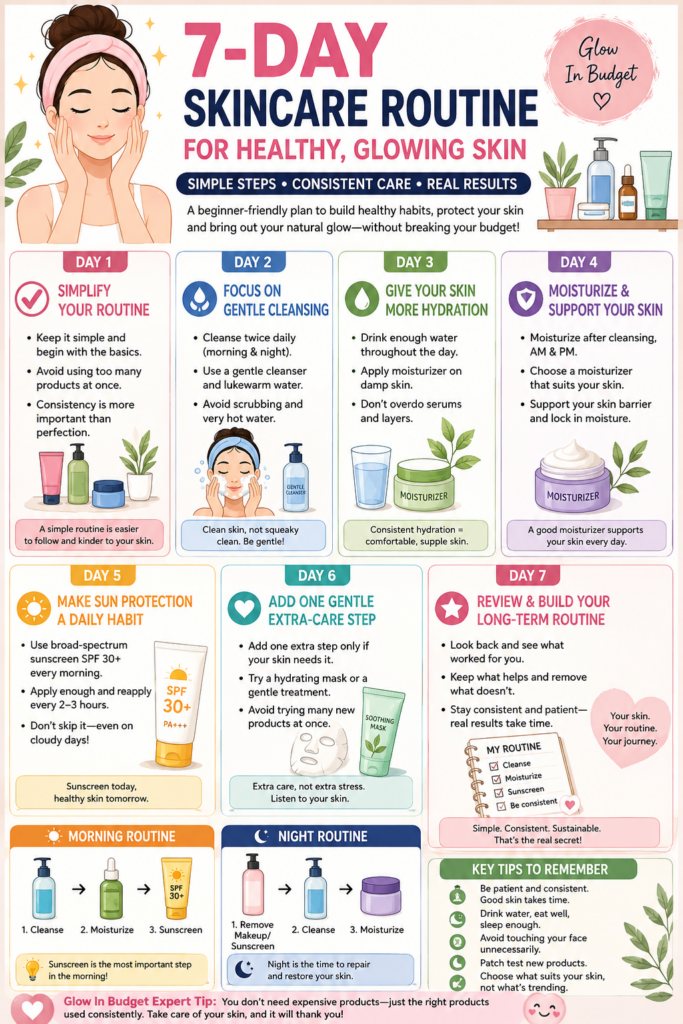
Throughout this guide, each day has one simple focus rather than a long list of tasks:
A simple skincare routine built around gentle cleansing, moisturizing, and sun protection is also consistent with basic guidance from the American Academy of Dermatology.
- Day 1: Simplify your skincare routine
- Day 2: Focus on gentle cleansing
- Day 3: Prioritize hydration
- Day 4: Moisturize and support your skin
- Day 5: Make sun protection a daily habit
- Day 6: Add one gentle extra-care step
- Day 7: Review what worked and build a sustainable routine
This approach is intentionally simple. You don’t need to buy seven new products or completely replace the skincare products you already own. In fact, using fewer well-chosen products can make your routine easier to maintain and may reduce the chance of irritation.
The seven days are also a starting point rather than a finish line. Your skin may look or feel a little fresher when you become more consistent, but meaningful changes in many skin concerns can take considerably longer. The real benefit of this routine is helping you establish habits that you can continue beyond the first week.
If you have generally balanced skin but notice changes during hot or humid weather, you can also follow our guide to normal skin care in humid weather for more targeted tips.
✨ Glow In Budget Expert Tip: Think of these seven days as a habit-building week, not a miracle skin challenge. The best routine is the one that is simple enough to follow consistently and gentle enough for your skin to tolerate.
What Can You Realistically Expect in 7 Days?
A seven-day skincare routine can help you become more consistent, but it is important to set realistic expectations. Seven days is enough to improve your skincare habits, not to completely transform your skin. Your skin has its own natural cycle, and concerns such as acne, pigmentation, fine lines, or uneven texture generally require more time and a routine tailored to your needs.
During the first week, the most noticeable changes may be related to how your skin feels and how consistently you care for it. If you have been skipping moisturizer, cleansing inconsistently, forgetting sunscreen, or constantly changing products, simplifying your routine may help your skin feel more comfortable and cared for.
What You May Notice During the Week
Depending on your skin type and your existing routine, you may notice:
- Skin feeling cleaner without feeling overly stripped
- Less dryness or tightness when you moisturize consistently
- A more comfortable, hydrated feeling
- A smoother-looking surface from better basic care
- Skin feeling less overwhelmed by too many products
- Better consistency with morning and night skincare
- Greater awareness of which products your skin tolerates well
- A routine that feels easier to maintain every day
However, not everyone will notice visible changes within seven days, and that’s completely normal. A skincare routine should be judged over time rather than by expecting dramatic results after a few applications. Dermatologists also emphasize that repeatedly switching products can make it harder to see what works and may contribute to irritation.
What You Shouldn’t Expect
A seven-day routine should not promise to:
- Completely clear acne
- Permanently remove dark spots
- Erase fine lines
- Dramatically change your skin tone
- Repair every skin concern
- Produce a permanent “glass skin” effect
- Replace professional treatment for persistent skin problems
Instead, use these seven days to build a better foundation. Once the week is over, the goal is to continue the habits that worked for you rather than immediately searching for another intensive skincare challenge.
Think of the Week as a Starting Point
The biggest benefit of this routine may not be something you can see in the mirror after seven days. It may simply be that you now know what your basic routine looks like and which habits you can realistically maintain.
For example, if you discover that your skin feels better when you cleanse gently, moisturize regularly, and apply sunscreen every morning, those habits can become part of your everyday routine. The American Academy of Dermatology recommends a simple foundation of cleansing, moisturizing, and sun protection rather than relying on a complicated collection of products.
So don’t worry if your skin doesn’t look dramatically different on Day 7. The real goal is to finish the week with a routine you can actually continue.
✨ Glow In Budget Expert Tip: Take a quick photo of your skin on Day 1 and another on Day 7 using similar lighting if you want to compare. Don’t obsess over tiny differences—use the week mainly to notice how your skin feels and how consistently you’re following your routine.
Before You Start: Simple Rules for Your 7-Day Skincare Routine
Before beginning your 7-day skincare routine, it’s important to resist the temptation to change everything at once. A one-week skincare plan works best when it gives your skin a consistent foundation rather than overwhelming it with new products, aggressive treatments, or complicated steps.
The goal is to make your routine simple, affordable, gentle, and realistic enough to continue after Day 7. Dermatologists from the American Academy of Dermatology recommend keeping a basic routine centered around cleansing, moisturizing, and protecting the skin, while also limiting unnecessary products that can become expensive or irritating.
1. Start With the Products You Already Have
You don’t need to purchase an entirely new skincare collection for this challenge. Look through the products you already use and identify your basic cleanser, moisturizer, and sunscreen.
If a product has been working comfortably for you, there’s no reason to replace it simply because you’re starting a new routine.
2. Don’t Introduce Several New Products at Once
A seven-day routine isn’t the right time to experiment with five new serums, exfoliators, masks, and treatments.
Introducing several products simultaneously makes it difficult to understand which product is helping or irritating your skin. It can also make your routine unnecessarily expensive.
Instead, make one change at a time whenever possible and give your skin an opportunity to adjust.
3. Keep Cleansing Gentle
Clean skin doesn’t mean skin that feels tight or squeaky-clean.
Use a gentle cleanser and avoid aggressively scrubbing your face. The AAD recommends gentle cleansing and advises limiting face washing to twice daily and after sweating, rather than repeatedly washing throughout the day.
4. Don’t Skip Moisturizer
Even if your skin feels comfortable or slightly oily, moisturizer can still be an important part of your routine.
Choose a moisturizer that suits your skin type and feels comfortable enough for everyday use. Applying moisturizer to slightly damp skin can also help retain water in the skin.
5. Make Sunscreen a Daily Habit
Your seven-day routine should include sun protection every morning.
Choose a broad-spectrum sunscreen with SPF 30 or higher, and use it consistently when you’re going outdoors. Sun protection isn’t something to add only when you’re spending a long day at the beach—it is part of everyday skincare.
The American Academy of Dermatology recommends choosing a sunscreen that provides broad-spectrum protection and SPF 30 or higher, with reapplication when needed.
6. Avoid Aggressive Exfoliation
Don’t assume that scrubbing away dead skin will automatically make your complexion glow.
Physical scrubbing can irritate the skin, especially when done too frequently or aggressively. During this seven-day routine, we’ll focus on consistency and gentle care rather than trying to force quick results.
7. Pay Attention to Your Skin
Your skin may not need the same products every day or in every season. Notice whether it feels comfortable, dry, oily, tight, itchy, or irritated.
If something causes persistent burning, redness, itching, or discomfort, stop using it rather than trying to continue simply because it’s part of the challenge.
8. Don’t Copy Someone Else’s Routine Exactly
A routine that works beautifully for someone online may not work the same way for you.
Skin type, sensitivity, climate, existing skin concerns, and the products you already use can all influence how your skin responds. Your goal during these seven days is to understand your own skin, not to recreate somebody else’s 10-step routine.
9. Keep Your Budget in Mind
A healthy-looking complexion doesn’t require buying every product that appears in a skincare trend.
Prioritize the basics first. If your cleanser, moisturizer, and sunscreen are working well for you, there’s no need to replace them just because a new product has become popular.
10. Remember That Seven Days Is Only the Beginning
The most important rule is to think beyond Day 7.
The purpose of this challenge isn’t to finish the week and immediately start another complicated routine. It’s to discover which simple habits you can realistically maintain.
By the end of the seven days, you should ideally have a clearer understanding of what your skin needs and which parts of your routine are worth continuing.
✨ Glow In Budget Expert Tip: Before buying anything new, check what you already own. If you already have a gentle cleanser, moisturizer, and sunscreen that your skin tolerates well, consistency with those basics is more valuable than constantly adding new products.
Day 1 — Simplify Your Skincare Routine
The first day of your 7-day skincare routine is all about doing less—but doing the basics consistently. Before adding new products or special treatments, take a moment to look at your current routine and remove anything that feels unnecessary, irritating, or difficult to maintain.
A complicated routine isn’t automatically a better routine. If you’re using several products every morning and night without knowing why you’re using them, Day 1 is the perfect opportunity to simplify.
Step 1: Take a Look at Your Current Products
Start by checking everything you currently use on your face.
Separate your products into three simple groups:
- Daily essentials: cleanser, moisturizer, and sunscreen
- Optional products: hydrating serums or other products your skin already tolerates well
- Occasional products: masks, exfoliators, or other treatments
You don’t have to throw anything away. The goal is simply to understand what you’re actually using and whether every step has a purpose.
Step 2: Keep Your Morning Routine Basic
For Day 1, your morning routine can be as simple as:
Gentle cleanse → Moisturizer → Sunscreen
If your skin doesn’t need a morning cleanse, you may prefer simply rinsing with water before moisturizing and applying sunscreen.
The important thing is to avoid adding several new products just because you’re starting a seven-day routine.
Step 3: Keep Your Night Routine Simple
At night, focus on removing the day’s buildup and keeping your skin comfortable:
Remove makeup/sunscreen → Gentle cleanse → Moisturizer
If you already use a skincare product that your skin tolerates well, you don’t necessarily need to remove it from your routine. The idea is to avoid introducing unnecessary new steps.
Step 4: Put Aggressive Treatments on Pause
For the first day, avoid turning your routine into an intensive treatment session.
Skip unnecessary:
- Harsh scrubs
- Multiple exfoliating products
- Several new active ingredients
- Strong DIY treatments
- Multiple face masks
- Products that previously caused irritation
This gives you a clean starting point for the rest of the week.
Step 5: Notice How Your Skin Feels
After simplifying your routine, pay attention to your skin rather than immediately searching for visible results.
Ask yourself:
- Does my skin feel comfortable after cleansing?
- Does it feel tight or dry?
- Does it become excessively oily?
- Does my moisturizer feel comfortable?
- Does anything sting or irritate my skin?
- Am I using products simply because they’re popular?
These observations will help you make better choices throughout the rest of the seven-day plan.
Why Start With Less?
When you simplify your routine, it becomes easier to identify what your skin actually responds to. It also makes your routine more affordable and much easier to maintain.
If your skin feels comfortable with a basic routine, there is no need to add five additional products simply to make the routine look more impressive.
The American Academy of Dermatology recommends keeping skincare simple and focusing on appropriate cleansing, moisturizing, and sun protection rather than spending excessively on unnecessary products.
✨ Glow In Budget Expert Tip: Don’t measure the success of Day 1 by how many skincare products you use. Measure it by how simple, comfortable, and sustainable your routine feels.
Day 2 — Focus on Gentle Cleansing
Day 2 is about one of the most basic—and often misunderstood—parts of skincare: cleansing. Clean skin is important, but cleansing more often or scrubbing harder doesn’t necessarily make your skin healthier.
The goal today is to find a cleansing routine that removes sweat, excess oil, sunscreen, makeup, and everyday buildup without leaving your skin feeling tight, dry, or irritated.
Step 1: Choose a Gentle Cleanser
Use a cleanser that feels comfortable on your skin rather than one that leaves your face feeling extremely tight or “squeaky clean.”
If your current cleanser works well for you and doesn’t cause dryness or irritation, there is no need to replace it simply because you’re following this seven-day routine.
Step 2: Cleanse at the Right Times
For many people, cleansing twice a day—morning and evening—is sufficient, with an additional cleanse after heavy sweating when needed. The AAD recommends washing the face twice a day and after sweating, using a gentle cleanser.
Your routine can look like:
Morning:
Gentle cleanse → Moisturizer → Sunscreen
Night:
Remove makeup/sunscreen → Gentle cleanse → Moisturizer
If your skin becomes sweaty during the day, you don’t necessarily need to keep washing your face repeatedly. Excessive cleansing can leave some skin types feeling dry or irritated.
Step 3: Use Gentle Movements
When cleansing, wet your face with lukewarm water and use your fingertips to gently massage the cleanser across the skin.
Avoid:
- Scrubbing with rough towels
- Using abrasive cleansing tools unnecessarily
- Scratching or rubbing the skin
- Very hot water
- Cleansing for an excessively long time
The AAD recommends using your fingertips and avoiding scrubbing because aggressive cleansing can irritate the skin.
Step 4: Don’t Confuse Tightness With Cleanliness
One common mistake is assuming that skin needs to feel tight after cleansing.
That tight feeling may simply mean your cleanser is removing too much of the skin’s natural oils or that you’re cleansing too aggressively.
After washing, your skin should ideally feel clean and comfortable, rather than dry, burning, or excessively tight.
Step 5: Pay Attention to Your Skin After Cleansing
Give your skin a few minutes after cleansing and notice how it feels.
If it feels:
- Comfortable → your cleansing routine may be working well.
- Tight or flaky → your cleanser or cleansing frequency may be too harsh.
- Burning or irritated → stop using the irritating product and simplify your routine.
- Excessively oily soon after cleansing → avoid responding by repeatedly washing your face; review the overall routine instead.
What About Double Cleansing?
Double cleansing can be useful for some people, particularly when removing makeup or water-resistant sunscreen, but it isn’t something everyone needs every night.
If your regular cleanser effectively removes what you’re wearing and your skin feels comfortable afterward, you don’t have to add another cleansing step simply because it is trending online.
Day 2 Goal
By the end of today, your goal is simple:
Clean your skin effectively without over-cleansing it.
You aren’t trying to make your skin feel stripped or completely oil-free. You’re creating a gentle cleansing habit that you can continue beyond this seven-day routine.
✨ Glow In Budget Expert Tip: If your face feels tight immediately after cleansing, don’t automatically reach for another product to fix the feeling. First ask whether your cleanser, water temperature, or cleansing technique may be too harsh.
Day 3 — Give Your Skin More Hydration
By Day 3, we’ve simplified the routine and focused on gentle cleansing. Today, we’re turning our attention to hydration.
Well-hydrated skin often feels more comfortable and supple, but hydration doesn’t mean covering your face with multiple serums or drinking excessive amounts of water in the hope of instantly changing your skin. The goal is to build simple habits that help your skin maintain its moisture.
Step 1: Start With Your Water Intake
Staying adequately hydrated is important for overall health. Drink water regularly according to your body’s needs rather than forcing yourself to consume unusually large amounts.
However, don’t expect drinking extra water alone to suddenly transform your skin. Your skin’s hydration also depends on your skincare routine and the environment around you.
Step 2: Apply Moisturizer After Cleansing
One of the easiest ways to support comfortable skin is to apply moisturizer after cleansing.
After gently washing your face, pat it dry rather than rubbing it vigorously, then apply your moisturizer while the skin is still slightly damp. Moisturizers help trap water in the skin and can reduce dryness and moisture loss.
You don’t need an expensive moisturizer. The best option is one that:
- Feels comfortable on your skin
- Doesn’t cause irritation
- Fits your skin type
- Is affordable enough to use consistently
- Works well with the rest of your routine
Step 3: Don’t Layer Products Just for Extra Hydration
If your skin already feels comfortable with a cleanser and moisturizer, you don’t necessarily need a hydrating toner, essence, serum, sleeping mask, and face oil on top of it.
More products don’t automatically mean more hydration.
Instead, introduce additional products only when you have a clear reason for using them and your skin tolerates them well.
Step 4: Pay Attention to Your Environment
Air conditioning, heat, wind, and dry surroundings can all influence how comfortable your skin feels.
If your skin frequently feels tight or dry, look at both your skincare products and your environment instead of assuming that you simply need another serum.
Step 5: Don’t Forget Your Lips
Your skincare routine doesn’t have to stop at your face.
If your lips feel dry, keep a simple lip balm nearby and reapply when needed. Avoid repeatedly licking your lips, as this can contribute to dryness and irritation.
Step 6: Notice Your Skin’s Hydration Signals
Throughout Day 3, pay attention to how your skin feels.
You may notice:
- Less tightness after cleansing
- Softer-feeling skin
- More comfortable application of moisturizer
- Reduced feeling of dryness
- Skin feeling more supple
But remember that visible changes won’t necessarily happen immediately. The purpose of today is to establish a consistent hydration habit, not to chase an instant glow.
A Simple Hydration Routine
Keep it easy:
Morning:
Cleanse → Moisturize → Sunscreen
During the day:
Drink water regularly → Reapply sunscreen as needed when outdoors
Night:
Cleanse → Moisturize
That’s enough for many people as a basic starting point.
✨ Glow In Budget Expert Tip: Before buying another “hydrating” product, make sure you’re consistently using the moisturizer you already own. A simple routine used every day can be more valuable than an expensive routine used inconsistently.
Day 4 — Moisturize and Support Your Skin
By Day 4, you’ve already simplified your routine, focused on gentle cleansing, and paid more attention to hydration. Today, we’re putting those habits together with one important goal: keeping your skin moisturized and comfortable.
Moisturizing isn’t only for people with visibly dry skin. A well-chosen moisturizer can help support the skin barrier and reduce moisture loss, making it an important part of a simple everyday skincare routine. The key is choosing a formula that suits your skin rather than assuming that a more expensive or heavier product will automatically work better.
Step 1: Choose a Moisturizer That Suits Your Skin
You don’t need a luxury moisturizer to take good care of your skin.
Look for a product that:
- Feels comfortable after application
- Doesn’t leave your skin excessively greasy
- Doesn’t cause stinging or irritation
- Works well with your cleanser and sunscreen
- Is affordable enough to use consistently
If your current moisturizer works well for you, keep using it. There’s no need to replace a product simply because you’re following a seven-day routine.
Step 2: Apply Moisturizer After Cleansing
After cleansing, gently pat your face dry and apply your moisturizer while the skin is still slightly damp.
This simple habit can help retain moisture and prevent your skin from feeling unnecessarily dry after cleansing. The American Academy of Dermatology recommends moisturizing after cleansing, particularly while the skin is still damp.
Step 3: Don’t Avoid Moisturizer Because Your Skin Feels Oily
One common misconception is that oily skin doesn’t need moisturizer.
In reality, skipping moisturizer isn’t necessarily the answer to excess oil. Instead, choose a lightweight, comfortable moisturizer if heavier formulas don’t suit your skin.
Your goal is balanced comfort, not trying to remove every trace of natural oil from your face.
Step 4: Give Your Skin a Break From Unnecessary Products
Day 4 isn’t about adding another five products to your routine.
If your skin feels comfortable with:
Cleanser → Moisturizer → Sunscreen
there’s no reason to complicate things.
Avoid introducing several new serums, strong exfoliants, masks, or treatments at the same time. Keeping the routine simple also makes it easier to notice how your skin responds.
Step 5: Don’t Forget Other Dry Areas
Your skincare routine doesn’t have to stop at the center of your face.
If your lips, around-the-nose area, or other exposed areas feel dry, give them appropriate gentle care rather than repeatedly scrubbing or exfoliating them.
Step 6: Notice Whether Your Skin Feels Comfortable
At the end of Day 4, ask yourself:
- Does my skin feel comfortable after moisturizing?
- Does my moisturizer feel too heavy?
- Does my skin feel tight a few hours after application?
- Am I using too many products?
- Is anything causing burning, itching, or redness?
These observations can help you decide what belongs in your long-term routine.
Day 4 Goal
Today’s goal isn’t to make your skin look dramatically different.
It’s to establish a simple moisturizing habit that helps your skin feel comfortable, supported, and cared for.
✨ Glow In Budget Expert Tip: Don’t choose a moisturizer because it is expensive or heavily promoted. Choose the one your skin tolerates well and that you can comfortably afford to use consistently.
Day 5 — Make Sun Protection a Daily Habit
By Day 5, your routine has become simpler and more consistent. Today, we’re focusing on one step that should remain part of your skincare routine long after this seven-day plan is finished: sun protection.
You don’t need to wait for a beach day or a particularly sunny afternoon to think about UV protection. Everyday exposure can add up, which is why sunscreen is considered an important part of a basic skincare routine.
Step 1: Choose the Right Sunscreen
For everyday use, look for a sunscreen that offers:
- Broad-spectrum protection
- SPF 30 or higher
- A formula that feels comfortable on your skin
- A texture you’re happy to use regularly
The American Academy of Dermatology recommends choosing a broad-spectrum, water-resistant sunscreen with an SPF of 30 or higher.
You don’t necessarily need the most expensive sunscreen available. A product that suits your skin and fits your budget is much more useful if it encourages you to apply it consistently.
Step 2: Apply It as the Final Morning Skincare Step
For Day 5, keep your morning routine straightforward:
Cleanse → Moisturize → Sunscreen
If you use other skincare products that already work well for you, apply them in their usual order before sunscreen.
Think of sunscreen as the final protective step of your morning skincare routine.
Step 3: Don’t Use Too Little
Applying too little sunscreen can reduce the level of protection you actually receive.
For the face, the AAD recommends using enough sunscreen to adequately cover exposed skin and remembering areas that are easy to overlook, such as the ears, neck, and hairline when exposed.
If you’re outdoors for an extended period, sweating, or swimming, follow the product’s directions for reapplication.
Step 4: Remember That Cloudy Days Still Count
A cloudy or cooler day doesn’t automatically mean you can forget sun protection.
UV exposure can still occur when the sky isn’t bright and sunny, so make sunscreen part of your regular morning habit when appropriate.
Step 5: Make Sunscreen Easier to Use
If you regularly skip sunscreen because you dislike the texture, white cast, stickiness, or fragrance, look for a different formula rather than abandoning sun protection altogether.
The best sunscreen is one that provides appropriate protection and that you can realistically use consistently.
Step 6: Protect More Than Just Your Face
When you’re spending time outdoors, remember that other exposed areas need protection too.
Depending on what is uncovered, this can include:
- Neck
- Ears
- Hands
- Chest
- Arms
Clothing, shade, hats, and sunglasses can also complement sunscreen as part of broader sun protection.
Day 5 Goal
Today’s goal is simple:
Turn sun protection from an occasional skincare step into a regular habit.
You don’t have to buy a collection of special sun-care products. Start with one suitable sunscreen and learn to use it consistently.
✨ Glow In Budget Expert Tip: Don’t choose sunscreen based only on the highest price tag or trendiest packaging. Choose a broad-spectrum SPF 30+ sunscreen that feels comfortable enough for you to use consistently. Consistency is what makes it useful.
Day 6 — Add One Gentle Extra-Care Step
By Day 6, you have already worked on the most important foundations: simplifying your routine, cleansing gently, staying hydrated, moisturizing, and protecting your skin from the sun.
Today is not about adding a long list of treatments. Instead, Day 6 gives you the option to add one gentle extra-care step based on what your skin actually needs.
The key word is one.
If your skin already feels comfortable with your basic routine, you don’t have to add anything at all. A simple routine is still a successful routine.
Step 1: Decide Whether Your Skin Actually Needs an Extra Step
Before reaching for a scrub, mask, peel, or active serum, ask yourself:
- Does my skin feel comfortable?
- Am I experiencing dryness or tightness?
- Is my skin already irritated?
- Have I recently introduced another new product?
- Do I actually need an additional treatment?
If your skin feels balanced and comfortable, you can simply continue your regular morning and night routine.
Step 2: Choose One Gentle Option
If you want some extra care, choose one option that already suits your skin.
Depending on your routine, this might be:
- A simple hydrating product you’ve used before
- A gentle face mask your skin already tolerates
- A moisturizer applied consistently to areas that feel dry
- A soothing skincare step without strong active ingredients
There is no need to make Day 6 the “big treatment day.”
Step 3: Be Careful With Exfoliation
Exfoliation can be useful for some people, but it isn’t something everyone needs frequently.
Avoid aggressive scrubbing or using several exfoliating products together. The AAD advises being gentle with the skin and notes that scrubbing can irritate it.
If you already use a suitable exfoliating product and your skin tolerates it well, follow its directions rather than increasing the frequency just because you’re following a seven-day routine.
Step 4: Don’t Experiment With Multiple New Products
This is especially important on Day 6.
Avoid combining:
New serum + new exfoliant + new mask + new scrub
just because you want faster results.
If your skin reacts, you won’t know which product caused the problem.
Instead, keep the rest of your routine unchanged and introduce only one optional step.
Step 5: Listen to Your Skin
If you experience burning, significant redness, itching, swelling, or persistent irritation after using a product, don’t try to push through it for the sake of completing the challenge.
Stop the irritating product and return to a simple routine.
If a skin reaction is severe or doesn’t settle, professional medical advice is appropriate.
A Simple Day 6 Routine
Morning:
Cleanse → Moisturize → Sunscreen
Optional extra care:
One gentle, familiar skincare step
Night:
Remove makeup/sunscreen → Cleanse → Moisturize
That’s it.
Day 6 Goal
The purpose of today isn’t to achieve an instant glow through an intensive treatment.
It’s to learn an important skincare lesson:
Extra care should support your routine—not overwhelm it.
If your skin is already happy with the basics, doing less can sometimes be the smarter choice.
✨ Glow In Budget Expert Tip: Never add an exfoliator, mask, or active treatment simply because you think you should. If your skin feels comfortable, your basic routine may already be giving it exactly what it needs.
Day 7 — Review Your Skin and Build a Long-Term Routine
You’ve reached Day 7! 🎉 But this isn’t the day to pile on extra products or expect a dramatic overnight transformation. The most valuable part of this 7-day skincare routine is what you’ve learned about your skin and your habits throughout the week.
Today is about looking back, identifying what worked, and turning the useful parts of this routine into habits you can continue.
Step 1: Look Back at Your Week
Think about how your skin felt on Day 1 compared with today.
Ask yourself:
- Does my skin feel more comfortable?
- Does it feel excessively dry or oily?
- Did any product cause irritation?
- Which products did I consistently enjoy using?
- Which steps felt unnecessary?
- Was my routine realistic enough to maintain?
- Did I remember sunscreen more consistently?
- Did simplifying my routine make skincare easier?
Don’t worry if you don’t see a dramatic visible difference. Seven days is a short period, and many skincare concerns require longer-term consistency.
Step 2: Identify Your Essential Steps
By now, you should have a clearer idea of which products are genuinely useful to you.
For many people, the foundation can remain simple:
Morning:
Cleanse → Moisturize → Sunscreen
Night:
Remove makeup/sunscreen → Cleanse → Moisturize
The American Academy of Dermatology recommends a simple skincare foundation built around cleansing, moisturizing, and sun protection.
Step 3: Keep Only the Extras That Make Sense
If you used an additional product during the week and your skin tolerated it well, decide whether it actually adds value to your routine.
Ask:
“Does this product solve a specific need, or am I using it because I saw it online?”
If it doesn’t have a clear purpose, you don’t necessarily need it.
Step 4: Don’t Start Another Challenge Immediately
One common mistake is finishing a seven-day skincare challenge and immediately jumping into another intensive routine.
You don’t need to constantly reset your skin.
Instead, continue the habits that worked:
- Gentle cleansing
- Regular moisturizing
- Daily sun protection
- Reasonable hydration
- Avoiding unnecessary irritation
- Being consistent
Step 5: Give Your Routine Time
Some skincare goals require patience.
Acne, hyperpigmentation, fine lines, uneven texture, and other concerns generally aren’t problems that can be completely addressed in seven days.
Rather than constantly switching products, give a suitable routine enough time to show whether it works for you.
Step 6: Take Your Day 7 Check-In
If you took a Day 1 photograph, you can take another today using similar lighting, distance, and camera settings.
But don’t rely entirely on photographs.
Also consider how your skin feels.
Sometimes the most meaningful improvement is simply that your skin feels more comfortable and your routine is easier to follow.
Your Routine After Day 7
Once the seven days are complete, your routine doesn’t need to become complicated.
☀️ Morning
Gentle cleansing → Moisturizer → Broad-spectrum SPF 30+ sunscreen
🌙 Night
Remove makeup/sunscreen → Gentle cleansing → Moisturizer
Then add other products only when you have a genuine reason for using them and your skin tolerates them.
Day 7 Goal
The final goal isn’t:
“How glowing does my skin look after seven days?”
Instead, ask:
“What skincare habits can I realistically continue?”
That is the real success of this challenge.
A good skincare routine should fit your skin, lifestyle, and budget. If you’ve finished the week with fewer unnecessary products, better consistency, and a clearer understanding of what your skin needs, you’ve already achieved something valuable.
✨ Glow In Budget Expert Tip: Don’t finish Day 7 by buying another collection of skincare products. Keep the simple habits that worked and give them time. Your long-term routine matters much more than a one-week challenge.
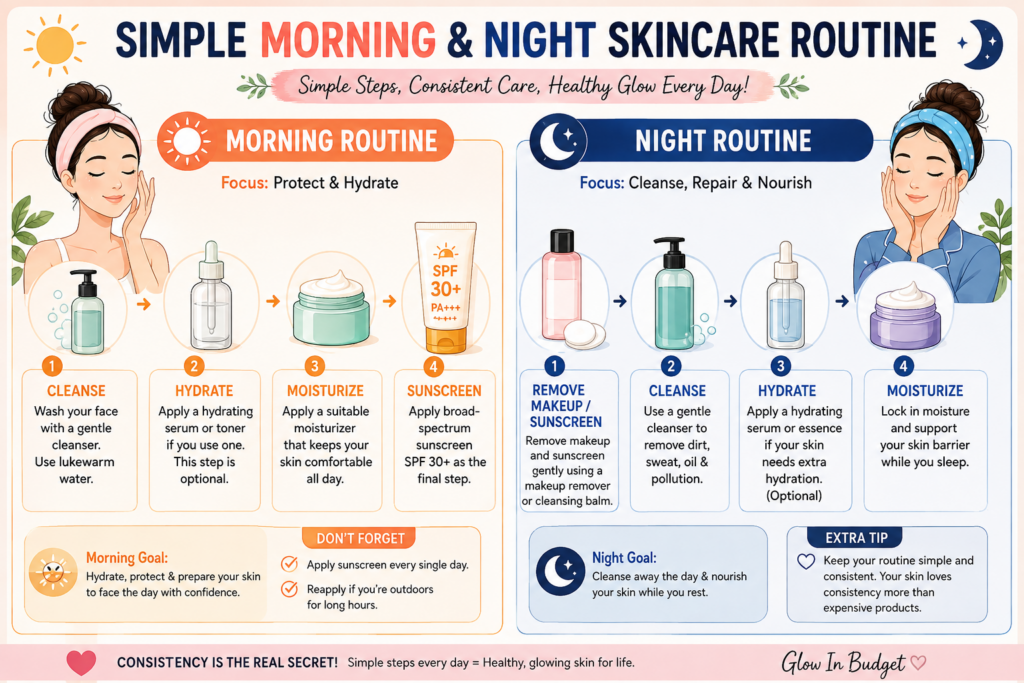
Morning Skincare Routine for a Healthy Glow
Your morning routine doesn’t need to be long to be effective. After completing the first seven days, the goal is to have a simple morning skincare routine that protects your skin, keeps it comfortable, and is easy to repeat every day.
For most people, the foundation is straightforward: cleanse gently, moisturize when needed, and finish with sunscreen. The American Academy of Dermatology recommends using sunscreen with broad-spectrum protection and SPF 30 or higher as part of everyday sun protection.
☀️ Step 1: Gently Cleanse
Start your morning by cleansing your face with a gentle cleanser if your skin needs it.
Use lukewarm water and your fingertips rather than scrubbing with a towel or cleansing tool.
If your skin feels comfortable and doesn’t need a morning cleanser, some people may prefer simply rinsing with water. Your morning cleansing choice should depend on how your skin feels rather than following a rigid rule.
💧 Step 2: Hydrate Your Skin
After cleansing, apply a hydrating product if one is already part of your routine and your skin tolerates it well.
This step doesn’t need to mean layering several products. A moisturizer can provide both hydration and moisture in a simple routine.
If your skin feels comfortable without an additional hydrating serum, you can skip one.
🧴 Step 3: Moisturize
Apply a suitable moisturizer to help keep your skin comfortable throughout the day.
Choose a texture that works with your skin type and the climate you’re living in. If a heavy moisturizer feels uncomfortable during hot or humid weather, a lighter texture may feel more pleasant.
The important thing is not the number of products you apply but whether the moisturizer works well for your skin.
☀️ Step 4: Finish With Sunscreen
Sunscreen should be the final step of your morning skincare routine.
Choose a broad-spectrum sunscreen with SPF 30 or higher, and apply it to exposed skin before heading outdoors. Remember areas that are commonly missed, such as the neck and ears when exposed.
If you’re outdoors for an extended period, sweating, or swimming, follow the sunscreen label’s directions for reapplication.
💄 Step 5: Makeup Comes After Skincare
If you wear makeup, apply it after your skincare routine and sunscreen have been applied.
You don’t need to sacrifice sunscreen because you’re wearing makeup. Instead, allow your skincare products to settle comfortably before applying makeup.
🌿 Keep Your Morning Routine Budget-Friendly
You don’t need a separate product for every skincare concern.
A practical morning routine can be:
Cleanser → Moisturizer → Sunscreen
If you already have a suitable hydrating serum or another product that works well for you, you can include it. But don’t feel pressured to purchase one.
What If Your Skin Feels Different in the Morning?
Your skin may not feel exactly the same every day.
For example, it might feel:
- Dry after sleeping
- Oily in a hot climate
- Comfortable and balanced
- Slightly sensitive after using a new product
Instead of immediately adding another product, first consider whether your existing routine needs adjusting.
If your skin is irritated, return to a simple routine and avoid adding multiple new products.
✨ Glow In Budget Expert Tip
Build your morning routine around protection, not perfection. A simple cleanser, comfortable moisturizer, and reliable SPF can be more useful than a complicated routine filled with products you don’t consistently use.
🌙 Night Skincare Routine for a Healthy Glow
Your nighttime skincare routine is all about cleansing away the day and keeping your skin comfortable while you rest. You don’t need a long list of products—just a few consistent steps can be enough.
Step 1: Remove Makeup and Sunscreen
If you wore makeup or water-resistant sunscreen during the day, remove it gently before cleansing.
You can use a suitable makeup remover or cleansing product that works well for your skin. Avoid rubbing the skin aggressively, especially around the eyes.
Step 2: Cleanse Gently
Use a gentle cleanser to remove sweat, dirt, excess oil, makeup residue, and sunscreen.
Massage it onto your skin with your fingertips rather than scrubbing. Rinse with lukewarm water and gently pat your face dry with a clean towel.
Your skin should feel clean and comfortable—not tight, dry, or squeaky.
Step 3: Apply Your Hydrating Product — If You Need One
If you already use a simple hydrating serum or essence that your skin tolerates well, you can apply it after cleansing.
However, this step is completely optional. You don’t need to add a separate hydrating product just because you’re following a 7-day routine.
If your moisturizer already keeps your skin comfortable, it may be enough.
Step 4: Moisturize
Apply your moisturizer after cleansing.
Moisturizing helps support your skin’s natural barrier and can help reduce that uncomfortable feeling of dryness or tightness.
Choose a moisturizer that suits your skin and fits comfortably into your budget. If your skin tends to feel oily, a lightweight moisturizer may feel more comfortable.
Step 5: Keep the Rest of Your Routine Simple
During this 7-day routine, avoid turning nighttime into a long skincare experiment.
If you already use treatments such as acne products, retinoids, or other active ingredients and your skin tolerates them well, continue according to their directions rather than suddenly adding several new products.
If you are starting from scratch, however, basic cleansing and moisturizing are a better starting point than introducing multiple strong treatments at once.
Your Simple Night Routine
Remove makeup/sunscreen → Gentle cleanser → Optional hydrating step → Moisturizer
That’s it.
A simple routine that you can follow consistently is usually more practical than a complicated routine filled with products you don’t actually need.
✨ Glow In Budget Expert Tip
Don’t measure a good nighttime routine by how many products you use. If your skin feels clean, comfortable, and moisturized—and you can maintain the routine consistently—you are already doing the important things right.
💰 Budget-Friendly Tips for Better Skincare
A healthy-looking skincare routine doesn’t have to be expensive. In fact, one of the biggest advantages of a simple routine is that you can focus your budget on the products that actually matter instead of constantly buying new launches or following every skincare trend.
You don’t need an expensive collection to build a useful skincare routine. The American Academy of Dermatology also recommends practical ways to care for your skin while keeping skincare costs under control.
Here are practical ways to make your skincare routine more affordable without making it unnecessarily complicated.
1. Start With What You Already Own
Before purchasing anything new, check your current skincare products.
You may already have a gentle cleanser, moisturizer, and sunscreen that work well for you. There is no need to replace them simply because a new product is trending.
2. Prioritize the Basics
If your budget is limited, concentrate on the products that form the foundation of your routine:
- Gentle cleanser
- Moisturizer
- Broad-spectrum sunscreen with SPF 30 or higher
Optional products can be added later if you genuinely need them.
3. Don’t Build a 10-Step Routine
More products don’t automatically mean better skin.
Using several products at once can make your routine more expensive and may also make it difficult to identify which product is causing irritation if your skin reacts.
A shorter routine is easier to maintain—and easier on your wallet.
4. Compare Ingredients, Not Just Packaging
Beautiful packaging and popular marketing can make a product look more effective than it actually is.
When comparing products, look at the ingredients, suitability for your skin, product size, and how consistently you can realistically use it.
5. Buy Products You Will Actually Use
An inexpensive product that sits unopened in your drawer isn’t a budget-friendly purchase.
Choose products that feel comfortable, fit your routine, and are realistic for your lifestyle.
6. Don’t Chase Every Skincare Trend
New skincare trends appear constantly, but you don’t need to try every one.
A product can be popular online and still not be necessary for your skin.
Give your basic routine enough time before deciding that you need another product.
7. Use the Right Amount
Using more product doesn’t necessarily make it work better.
Follow the product’s directions and use an appropriate amount. This can help your products last longer and prevent unnecessary waste.
8. Keep Your Routine Consistent
Consistency is one of the most budget-friendly skincare strategies.
Instead of repeatedly buying new products hoping for faster results, focus on using a simple routine regularly.
Simple + suitable + consistent is a much better long-term approach than constantly changing products.
✨ Glow In Budget Expert Tip
When your skincare budget is tight, don’t try to save money by skipping the basics—save money by reducing unnecessary steps. A suitable cleanser, moisturizer, and sunscreen can be a smarter investment than a drawer full of trendy products.
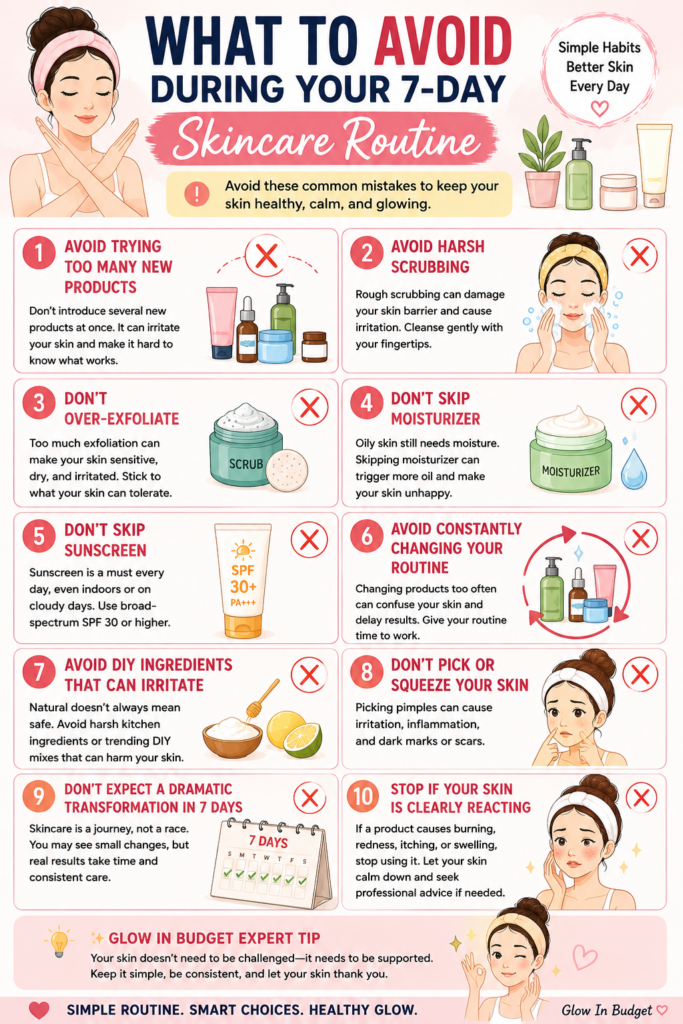
🚫 What to Avoid During Your 7-Day Skincare Routine
A 7-day skincare routine should make your skincare simpler—not more aggressive. Trying too many products or treatments at once can leave your skin irritated and make it difficult to understand what actually works for you.
If your skin is easily irritated, our guide to sensitive skin care in humid weather can help you choose gentler products and avoid common triggers.
During these seven days, focus on consistency and give your skin time to adjust.
1. Avoid Trying Too Many New Products
Don’t introduce several new products at the same time.
If your skin reacts, it can become difficult to identify which product caused the problem.
Better approach: Introduce new products gradually and give your skin time to adjust.
2. Avoid Harsh Scrubbing
Scrubbing your face aggressively won’t make it cleaner or give you faster results.
Avoid rough physical scrubs, vigorous rubbing, and using exfoliating tools too frequently.
Cleanse gently with your fingertips instead.
3. Don’t Over-Exfoliate
Exfoliation can be useful for some people, but more is not better.
During this 7-day routine, don’t suddenly add multiple exfoliating products or use strong exfoliants every day.
If exfoliation is already part of your routine and your skin tolerates it, follow the product’s directions.
4. Don’t Skip Moisturizer Because Your Skin Feels Oily
Oily skin can still benefit from moisturizing.
If your skin tends to become oily, choose a lightweight moisturizer that feels comfortable rather than skipping moisturizer completely.
5. Don’t Skip Sunscreen
A healthy-looking skincare routine isn’t complete without daily sun protection.
Use a broad-spectrum sunscreen with SPF 30 or higher and reapply when needed, particularly during extended outdoor exposure.
6. Avoid Constantly Changing Your Routine
Don’t change products every day because you don’t see an immediate difference.
Seven days is primarily about building better habits and understanding how your skin responds to a simpler routine.
7. Avoid DIY Ingredients That Can Irritate Your Skin
Natural doesn’t automatically mean gentle.
Avoid experimenting with harsh kitchen ingredients or untested DIY combinations simply because they’re trending online.
In particular, be cautious with ingredients or methods that can cause burning, excessive dryness, irritation, or photosensitivity.
8. Don’t Pick or Squeeze Your Skin
Try not to repeatedly touch, pick, or squeeze pimples and other skin imperfections.
This can irritate the area and may increase the risk of marks or scarring.
9. Don’t Expect a Dramatic Transformation in One Week
The purpose of this routine isn’t to completely change your skin in seven days.
You may notice that your skin feels more comfortable, hydrated, or manageable, but concerns such as persistent acne, pigmentation, or other skin conditions generally require more time and sometimes professional guidance.
10. Stop If Your Skin Is Clearly Reacting
If a product causes significant burning, swelling, itching, redness, or persistent irritation, don’t force yourself to continue using it.
Stop the product and allow your skin to settle. If the reaction is severe or doesn’t improve, consider seeking advice from a qualified healthcare professional.
✨ Glow In Budget Expert Tip
Your skin doesn’t need to be challenged—it needs to be supported. If your skin feels comfortable throughout the seven days, that’s a much better sign than trying to create dramatic results through aggressive treatments.
⚠️ Common Skincare Mistakes to Avoid
Even a simple skincare routine can become less effective when small mistakes turn into everyday habits. During your 7-day skincare routine, avoid these common problems so you can keep your routine comfortable, affordable, and easy to maintain.
- Using too many products at once: Adding multiple new products makes it difficult to know what works for your skin and may increase the chance of irritation.
- Thinking more product means better results: Applying excessive amounts of skincare doesn’t necessarily improve results and can simply waste your products.
- Washing your face too aggressively: Scrubbing harder doesn’t mean cleaner skin. Gentle cleansing is a better approach for maintaining skin comfort.
- Skipping moisturizer because your skin is oily: Oily skin can still need moisture. Choose a lightweight moisturizer if richer formulas feel uncomfortable.
- Forgetting sunscreen: A routine focused on healthy-looking skin should include daily sun protection.
- Changing your routine every few days: Constantly switching products prevents you from understanding which products suit your skin.
- Following skincare trends without considering your skin: A product that works for someone else may not be appropriate for you.
- Expecting instant results: Seven days can help you establish better habits, but many skin concerns require consistent care over a longer period.
- Ignoring irritation: Burning, significant redness, swelling, itching, or persistent discomfort shouldn’t be treated as a sign that a product is “working.”
- Spending more instead of simplifying: A bigger skincare budget doesn’t automatically create better results. Focus on products you genuinely need and can use consistently.
✨ Glow In Budget Expert Tip
Don’t turn your skincare routine into a race. The goal of this 7-day plan is to build simple habits that you can continue—not to use as many products as possible or force overnight results.
🌸 FAQs — 7-Day Skincare Routine for a Healthy Glow on a Budget
1. Can a 7-day skincare routine really make my skin glow?
A 7-day skincare routine can help you build better habits and may make your skin feel cleaner, more hydrated, and more comfortable. However, it shouldn’t be treated as a promise of dramatic results in one week.
The goal is to establish simple habits that you can continue long term.
2. What should I use during a 7-day skincare routine?
You can keep your routine simple with three basic products:
- A gentle cleanser
- A suitable moisturizer
- A broad-spectrum sunscreen with SPF 30 or higher
An additional hydrating or treatment product can be included if you already use one and your skin tolerates it well.
3. Do I need to buy new skincare products for this routine?
No.
In fact, one of the best ways to keep this routine budget-friendly is to start with products you already own.
If your cleanser, moisturizer, and sunscreen are suitable for your skin, there’s no need to replace them simply because you’re starting a new routine.
4. Should I exfoliate during the 7-day skincare routine?
Exfoliation isn’t essential for completing this routine.
If you already use a gentle exfoliating product and your skin tolerates it, continue according to its directions. But don’t suddenly introduce strong exfoliants or exfoliate aggressively in an attempt to get faster results.
5. Can I follow this routine if I have oily skin?
Yes. The basic principles can work for oily skin too.
Use a gentle cleanser, choose a lightweight moisturizer if you prefer that texture, and use a broad-spectrum sunscreen that feels comfortable on your skin. If your skin becomes especially oily in hot or humid conditions, see our guide to oily skin care in humid weather for more specific routine ideas.
Your skin type may affect which specific products and textures work best for you.
6. Can I follow this routine if I have dry skin?
Yes. Dry skin may benefit from paying particular attention to gentle cleansing and regular moisturizing.
Avoid harsh cleansing and very hot water, and choose a moisturizer that provides enough comfort for your skin.
7. What if my skin becomes irritated during the 7-day routine?
Don’t try to push through significant irritation.
If a product causes burning, swelling, intense itching, significant redness, or persistent discomfort, stop using it and allow your skin to settle. If the reaction is severe or doesn’t improve, seek advice from a qualified healthcare professional.
8. Can I use DIY face masks during these seven days?
You don’t need a DIY face mask to complete the routine.
If you already have a simple mask that your skin has tolerated well, you may use it as an optional extra-care step. Avoid experimenting with harsh or irritating DIY ingredients just to make the routine more intensive.
9. How long should I continue the routine after Day 7?
You can continue the basic routine beyond the seven days.
The seven-day plan is designed as a starting point. After Day 7, keep the steps that work well for you and gradually adjust your routine according to your skin’s needs.
10. Is an expensive skincare routine better than a budget-friendly one?
Not necessarily.
A higher price doesn’t automatically make a product more suitable for your skin.
A simple routine containing products your skin tolerates well—and that you can consistently afford and use—is often more practical than constantly purchasing expensive products.
11. Can I follow this routine every month?
You don’t need to repeatedly “reset” your skin every month.
Once you’ve established a simple routine, the better approach is to maintain those habits consistently and make changes only when your skin’s needs change.
12. What is the most important step in a 7-day skincare routine?
If we had to simplify the entire plan, focus on gentle cleansing, moisturizing, and daily sun protection, while avoiding unnecessary irritation.
The most important part is not completing a perfect seven-day challenge—it’s creating habits you can realistically maintain.
✨ Glow In Budget Expert Tip
Think of the seven days as the beginning of your skincare routine, not the finish line. Your skin doesn’t need a new challenge every week; it needs simple, suitable care that you can continue consistently.
🌸 Final Thoughts
A 7-day skincare routine doesn’t need to be complicated, expensive, or filled with trendy products.
The real purpose of these seven days is to help you slow down, simplify your routine, and pay attention to what your skin actually needs. Gentle cleansing, regular moisturizing, daily sun protection, hydration, and consistent habits can create a much stronger foundation than constantly changing products.
You also don’t need to expect dramatic results after just one week. Some improvements may be noticeable quickly, such as skin feeling more comfortable or hydrated, while concerns like acne, pigmentation, uneven texture, and other long-term skin issues may require much more consistent care.
Once Day 7 is complete, don’t feel like you need to start another skincare challenge. Instead, take the simple steps that worked for you and turn them into your everyday routine.
Your best skincare routine isn’t necessarily the longest one or the most expensive one—it’s the one your skin tolerates, your budget can support, and you can consistently follow.
✨ Glow In Budget Expert Tip
Don’t chase perfect skin—build consistent skin-friendly habits. Give your routine time, listen to your skin, and make changes thoughtfully rather than constantly starting over.
💕 Follow Glow In Budget
Found this guide helpful?
Follow @glowinbudget for more affordable beauty, skincare, hair care, and self-care tips. We regularly share practical routines, expert-backed advice, and budget-friendly solutions to help you look and feel your best—without overspending.