Introduction.
Combination skin can be tricky to manage in humid weather. Your forehead, nose, and chin may become shiny or oily, while your cheeks can still feel dry, tight, or uncomfortable. Because different areas of the face can react differently to humidity, using the same heavy or oil-controlling approach everywhere may not give your skin what it needs.
Humidity can increase sweat and surface oil, making the T-zone feel greasy or congested. At the same time, air conditioning, frequent cleansing, sun exposure, or an overly harsh routine can leave the drier areas feeling dehydrated or irritated. If you also enjoy simple at-home treatments, explore our guide to DIY skincare for combination skin for gentle, budget-friendly ideas that complement your everyday routine.
The key is not to treat your entire face as either oily or dry. A balanced combination skin care routine in humid weather should keep the whole face gently cleansed, hydrated, and protected while adjusting product amounts or textures according to what each area actually needs.
In this guide, you’ll learn how to build a simple morning, daytime, night, and weekly routine for combination skin in humid weather, how to balance an oily T-zone with drier cheeks, which common mistakes to avoid, and how to adjust your routine when your skin changes.
Why Does Combination Skin Behave Differently in Humid Weather?
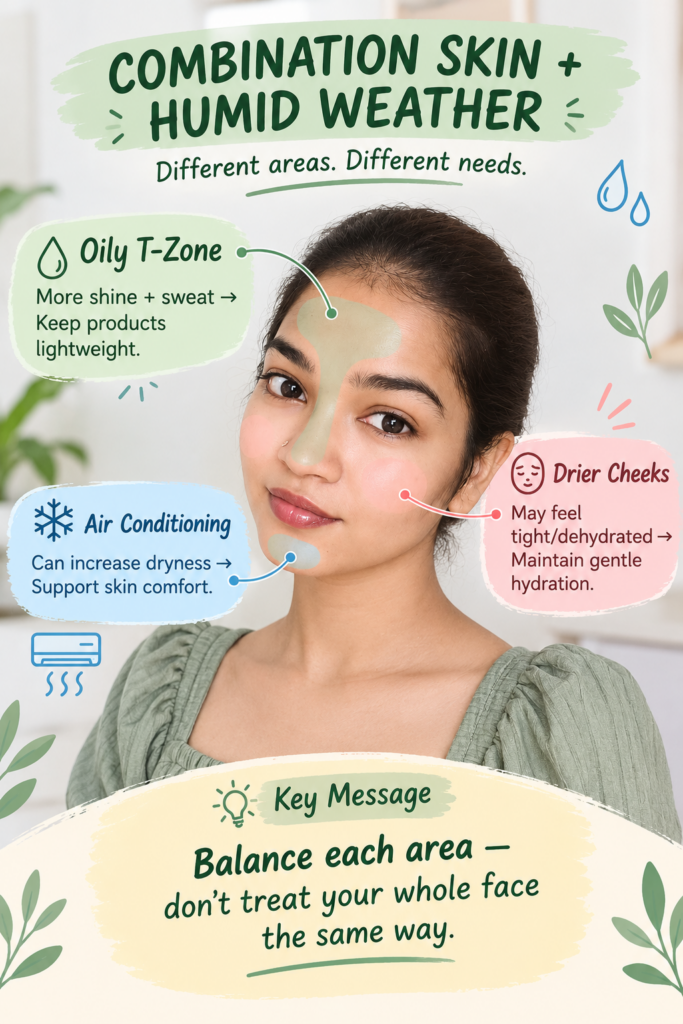
Combination skin has areas with different oil and moisture needs. Typically, the T-zone—forehead, nose, and chin—produces more oil, while the cheeks may be normal, dry, or more easily dehydrated. Because of this, humidity can affect different parts of the face differently.
When humidity is high, sweat and surface moisture can make the oilier areas feel shinier, sticky, or heavier. If you respond by repeatedly washing your face or using strong oil-control products, the drier areas may become uncomfortable or irritated.
Air conditioning can add another challenge. Spending long periods in air-conditioned environments can make some areas feel less comfortable or tight, even when the outdoor weather is humid. So, humid weather does not automatically mean your entire face needs less hydration.
How Humid Weather Can Affect Different Areas
- T-zone: May look shinier and feel oilier or more congested.
- Cheeks: May remain normal or feel dry, tight, or dehydrated.
- Around the mouth: Can sometimes feel drier than the rest of the face.
- Overall skin: May feel sweaty or sticky while still needing appropriate hydration.
The goal is therefore balance, not over-correction. Instead of trying to make the entire face completely matte, build a routine that keeps oilier areas comfortable while giving drier areas enough hydration.
✨ Glow In Budget Expert Tip
Treat your face according to what each area needs. Use a gentle routine across the whole face, then adjust the amount or texture of moisturizer and targeted products for your T-zone and cheeks rather than using harsh oil-control products everywhere.
Signs Your Combination Skin Needs Extra Care in Humid Weather
Combination skin doesn’t always need a more complicated routine in humid weather. Instead, pay attention to changes in different areas of your face. If your T-zone is becoming increasingly oily while your cheeks feel uncomfortable or dry, your routine may need a small adjustment.
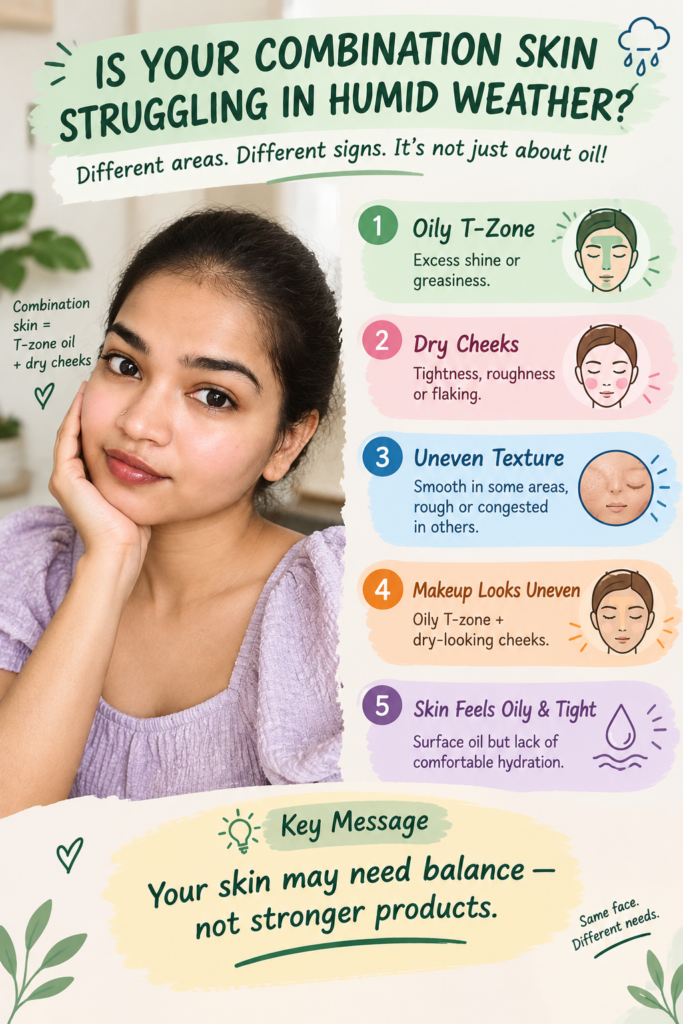
Signs to Watch For
- Excess shine on the T-zone: Your forehead, nose, or chin becomes noticeably oily or shiny soon after cleansing.
- Dry or tight cheeks: Your cheeks feel tight, rough, or uncomfortable even though the weather is humid.
- Uneven skin texture: Some areas feel smooth while others become rough, flaky, or congested.
- More frequent clogged pores: The oilier areas may develop more visible congestion or small bumps.
- Makeup becomes uneven: Foundation or other products may become oily around the T-zone but look dry or patchy around the cheeks.
- Skin feels both oily and dehydrated: Your face can feel greasy on the surface while still feeling tight underneath.
- Increased sensitivity or irritation: Redness, stinging, or discomfort can indicate that your routine is too harsh or that you’re over-cleansing.
What These Signs Can Tell You
These changes don’t necessarily mean you need completely different products for every part of your face. They may simply mean that your product amount, texture, or routine frequency needs adjusting.
For example, if your T-zone is very shiny but your cheeks feel tight, reducing moisturizer everywhere isn’t necessarily the answer. You may need a lighter amount on the T-zone while maintaining adequate hydration on the cheeks.
✨ Glow In Budget Expert Tip
Don’t let an oily T-zone convince you that your entire face needs oil-control products. Look at each area separately and adjust your routine gently. Combination skin usually benefits from balance rather than aggressive oil removal.
How to Balance an Oily T-Zone and Drier Cheeks
Combination skin works best when you balance different areas instead of treating the entire face as oily or dry. In humid weather, this becomes especially important because the T-zone may need lighter textures while the cheeks still benefit from comfortable hydration.
1. Keep Cleansing Gentle
Use a gentle cleanser that removes sweat, sunscreen, and excess oil without leaving your cheeks feeling tight.
Avoid repeatedly washing your face simply because your T-zone looks shiny. Over-cleansing can make the drier areas feel uncomfortable.
2. Adjust Hydration by Area
You don’t necessarily need completely different products for each part of your face.
- T-zone: Use a lighter layer of moisturizer if this area becomes oily quickly.
- Cheeks: Apply enough moisturizer to keep them comfortable and hydrated.
- Around the mouth: Give extra attention if this area tends to feel dry.
3. Choose Lightweight, Comfortable Textures
In humid weather, lightweight gels, lotions, or fluid moisturizers may feel more comfortable than very heavy creams.
However, lightweight doesn’t mean skipping moisturizer. Your skin still needs appropriate hydration even when the weather feels hot and sticky.
4. Don’t Over-Control Oil
Trying to make your T-zone completely matte can backfire if it leaves the rest of your face dry or irritated.
Instead, focus on reducing excess shine while maintaining skin comfort.
✨ Glow In Budget Expert Tip
Use the same basic routine across your face, but adjust the amount and texture according to each area. Your T-zone doesn’t need to be stripped just because it is oily, and your cheeks don’t need to be neglected because the weather is humid.
Morning Skincare Routine for Combination Skin in Humid Weather
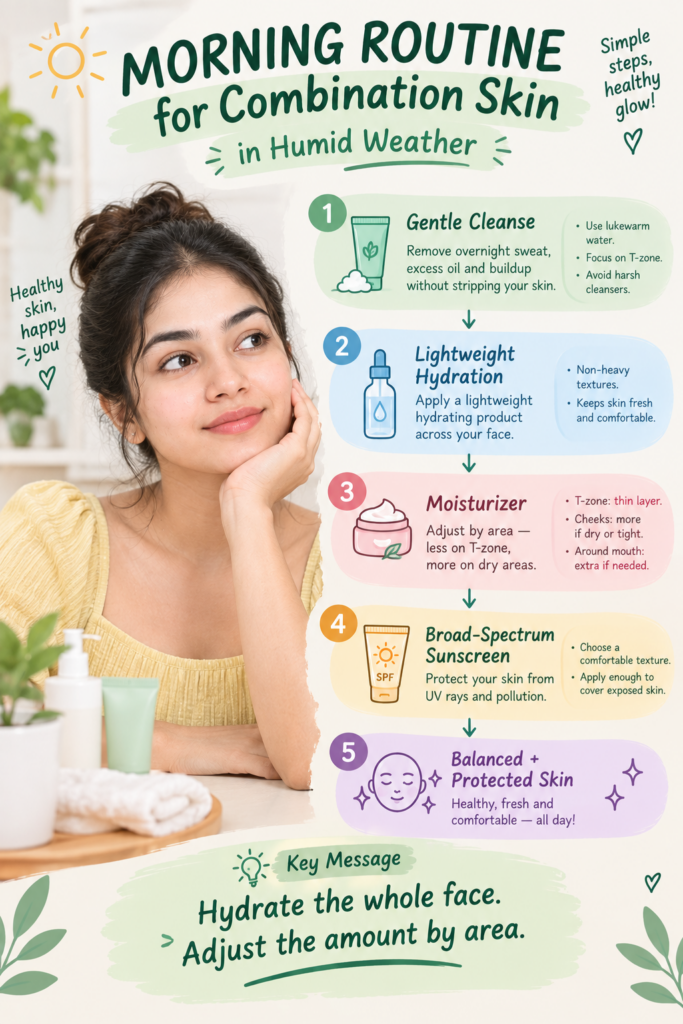
A good morning routine for combination skin should protect the entire face without making the T-zone feel greasy or leaving the cheeks under-hydrated. The easiest approach is to keep the routine simple and adjust the amount or texture of moisturizer according to each area.
Step 1: Gentle Cleanse
Start with a gentle cleanser to remove overnight sweat, excess oil, and buildup without stripping the skin.
- Use lukewarm water.
- Pay attention to the T-zone without aggressively scrubbing it.
- Avoid harsh cleansers that leave your cheeks feeling tight.
Step 2: Lightweight Hydration
Apply a lightweight hydrating product across the face.
Look for comfortable, non-heavy textures that provide hydration without making the T-zone feel coated.
Step 3: Moisturizer — Adjust by Area
This is where combination skin can benefit from a little customization.
- T-zone: Apply a thin layer if it becomes oily quickly.
- Cheeks: Use a slightly more generous amount if they feel dry or tight.
- Around the mouth: Add a little extra moisturizer if this area tends to become dry.
You don’t have to use separate moisturizers unless your skin genuinely benefits from them.
Step 4: Broad-Spectrum Sunscreen
Finish with a broad-spectrum sunscreen suitable for your skin and apply enough to adequately cover exposed skin. If you spend time outdoors, choose a water-resistant formula and reapply as needed, especially after sweating. The American Academy of Dermatology provides helpful guidance on how to select sunscreen based on these key protection factors.
Choose a comfortable texture that you can use consistently without making the T-zone feel excessively greasy.
✨ Glow In Budget Expert Tip
Don’t skip moisturizer just because your T-zone is oily. Keep the overall routine hydrating, then adjust the amount by area—less where you get oily and more where your skin feels dry.
🌙 Night Routine for Combination Skin in Humid Weather
Nighttime is an important opportunity to remove the day’s buildup and support your skin barrier. But with combination skin, the goal isn’t to cover your entire face with rich products. Your T-zone may already feel oily or sticky, while your cheeks and other areas can still feel dry or tight.
A good nighttime routine should therefore focus on gentle cleansing, lightweight hydration, and balanced moisturization. You can also adjust the amount of product depending on what different areas of your skin need.
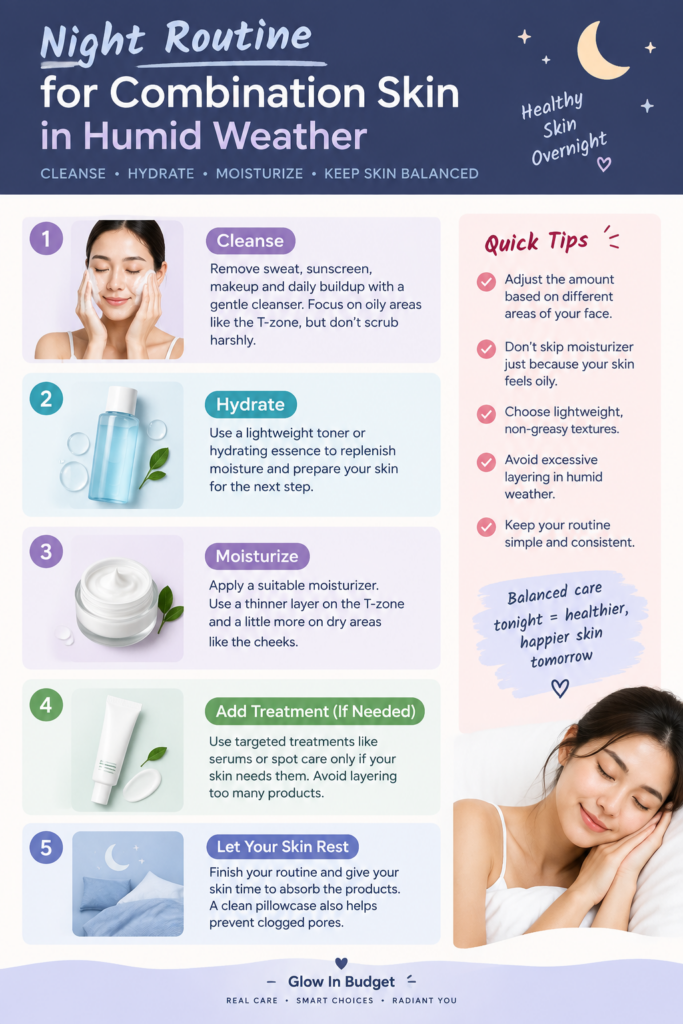
1. Gently Cleanse Your Skin
Start by cleansing your face to remove sunscreen, sweat, excess oil, dirt, and makeup or other products from the day.
Choose a gentle cleanser that doesn’t leave your skin feeling tight, squeaky-clean, or uncomfortable after washing. Over-cleansing can make already-dry areas feel even more uncomfortable while encouraging you to add more products afterward.
How to do it:
- Wet your face with lukewarm water.
- Apply a small amount of gentle cleanser.
- Massage softly with your fingertips.
- Pay attention to the T-zone, especially if it feels oily.
- Rinse thoroughly.
- Pat your face dry instead of rubbing it.
If you wore makeup or water-resistant sunscreen, make sure it is properly removed before your final cleanse.
2. Apply Lightweight Hydration
After cleansing, your skin may benefit from a lightweight hydrating product.
Look for simple, comfortable formulas that provide hydration without making the face feel excessively sticky or greasy. This can be particularly helpful when the humid weather already makes your skin feel sweaty.
Apply a thin, even layer over your face and allow it to settle before moving to the next step.
Remember: hydration and oiliness aren’t the same thing. Combination skin can have an oily T-zone and still need adequate hydration.
3. Use Moisturizer According to Your Skin’s Needs
This is where a combination-skin routine should be adjusted rather than treating the whole face exactly the same way.
Use a lightweight moisturizer over most of your face, then adjust the amount according to how each area feels.
- T-zone: Use a thinner layer if this area becomes oily or sticky easily.
- Cheeks: Apply a little more if they feel dry or tight.
- Dry patches: Give these areas additional moisturizer when needed.
- Comfortable areas: Use enough to maintain comfort without unnecessary layering.
You don’t need two completely different moisturizers unless your skin genuinely benefits from them. Often, simply changing the amount of one suitable moisturizer is enough.
4. Add Targeted Treatment Only When Needed
If you’re using a treatment product for a specific concern, nighttime can be a convenient time to include it.
However, avoid adding several strong products simply because combination skin has both oily and dry areas. Too many active ingredients can make your routine harder to tolerate, especially if your skin barrier becomes irritated.
Keep targeted treatments simple and purposeful, and follow the product’s directions.
If your skin becomes unusually dry, irritated, burning, or uncomfortable, simplify your routine rather than adding more products.
5. Give Dry Areas Extra Attention
Before going to bed, take a quick look at how your skin feels.
If your cheeks or other areas feel tight, flaky, or uncomfortable, apply a small additional amount of moisturizer to those areas.
At the same time, you don’t need to keep adding moisturizer to an already-oily T-zone.
This small adjustment can make your nighttime routine much more comfortable during humid weather.
6. Keep the Night Routine Lightweight
Humid weather can make heavy skincare feel uncomfortable, especially overnight.
You don’t need multiple layers of creams, oils, masks, and treatments to care for combination skin. A simple routine that your skin tolerates consistently is often easier to maintain.
A practical nighttime sequence is:
Gentle Cleanser → Lightweight Hydration → Moisturizer → Targeted Treatment When Needed
The exact products can vary depending on your skin’s individual needs.
✨ Glow In Budget Expert Tip
Don’t treat combination skin as if your entire face has the same needs. In humid weather, keep the T-zone comfortable with lighter layers while giving drier areas the extra hydration and moisturization they need. The goal is balanced, comfortable skin—not completely matte skin or an overly rich nighttime routine.
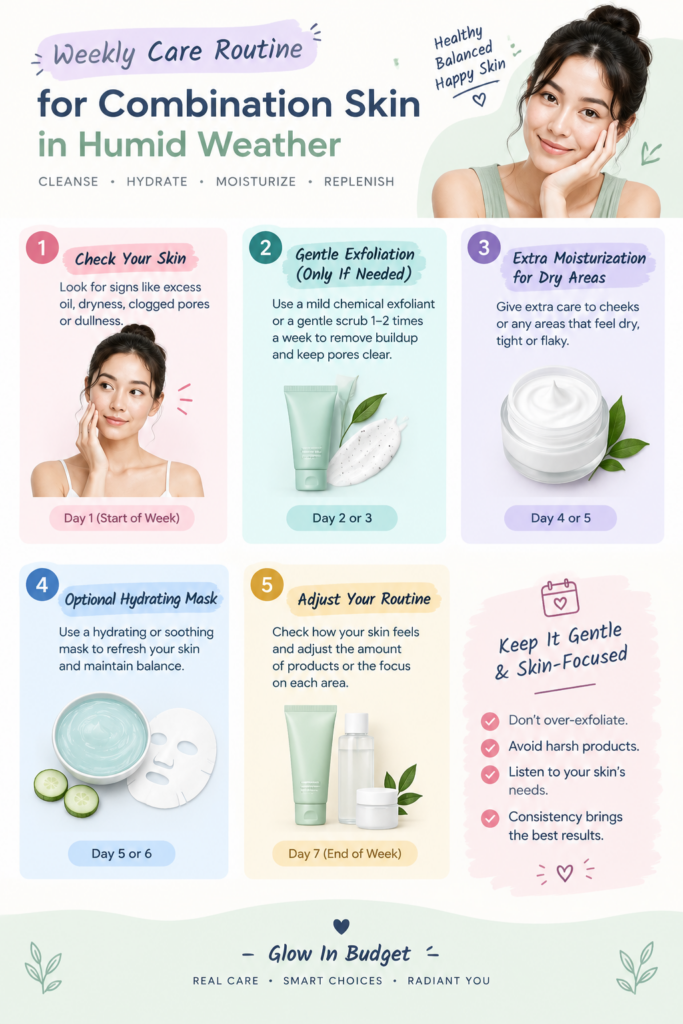
🧖♀️ Weekly Care Routine for Combination Skin in Humid Weather
Daily skincare is the foundation, but combination skin can also benefit from a simple weekly routine. The key is not to overdo exfoliation or use heavy treatments just because your skin has both oily and dry areas.
1. Check How Your Skin Feels
Before doing any weekly treatment, assess your skin.
- If your T-zone feels oily but your cheeks feel comfortable, keep the routine balanced.
- If your cheeks feel dry or tight, focus more on hydration.
- If your skin feels irritated or unusually sensitive, skip exfoliation and concentrate on gentle care.
- If your skin feels comfortable overall, you may not need additional treatment that week.
2. Gentle Exfoliation — Only If Needed
Exfoliation isn’t something combination skin automatically needs every week.
If you choose to exfoliate, use a gentle product and follow its directions. Avoid aggressive scrubbing, especially on dry areas.
Do not exfoliate simply to remove every trace of oil from your T-zone. Over-exfoliation can leave the skin irritated and uncomfortable.
3. Give Dry Areas Extra Moisturization
After cleansing or other weekly care, pay attention to areas that feel drier.
Apply a comfortable layer of moisturizer to dry areas while keeping the amount lighter on areas that become oily easily.
This targeted approach helps you care for different areas without making the entire face feel heavy.
4. Optional Hydrating Mask
If your skin feels dry or dehydrated, you can occasionally use a simple hydrating mask.
Choose a gentle formula that doesn’t contain unnecessary irritating ingredients. A hydrating mask should complement your routine—not replace your regular moisturizer.
If your skin already feels comfortable and balanced, you don’t have to use a mask just because it’s part of a “weekly routine.”
5. Adjust Your Routine Based on Your Skin
Combination skin can change with weather, humidity, air conditioning, hormonal fluctuations, and your daily routine.
So your weekly care doesn’t need to look exactly the same every week.
A simple approach:
Check Your Skin → Exfoliate Only If Needed → Hydrate Dry Areas → Optional Hydrating Care → Adjust
✨ Glow In Budget Expert Tip
Let your skin decide what it needs each week. Combination skin doesn’t require aggressive oil control or frequent exfoliation. Keep weekly care gentle, give dry areas extra hydration when needed, and reduce unnecessary steps when your skin already feels comfortable.
🚫 Common Mistakes to Avoid for Combination Skin in Humid Weather
Combination skin can be tricky because the T-zone and drier areas may respond differently to the same product. Humid weather can make this even more noticeable. Avoiding a few common mistakes can help keep your routine balanced and comfortable.
1. Using Heavy Products All Over the Face
A rich moisturizer may feel comfortable on dry cheeks but unnecessarily heavy on an oily T-zone.
Instead, adjust the amount and texture according to what different areas of your skin need.
2. Over-Cleansing to Control Oil
Washing your face repeatedly may temporarily remove excess oil, but it can leave other areas feeling dry or tight.
Stick to a gentle cleansing routine and avoid repeatedly washing your face just because your T-zone looks shiny.
3. Skipping Moisturizer Because Your Skin Feels Oily
An oily T-zone doesn’t automatically mean your entire face doesn’t need moisturizer.
Use a lightweight moisturizer and adjust the amount according to your skin’s needs.
4. Over-Exfoliating the T-Zone
Seeing more oil around your nose and forehead can make you want to exfoliate frequently.
But aggressive or excessive exfoliation can irritate the skin and make dry areas even more uncomfortable.
Use exfoliation sparingly and gently.
5. Using the Same Amount of Product Everywhere
Combination skin doesn’t always need an identical amount of product on every area.
You can use:
- Less moisturizer on oily areas.
- A little more on dry areas.
- Lightweight layers across the rest of the face.
6. Layering Too Many Products
Adding multiple serums, treatments, masks, and creams can make your routine complicated and harder for your skin to tolerate.
Focus on the basics first:
Cleanse → Hydrate → Moisturize → Protect During the Day
Then add targeted products only when they serve a specific purpose.
7. Ignoring Sunscreen Because It’s Humid
Humidity doesn’t replace sun protection.
Use a broad-spectrum sunscreen during the day and choose a comfortable texture that you can apply consistently without feeling excessively greasy.
8. Changing Your Entire Routine When the Weather Changes
Your skin may need small adjustments rather than a complete routine overhaul.
If your skin feels sticky, try lighter layers or a smaller amount of moisturizer. If your cheeks become tight or dry, increase hydration and moisturization there.
✨ Glow In Budget Expert Tip
Don’t try to make combination skin behave like completely oily or completely dry skin. The goal is to balance different areas of your face with the right amount of hydration, moisturization, and oil control—without over-treating either side.
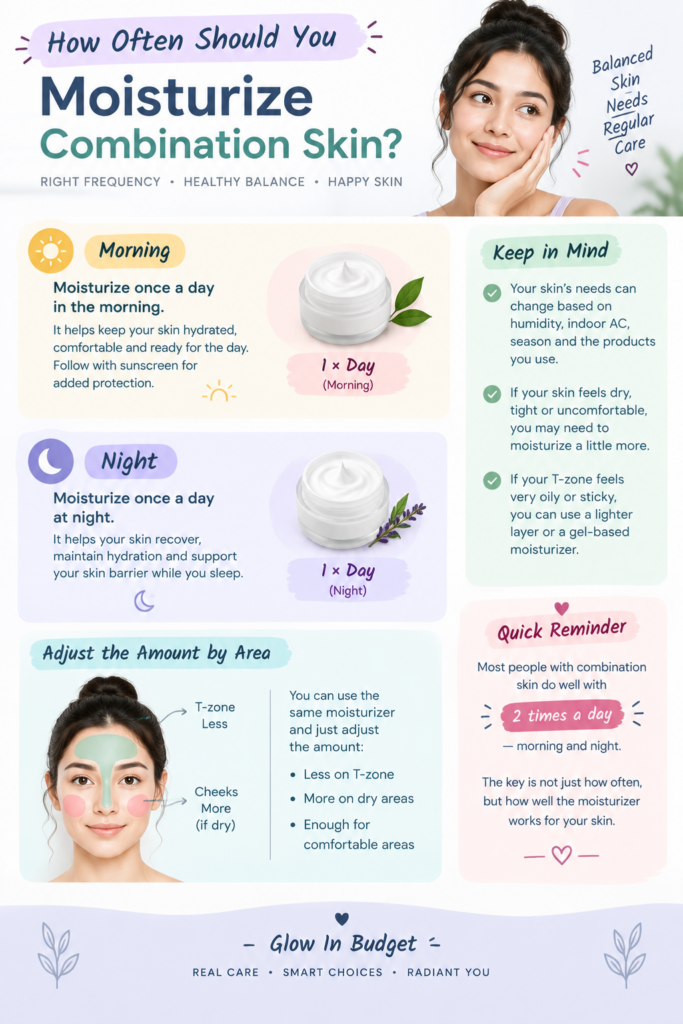
💧 How Often Should You Moisturize Combination Skin in Humid Weather?
Combination skin still needs regular moisturization, even when humid weather makes the face feel oily or sweaty. Humidity can make the skin feel more hydrated on the surface, but it doesn’t mean you should automatically stop using moisturizer.
The right frequency depends on how your skin feels, the products you use, and how different areas of your face behave.
Morning: Moisturize Before Sunscreen
In the morning, apply moisturizer after cleansing and hydration, then follow with sunscreen.
If your skin becomes oily easily in humid weather, you may prefer a lightweight moisturizer and a thinner layer, particularly over the T-zone.
For areas that feel drier, such as the cheeks, you can apply a slightly more comfortable layer.
If your cheeks or other areas of your face feel tight, rough, or flaky, they may need more moisturizing than your oilier T-zone. Instead of applying the same amount of moisturizer everywhere, adjust the quantity based on how each area feels. If your cheeks are particularly dry, our guide to dry skin care in humid weather can help you understand how to keep dry areas comfortable without making the rest of your face feel heavy or greasy.
Simple morning order:
Cleanser → Hydration → Lightweight Moisturizer → Sunscreen
If your sunscreen already provides enough moisturizing comfort for your skin, you may not always need a separate heavy moisturizer underneath. The goal is comfortable, adequately moisturized skin without unnecessary layering.
Night: Moisturize Every Day
Nighttime is generally a good opportunity to moisturize after cleansing.
Use a comfortable moisturizer across the face, adjusting the amount based on different areas:
- Oily T-zone: Use a thinner layer.
- Dry cheeks: Apply a little more if needed.
- Dry patches: Give these areas additional attention.
- Comfortable areas: Use enough to maintain comfort without over-layering.
You don’t need to keep adding moisturizer simply because it’s nighttime. Use enough to prevent dryness and support comfortable skin.
What If Your Skin Feels Oily?
Don’t automatically skip moisturizer.
Instead, first consider whether your current moisturizer is too rich or whether you’re applying too much.
Try:
- Using a lighter texture.
- Applying a smaller amount.
- Concentrating more product on dry areas.
- Keeping the T-zone layer thin.
- Reducing unnecessary skincare layers underneath.
What If Your Skin Feels Dry?
If your cheeks or other areas feel tight, flaky, or uncomfortable, you may need more moisturization rather than more cleansing.
You can:
- Increase the amount slightly on dry areas.
- Add lightweight hydration underneath.
- Avoid harsh cleansing.
- Avoid excessive exfoliation.
- Reassess whether your current products are drying your skin.
How Do You Know You’re Using Enough?
Your skin should feel comfortable, soft, and adequately moisturized rather than greasy, sticky, or excessively tight.
Combination skin doesn’t have to feel completely matte after moisturizing.
A useful rule is:
T-zone feels comfortable → maintain your amount.
Dry areas feel tight → add a little more moisture.
Skin feels greasy or heavy → reduce the amount or choose a lighter texture.
✨ Glow In Budget Expert Tip
Don’t follow a fixed amount of moisturizer just because your skin is “combination.” Humid weather, indoor air conditioning, cleansing, and your skin’s daily condition can all change how much moisture you need. Start with a comfortable layer and adjust the amount by area instead of skipping moisturizer altogether.
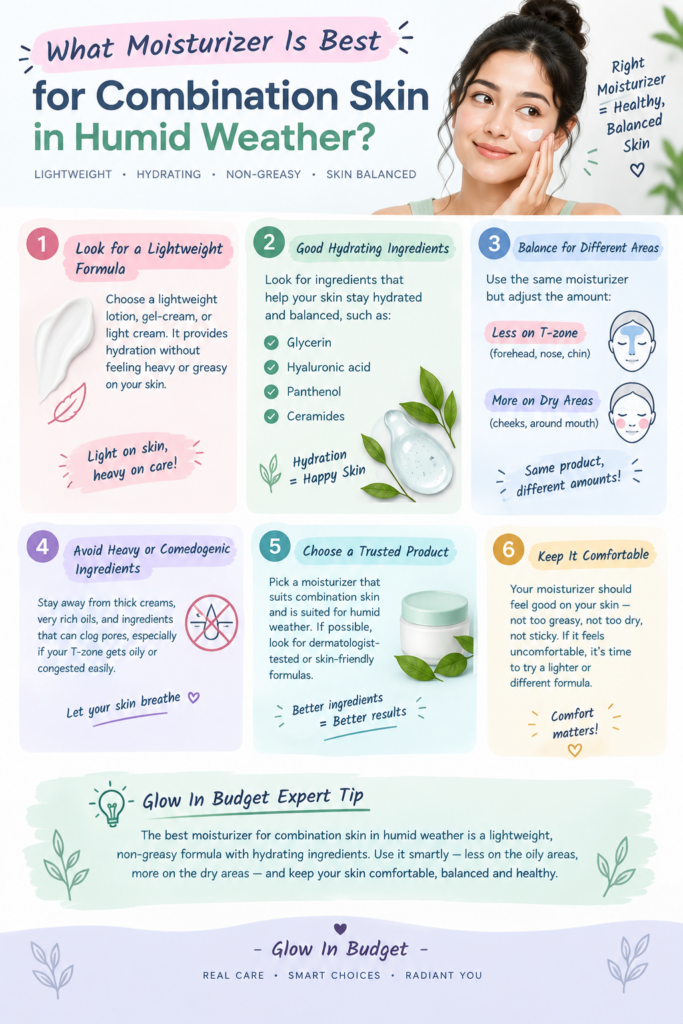
🧴 What Moisturizer Is Best for Combination Skin in Humid Weather?
Choosing a moisturizer for combination skin can be tricky because different areas of your face may need different levels of moisture. Your T-zone may become oily or sticky, while your cheeks can still feel dry or tight.
In humid weather, the goal isn’t to find the richest moisturizer possible. Instead, look for a formula that provides enough hydration and moisturization without leaving your skin feeling excessively greasy, heavy, or uncomfortable.
1. Choose a Lightweight, Comfortable Texture
For humid weather, lightweight textures are often easier to tolerate than very thick creams.
Depending on your skin’s needs, you might prefer:
- Lightweight lotions
- Gel-creams
- Light creams
- Other comfortable, non-heavy formulations
The best texture is ultimately the one that moisturizes your skin without making it feel excessively oily or uncomfortable.
2. Look for Hydrating Ingredients
A good moisturizer can contain ingredients that help attract and retain water in the skin.
Common examples include:
- Glycerin
- Hyaluronic acid
- Panthenol
These can provide hydration without necessarily requiring a heavy-feeling formula.
3. Look for Ingredients That Support the Skin Barrier
Combination skin still needs a healthy skin barrier.
Depending on the formulation, ingredients such as ceramides can help support the skin barrier and may be useful when some areas of your face feel dry or uncomfortable.
You don’t need to choose a product simply because it contains a long list of ingredients. A straightforward formula that your skin tolerates well can be perfectly suitable.
4. Consider Your T-Zone and Dry Areas Separately
You don’t necessarily need two moisturizers.
Often, you can use one suitable moisturizer and simply change how much you apply:
- T-zone: Use a thin layer.
- Cheeks: Apply a little more if they’re dry.
- Dry patches: Add extra moisturizer where needed.
- Comfortable areas: Keep the application moderate.
This approach can be especially practical when the weather is humid.
5. Don’t Choose a Moisturizer Solely Because It Says “For Oily Skin”
A product marketed for oily skin isn’t automatically the right choice for combination skin.
If it’s too lightweight or drying for your cheeks, you may end up with uncomfortable dry areas while still trying to control your T-zone.
Instead, consider how the whole face responds to the product.
6. Avoid Automatically Choosing Very Heavy Formulas
A rich moisturizer isn’t necessarily bad for combination skin, but it may feel uncomfortable when humidity is already high.
If a moisturizer consistently leaves your face feeling:
- Heavy
- Greasy
- Sticky
- Overly coated
you may want to try a lighter texture or reduce the amount you apply.
7. “Non-Comedogenic” Can Be a Useful Preference
If you’re prone to clogged pores, you may prefer products labelled non-comedogenic.
However, the label isn’t a guarantee that a particular product will work perfectly for every person. Your individual skin response still matters.
If a product repeatedly causes congestion or irritation, reconsider using it even if its packaging makes a general claim about pore-friendliness.
✨ Glow In Budget Expert Tip
The best moisturizer for combination skin in humid weather is not necessarily the lightest or the most expensive one—it’s the one that keeps your skin comfortable without making oily areas excessively greasy or dry areas tight. Start with a lightweight, well-tolerated formula and adjust the amount by area rather than automatically applying a thick layer everywhere.
✨ How to Prevent Clogged Pores With Combination Skin in Humid Weather
Humid weather can make combination skin feel more congested because sweat, excess sebum, sunscreen, makeup, and multiple skincare layers can build up on the skin. At the same time, trying too hard to keep pores “completely clean” can lead to over-cleansing and irritation.
The goal is to keep the skin clean and balanced without stripping or aggressively scrubbing it.
1. Cleanse Gently and Consistently
Use a gentle cleanser to remove sweat, excess oil, sunscreen, and daily buildup.
Focus especially on areas that become oilier, such as the forehead, nose, and chin, but don’t scrub them aggressively.
Over-cleansing can leave other areas of combination skin dry and uncomfortable.
2. Remove Sunscreen and Makeup Properly
If you wear sunscreen or makeup during the day, make sure it is properly removed at night.
A simple nighttime cleansing routine can help remove accumulated products before you apply your evening skincare.
If you wear heavier or water-resistant products, follow the removal method appropriate for those products rather than repeatedly washing your face.
3. Keep Skincare Layers Lightweight
Humidity can already make your skin feel sticky, so layering several rich products may make the skin feel unnecessarily heavy.
Instead:
Cleanse → Hydrate → Moisturize
Add treatment products only when you actually need them.
The T-zone tends to produce more oil, it can be more prone to clogged pores in humid weather. Keep this area clean without over-cleansing or scrubbing, and choose lightweight, non-comedogenic products when possible. For more practical tips on managing excess oil in humid weather, see our guide to oily skin care in humid weather.
For more dermatologist-backed guidance on managing excess oil, see the American Academy of Dermatology’s tips for controlling oily skin.
4. Don’t Skip Moisturizer Completely
It may seem logical to stop moisturizing when your T-zone feels oily, but that isn’t necessarily helpful.
Use a lightweight moisturizer and adjust the amount:
- Less on oily areas
- More on dry areas
- Enough to keep the skin comfortable
This lets you maintain hydration without unnecessarily coating the T-zone.
5. Avoid Excessive Exfoliation
If you notice clogged pores, it can be tempting to exfoliate more often.
But frequent or aggressive exfoliation can irritate your skin and damage the skin barrier.
If you use an exfoliating product, follow its directions and avoid combining multiple strong exfoliating products without a good reason.
6. Don’t Scrub or Pick at Your Pores
Physical scrubs, rough cleansing tools, and picking at clogged pores can irritate the skin and potentially cause inflammation or marks.
Gentle, consistent skincare is a better approach than trying to manually remove every visible pore or bump.
7. Keep Things That Touch Your Face Clean
Your skincare routine isn’t the only thing that matters.
Regularly clean or change items that come into frequent contact with your face, such as:
- Pillowcases
- Makeup brushes
- Phone screens
- Towels
This is a simple hygiene step that can complement your regular skincare routine.
8. Pay Attention to Products That Consistently Feel Heavy
If a particular product repeatedly leaves your skin feeling greasy, congested, or uncomfortable, don’t assume you need to add another product to fix the problem.
Instead, reassess the product itself.
Sometimes simplifying the routine is more useful than adding another cleansing or exfoliating step.
9. Don’t Chase “Poreless” Skin
Pores are a normal part of skin and cannot be permanently eliminated through skincare.
The realistic goal is to keep them from becoming excessively congested while maintaining a healthy skin barrier.
✨ Glow In Budget Expert Tip
When combination skin feels congested in humid weather, simplify before you intensify. Gentle cleansing, lightweight layers, appropriate moisturization, and avoiding excessive exfoliation can help you maintain balanced skin without turning your routine into an aggressive pore-clearing routine.
🌿 Bonus Tips for Combination Skin in Humid Weather
Small changes can make combination skin feel much more comfortable during humid weather. Instead of adding more products, focus on using your existing routine more thoughtfully.
1. Adjust Product Amounts by Area
Your entire face doesn’t necessarily need the same amount of every product.
- Use lighter layers on the T-zone.
- Apply a little more moisturizer to dry areas.
- Avoid applying thick layers everywhere simply because some areas feel dry.
2. Give Your Skin Time Between Layers
You don’t need to rush through every skincare step.
Allow each lightweight layer to settle comfortably before applying the next product. This can help prevent your routine from feeling unnecessarily sticky or heavy.
3. Choose Comfortable Textures
During humid weather, products that feel comfortable on your skin are often easier to use consistently.
If a product repeatedly feels excessively greasy, sticky, or heavy, consider whether you need a lighter texture or a smaller amount.
4. Don’t Keep Washing Your Face Throughout the Day
Sweat and oil can make combination skin feel uncomfortable, but repeatedly washing your face isn’t always the solution.
Over-cleansing can leave drier areas feeling tight and may make your routine harder to balance.
Instead, keep your regular cleansing routine consistent and use gentle methods to manage daytime sweat when needed.
5. Keep Your Sunscreen Comfortable
Sunscreen remains an important part of your daytime routine, even when the weather is humid.
If sunscreen feels too heavy, look for a formula that feels comfortable on your skin rather than skipping sun protection.
6. Pay Attention to Indoor Air Conditioning
Humid outdoor weather doesn’t mean your skin experiences the same environment all day.
Spending long periods in air-conditioned spaces can make some areas feel drier. If your cheeks or other areas become tight, adjust your hydration or moisturizer rather than assuming humidity means your skin needs less moisture.
7. Keep Your Routine Simple When Your Skin Feels Comfortable
You don’t need to keep adding products just because combination skin has different needs.
A simple routine that keeps your skin comfortable is often easier to maintain than a complicated routine with unnecessary steps.
8. Change One Product at a Time
If you’re trying to identify what is causing congestion, dryness, or irritation, avoid changing several products at once.
Introducing changes gradually makes it easier to understand how your skin responds.
✨ Glow In Budget Expert Tip
Think of combination skin as a skin type that needs adjustment—not correction. In humid weather, use lighter layers where your skin feels oily, give extra care to dry areas, and simplify your routine whenever possible. The goal is comfortable, balanced skin rather than trying to make every part of your face behave exactly the same way.
🌸 FAQs About Combination Skin Care in Humid Weather
1. Should I moisturize combination skin in humid weather?
Yes. Combination skin still needs regular moisturization even when the weather is humid. Use a lightweight moisturizer and adjust the amount according to different areas of your face. Apply less to the oily T-zone and a little more to dry areas when needed.
2. How often should I moisturize combination skin?
Most people can moisturize combination skin twice daily—morning and night. However, the amount you need may change depending on how your skin feels, the products you use, humidity, and indoor air conditioning.
3. What type of moisturizer is best for combination skin in humid weather?
A lightweight lotion, gel-cream, or light cream can work well. Look for a formula that provides enough hydration without leaving your skin excessively greasy or sticky. Ingredients such as glycerin, hyaluronic acid, panthenol, and ceramides can be useful depending on your skin’s needs and tolerance.
4. Why does my combination skin feel oily and dry at the same time?
Combination skin naturally has areas with different needs. The T-zone may produce more oil, while the cheeks or other areas may feel dry or tight. Humidity, cleansing habits, skincare products, and air conditioning can also affect how these areas feel.
5. Can I use the same moisturizer on my whole face?
Yes. You don’t necessarily need separate moisturizers for different areas. You can often use the same suitable moisturizer but change the amount—a thinner layer on oily areas and a slightly thicker layer on dry areas.
6. How can I prevent clogged pores in humid weather?
Keep your routine simple and consistent. Gently cleanse your skin, remove sunscreen and makeup properly, avoid excessive product layering, choose comfortable textures, and don’t over-exfoliate or scrub your skin.
7. Should I skip moisturizer if my T-zone becomes very oily?
Not necessarily. Instead of completely skipping moisturizer, try using a lighter formula or a smaller amount on the oily areas while continuing to moisturize areas that feel dry.
8. Should combination skin be exfoliated every week?
Not automatically. Exfoliation should depend on how your skin feels and the products you’re already using. If you exfoliate, keep it gentle and avoid using multiple strong exfoliating products at the same time.
9. Why does my skin feel more congested in humid weather?
Sweat, sebum, sunscreen, makeup, and multiple skincare layers can contribute to a congested feeling. However, humidity itself does not mean everyone will develop clogged pores. Your individual skin type, products, cleansing routine, and environment also matter.
10. Should I change my entire skincare routine during humid weather?
Usually, you don’t need to completely replace your routine. Instead, adjust the texture and amount of products according to how your skin responds. If your skin becomes sticky, reduce unnecessary layers; if dry areas become tight, increase hydration or moisturization there.
✨ Glow In Budget Expert Tip
Combination skin doesn’t need a complicated routine just because the weather is humid. Focus on gentle cleansing, lightweight hydration, appropriate moisturization, sunscreen, and adjusting products based on how your skin actually feels.
🌸 Final Thoughts
Combination skin can be a little tricky in humid weather because different areas of your face may need different levels of care. Your T-zone may become oily or congested, while your cheeks or other areas can still feel dry or tight.
The key is not to treat your entire face as completely oily or completely dry. Instead, focus on gentle cleansing, lightweight hydration, comfortable moisturization, daily sunscreen, and adjusting product amounts according to your skin’s needs.
You also don’t need an overly complicated routine. If your skin feels comfortable, there’s no need to keep adding products. If certain areas become oily, dry, or congested, make small adjustments rather than changing everything at once.
With a simple and consistent approach, you can keep combination skin feeling balanced, hydrated, comfortable, and fresh—even during humid weather.
✨ Glow In Budget Expert Tip
Listen to your skin more than the weather. Humidity can change how your skin feels, but your routine should ultimately be guided by what your skin actually needs each day.
💗 Follow Glow In Budget
Found this guide helpful?
Follow @glowinbudget for more affordable beauty, skincare, hair care, and self-care tips. We regularly share practical routines, expert-backed advice, and budget-friendly solutions to help you look and feel your best—without overspending.