Introduction
If you’re looking for effective oily skin care tips in humid weather, you’re probably dealing with more shine, sweat, or congestion than usual. Humid weather can make oily skin feel heavier and harder to keep comfortable throughout the day. Humidity can make oily skin feel heavier and harder to keep comfortable throughout the day. Sweat, excess sebum, and frequent touching can also make clogged pores and breakouts seem more noticeable.
The good news is that managing oily skin in humid weather doesn’t mean trying to remove every trace of oil from your face. Over-cleansing or using harsh products can leave your skin irritated and may make your routine harder to maintain.
In this guide, we’ll cover practical oily skin care tips in humid weather, including a simple morning and night routine, ways to manage excess shine during the day, helpful ingredients, weekly care, and common mistakes to avoid—so your skin can feel fresh, balanced, and comfortable without an unnecessarily complicated routine.
Why Oily Skin Gets More Difficult in Humid Weather
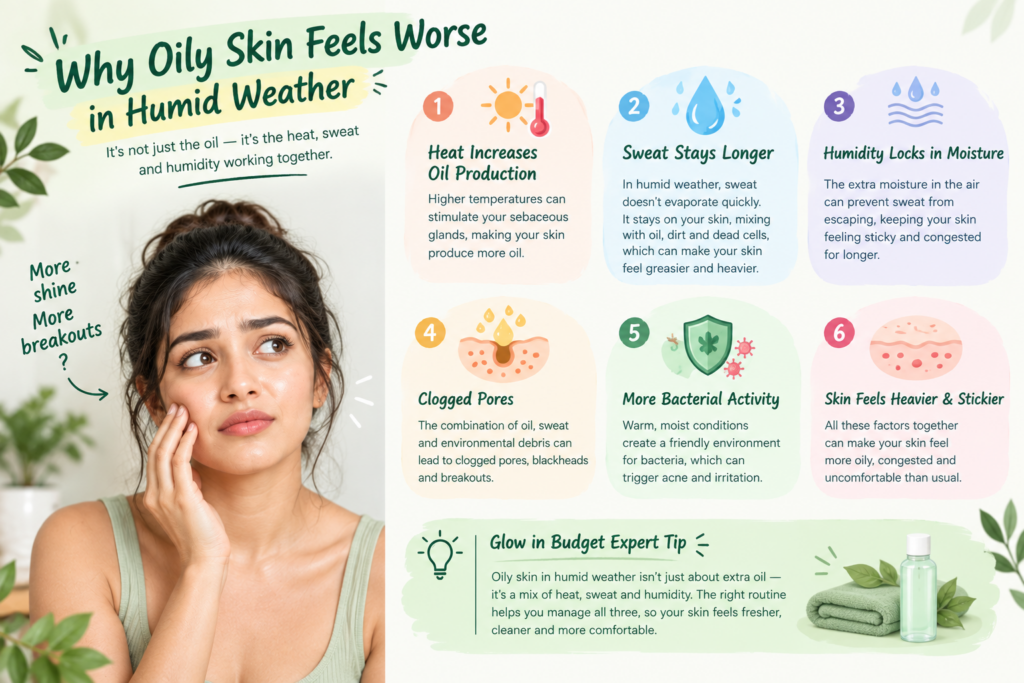
Hot and humid weather can make oily skin feel much heavier and shinier than usual. When the air contains more moisture, sweat tends to evaporate less efficiently from the skin’s surface. Combined with naturally higher sebum production, this can leave your face feeling greasy, sticky, and uncomfortable.
Humidity itself does not automatically make everyone’s skin produce more oil, but heat, sweating, and an already oily skin type can make excess shine and congestion more noticeable. Sweat and sebum can mix with sunscreen, makeup, and other products on the skin, which may contribute to a heavier feeling and make clogged pores more noticeable.
What Happens to Oily Skin in Humidity?
- More noticeable shine: Excess sebum can make the skin look shinier, especially around the forehead, nose, and chin.
- More sweating: Hot weather increases sweating, and high humidity can make sweat linger longer on the skin.
- A heavier, sticky feeling: Sweat, oil, and skincare products can build up on the skin’s surface, making it feel less fresh.
- More visible congestion: Oil, dead skin cells, makeup, sunscreen, and other residue can contribute to clogged pores.
- Makeup may wear differently: Increased sweat and oil can cause foundation or other makeup products to become patchy or slide more easily.
- Skin can still become dehydrated: Oily skin can lack water even when it produces plenty of oil, so trying to completely dry out the skin is not the solution.
The goal during humid weather is therefore not to remove every trace of oil. Instead, a balanced routine should gently cleanse the skin, provide lightweight hydration, protect it from the sun, and manage excess shine without repeatedly stripping or irritating the skin.
✨ Glow In Budget Expert Tip
Don’t fight oily skin by trying to make it completely oil-free. In humid weather, focus on keeping the skin clean, comfortably hydrated, and protected rather than using harsh products that leave it tight or irritated.
Signs Your Oily Skin Needs Extra Care in Humid Weather
Oily skin naturally produces more sebum than other skin types, so some shine is completely normal. However, hot and humid weather can make oil, sweat, and product buildup feel more noticeable. Paying attention to how your skin behaves can help you decide when your routine needs a little adjustment.
Common Signs to Look For
- Excessive shine: Your face becomes noticeably shiny or greasy soon after cleansing, particularly around the forehead, nose, and chin.
- A sticky or heavy feeling: Your skin feels uncomfortable because sweat and oil seem to remain on the surface.
- More frequent clogged pores: Blackheads, whiteheads, or small bumps appear more often than usual.
- More breakouts: You notice an increase in pimples or acne-prone areas during hot, humid days.
- Makeup becomes difficult to manage: Foundation or other makeup starts looking patchy, slides around, or breaks down faster because of excess oil and sweating.
- Skin feels oily but tight: Your face looks shiny but feels uncomfortable, tight, or dehydrated. This can happen when oily skin is not getting enough water or when the routine is too harsh.
- Increased irritation: Your skin becomes red, sensitive, dry, or uncomfortable after using strong cleansers, scrubs, or too many active products.
These signs don’t necessarily mean that you need a completely new skincare routine. Often, small changes—such as using a gentler cleanser, choosing lightweight hydration, applying sunscreen consistently, and avoiding excessive cleansing—can make your skin much more comfortable in humid weather.
✨ Glow In Budget Expert Tip
Don’t judge your skin only by how shiny it looks. If your oily skin also feels tight, dry, or irritated, the answer may not be more oil-control products. Your routine may actually need gentler cleansing and better lightweight hydration.
How to Care for Oily Skin in Humid Weather
These oily skin care tips in humid weather focus on maintaining a simple balance: controlling excess shine while keeping your skin hydrated, comfortable, and protected.
Caring for oily skin in humid weather is less about removing every bit of oil and more about keeping the skin clean, hydrated, protected, and comfortable. When the weather is hot and sticky, it can be tempting to wash your face repeatedly or use strong oil-control products, but this can leave your skin irritated and uncomfortable.
For additional dermatologist-backed guidance on managing oily skin, see the American Academy of Dermatology’s recommendations for controlling oily skin. AAD specifically recommends gentle cleansing, moisturizing even with oily skin, and avoiding overly harsh products.
A simple, consistent routine is usually a better approach. Focus on a few essential steps and choose lightweight products that suit your skin rather than layering too many products.
Keep These Oily-Skin Principles in Mind
- Cleanse gently: Use a gentle cleanser to remove excess oil, sweat, sunscreen, and daily buildup without leaving your skin feeling tight or stripped.
- Don’t skip hydration: Oily skin still needs water. A lightweight, non-comedogenic moisturizer can help keep the skin comfortable without feeling overly heavy.
- Use sunscreen every day: Choose a lightweight sunscreen that feels comfortable on oily skin and provides broad-spectrum protection.
- Avoid over-washing: Washing repeatedly throughout the day can irritate the skin. Cleanse when needed rather than trying to keep your face completely oil-free.
- Choose lightweight textures: Gel or lightweight lotion textures may feel more comfortable than rich creams in hot, humid conditions.
- Introduce active ingredients carefully: Ingredients commonly used for oily or acne-prone skin can be helpful, but using several strong products at once can increase irritation.
- Keep your hands away from your face: Frequent touching can transfer dirt and other substances to the skin and may worsen irritation or breakouts.
- Adjust based on your skin: If your face becomes tight, flaky, burning, or unusually sensitive, your routine may be too aggressive.
The goal is a routine that manages excess shine and congestion while maintaining the skin barrier. You don’t need a long list of products to take good care of oily skin in humid weather.
✨ Glow In Budget Expert Tip
If your face feels “squeaky clean” after washing, that isn’t necessarily a good sign. For oily skin, comfortable and clean is the goal—not tight, dry, or stripped.
Morning Skincare Routine for Oily Skin in Humid Weather
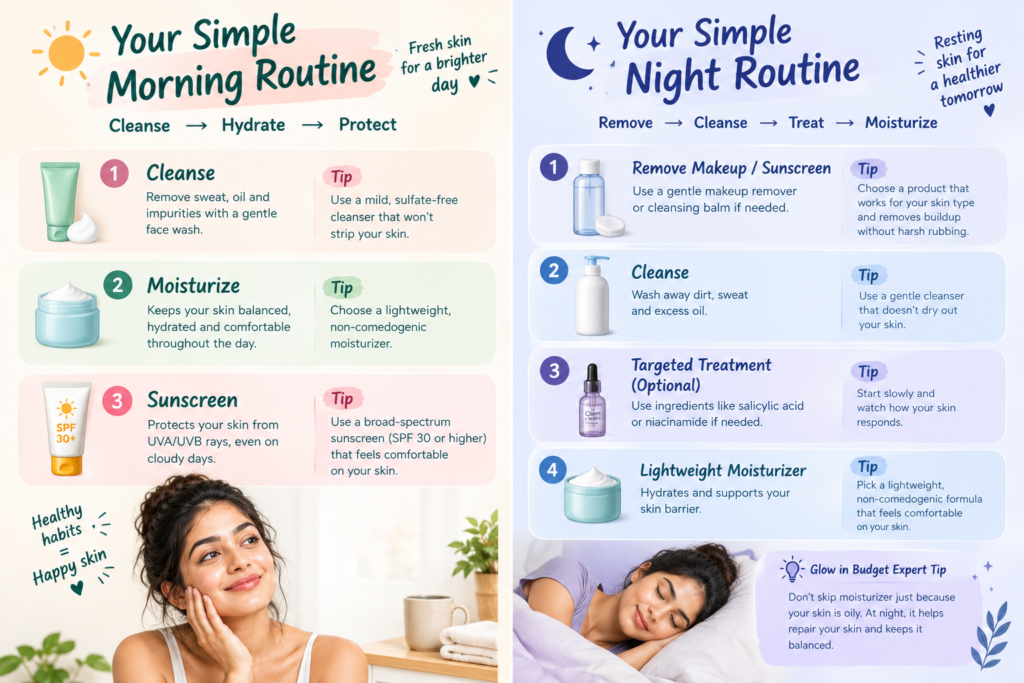
A good morning routine for oily skin in humid weather should be simple, lightweight, and consistent. The goal is to remove overnight buildup, provide enough hydration, protect your skin from UV exposure, and manage excess shine without making your skin feel dry or stripped.
You don’t need a long list of products. A few well-chosen steps can be enough for most people.
1. Start With a Gentle Cleanser
Begin your morning with a gentle cleanser to remove excess oil, sweat, and overnight buildup. The American Academy of Dermatology’s face-washing guidance also recommends using a gentle, non-abrasive cleanser, avoiding scrubbing, and limiting face washing to twice daily plus after heavy sweating.
Look for a cleanser that leaves your skin feeling clean but comfortable rather than tight or squeaky. If your skin is very oily or acne-prone, a cleanser containing an appropriate oil- or acne-targeting ingredient may be useful, but stronger is not automatically better.
How to use: Wet your face with lukewarm water, gently massage the cleanser over your skin, and rinse thoroughly. Avoid scrubbing or using very hot water.
2. Apply Lightweight Hydration
Oily skin still needs hydration, even when the weather feels hot and sticky.
Choose a lightweight moisturizer or hydrating product that feels comfortable on your skin. Gel or lightweight lotion textures can be particularly pleasant in humid weather.
If your skin feels tight after cleansing, don’t skip this step simply because your face becomes oily later.
3. Add a Targeted Treatment If Needed
If you have a specific concern such as excess oil, clogged pores, or acne, you can consider adding one suitable treatment to your routine.
For example, products containing ingredients such as niacinamide or salicylic acid may be useful for some people. However, you don’t need multiple active ingredients just because your skin is oily.
Start slowly and pay attention to how your skin responds.
4. Finish With Sunscreen
Sunscreen should be the final step of your morning skincare routine.
For more guidance on choosing sunscreen, the American Academy of Dermatology recommends broad-spectrum, water-resistant sunscreen with SPF 30 or higher.
Choose a broad-spectrum sunscreen with SPF 30 or higher that feels comfortable enough for everyday use. If you have oily or acne-prone skin, you may prefer a lightweight, non-comedogenic formula.
Apply enough sunscreen to adequately cover exposed skin, including commonly missed areas such as the ears and neck.
Simple Morning Routine at a Glance
Cleanser → Lightweight hydration → Optional targeted treatment → Sunscreen
That’s it. You don’t need to keep adding products simply because your skin becomes shiny during the day.
✨ Glow In Budget Expert Tip
Don’t skip moisturizer because your skin is oily. If your routine leaves your skin tight and uncomfortable, adding lightweight hydration may actually make the routine easier to tolerate than constantly increasing oil-control products.
How to Control Excess Oil During the Day
Even with a good morning skincare routine, oily skin can become shiny again as the day goes on—especially in hot and humid weather. Instead of repeatedly washing your face or using harsh oil-control products, focus on simple ways to manage shine while keeping your skin comfortable.
1. Use Blotting Papers When Needed
Blotting papers can help absorb excess surface oil without requiring you to wash your face again.
Gently press the paper onto oily areas such as the forehead, nose, and chin. Avoid rubbing, as friction can irritate the skin.
2. Avoid Washing Your Face Repeatedly
It may feel tempting to cleanse your face every time it becomes shiny, but frequent washing can leave the skin irritated and uncomfortable.
For most people, cleansing in the morning and evening is sufficient. If you become sweaty after exercise or outdoor activity, rinsing or cleansing appropriately may be helpful.
3. Keep Touching to a Minimum
Touching your face frequently can transfer oil, dirt, and other substances from your hands onto your skin. Try to avoid constantly wiping, rubbing, or squeezing oily areas.
If you need to wipe away sweat, gently pat rather than aggressively rubbing your skin.
4. Reapply Sunscreen
If you’re spending time outdoors, remember that sunscreen protection needs to be maintained according to the product’s directions and your activities.
When reapplying, choose a sunscreen texture that works comfortably with your oily skin so you’re more likely to use it consistently.
5. Don’t Add Too Many Oil-Control Products
When your face becomes shiny, adding another mattifying product, powder, serum, or treatment may seem like the quickest solution. But layering too many products can make your skin feel heavy or irritated.
Keep your daytime routine simple and adjust only what you actually need.
6. Stay Mindful of Sweat and Humidity
After exercising or spending a long time outdoors, gently cleanse or rinse your face when appropriate rather than allowing sweat and buildup to sit on the skin for extended periods.
Also, avoid sharing towels and use a clean towel to gently pat your face dry.
A Simple Daytime Oil-Control Approach
Blot excess oil → Avoid unnecessary cleansing → Don’t touch or squeeze → Reapply sunscreen when needed → Keep products lightweight
The goal isn’t to keep your face completely matte all day. Some shine is normal for oily skin, and trying to eliminate it completely can lead to an unnecessarily aggressive routine.
✨ Glow In Budget Expert Tip
A little shine doesn’t mean your skincare routine has failed. If your skin feels comfortable and isn’t becoming increasingly irritated or congested, you don’t need to keep removing oil every few hours.
Night Skincare Routine for Oily Skin
Your nighttime routine is a good opportunity to remove the day’s buildup and give your skin a chance to recover. For oily skin, the goal is not to use the strongest oil-control products possible. Instead, keep your routine gentle, lightweight, and consistent.
During the day, your skin may collect excess oil, sweat, sunscreen, makeup, and environmental residue. A simple night routine can help remove this buildup without unnecessarily irritating the skin.
1. Remove Makeup and Sunscreen
If you wore makeup or sunscreen during the day, start by thoroughly removing it before cleansing.
You can use a suitable makeup remover or cleansing product that works for your skin. Avoid aggressively rubbing the skin, particularly around the eyes and other sensitive areas.
2. Cleanse Your Skin Gently
Follow with a gentle cleanser to remove remaining oil, sweat, and daily buildup.
Massage the cleanser gently over your face and rinse with lukewarm water. There is no need to scrub your skin to make it feel extra clean.
If you exercised or became particularly sweaty during the day, cleansing appropriately afterward can also help remove sweat and buildup.
3. Apply a Lightweight Treatment If Needed
Nighttime can be a convenient time to use a targeted treatment if you have a specific concern such as clogged pores, excess oil, or acne.
Depending on your skin and the product, ingredients such as salicylic acid, niacinamide, or other appropriate treatments may be useful for some people.
However, avoid introducing several active ingredients at once. Start with one suitable product and give your skin time to adjust.
4. Finish With a Lightweight Moisturizer
Even oily skin benefits from nighttime hydration.
Choose a lightweight, non-comedogenic moisturizer that helps keep your skin comfortable without feeling excessively heavy. A gel or lightweight lotion may feel particularly comfortable in humid weather.
If your skin feels tight or flaky after cleansing, this step becomes even more important.
Simple Night Routine at a Glance
Remove makeup/sunscreen → Gentle cleanser → Optional targeted treatment → Lightweight moisturizer
You don’t need a complicated nighttime routine to care for oily skin effectively. Consistency is generally more useful than constantly adding new products.
✨ Glow In Budget Expert Tip
Don’t go to bed with the mindset that oily skin needs to be completely “dried out.” A comfortable, hydrated skin barrier is still important. If your face feels tight, burning, or excessively dry after your nighttime routine, it’s a sign to reconsider how aggressive your products are.
Weekly Skincare Routine for Oily Skin
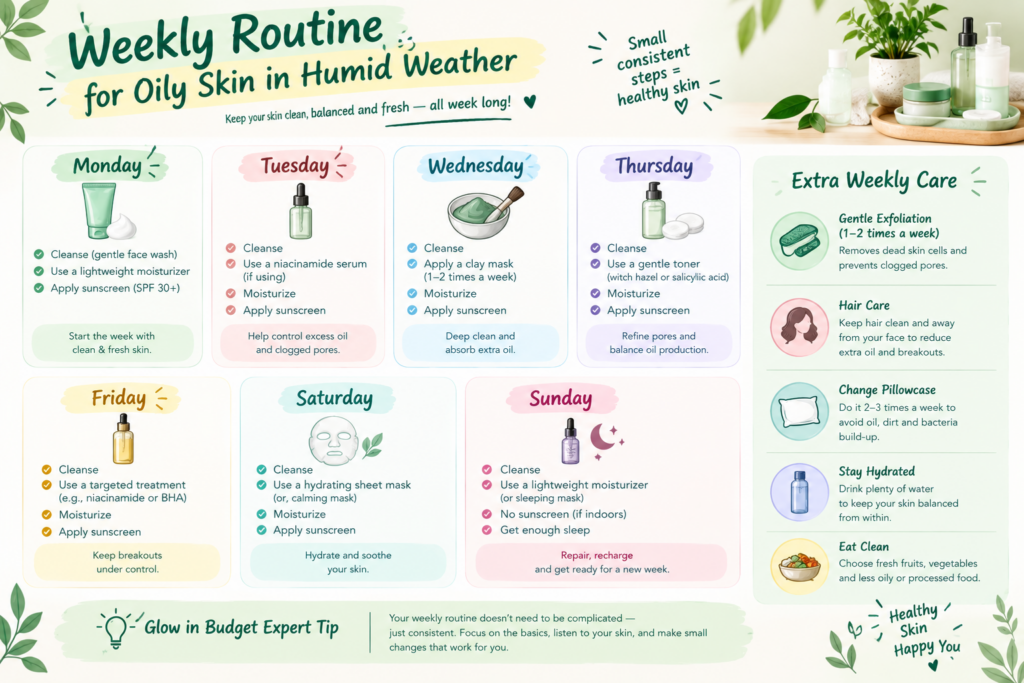
Your daily morning and night routine does most of the work when it comes to caring for oily skin. A weekly routine should simply provide a little extra care when your skin needs it, rather than adding several strong treatments.
The biggest mistake is assuming that oily skin needs frequent scrubbing, clay masks, or aggressive exfoliation. Too much exfoliation can leave the skin irritated, dry, or uncomfortable.
1. Exfoliate Gently If Your Skin Needs It
If your skin produces significantly more oil than usual, you may also find our guide to DIY Face Masks for Extremely Oily Skin in Humid Weather helpful for additional ideas.
Ingredients such as salicylic acid (BHA) are commonly used in products designed for oily or congestion-prone skin because they can help exfoliate inside pores.
However, you don’t need to exfoliate every day. Start according to the product’s directions and your skin’s tolerance.
Avoid: harsh scrubs, rough brushes, or vigorous rubbing.
2. Use a Clay Mask Occasionally
A clay mask can be an optional addition for people who enjoy a temporary oil-absorbing effect.
Apply it according to the product instructions and don’t leave it on until your skin becomes extremely dry or uncomfortable.
If you enjoy adding occasional masks to your routine, you can also explore our guide to DIY face masks for oily skin in humid weather for simple options and usage tips.
A clay mask is not a replacement for your regular cleanser or moisturizer, and you don’t need to use one several times a week simply because your skin is oily.
3. Give Your Skin Extra Hydration When Needed
Weekly care doesn’t always have to mean oil control.
If your skin feels tight, flaky, or irritated, skip exfoliation and focus on gentle cleansing and hydration instead.
A lightweight hydrating mask or moisturizer can be a more appropriate choice when your skin needs comfort rather than additional exfoliation.
4. Keep Your Routine Simple
You don’t need to schedule several different masks and exfoliating treatments throughout the week.
A simple approach could look like:
Daily:
Gentle cleansing → Lightweight hydration → Sunscreen in the morning
1–2 times a week, only if needed and tolerated:
One suitable exfoliating treatment or another targeted treatment
Occasionally:
Clay mask if your skin enjoys it
The exact frequency depends on the product, your skin’s tolerance, and whether you have other active ingredients in your routine.
Important Note for Acne-Prone or Sensitive Skin
If you regularly experience painful acne, persistent irritation, or significant sensitivity, adding more DIY treatments or strong exfoliants isn’t necessarily the answer.
In these situations, a simple routine may be preferable, and persistent or severe acne is worth discussing with a dermatologist.
✨ Glow In Budget Expert Tip
More weekly treatments don’t mean better results. For oily skin, consistency with a gentle daily routine is usually more valuable than constantly trying to “deep clean” your pores. If your skin becomes red, tight, flaky, or irritated, reduce the extra treatments rather than adding more.
Ingredients That Work Well for Oily Skin
Choosing skincare based on ingredients can make it easier to build a routine that works for oily skin, especially in hot and humid weather. You don’t need to use every ingredient listed below. The right choice depends on your skin concerns, sensitivity, and the rest of your routine.
1. Salicylic Acid
Salicylic acid is a beta hydroxy acid (BHA) commonly used in products designed for oily and congestion-prone skin.
It can help exfoliate dead skin cells and is particularly useful when clogged pores and excess oil are concerns.
If you’re new to salicylic acid, start with a product and frequency appropriate for your skin rather than using it too often.
If you’re considering salicylic acid for clogged pores or acne, the American Academy of Dermatology explains how this ingredient is used in acne treatment.
2. Niacinamide
Niacinamide, a form of vitamin B3, is a popular ingredient in skincare for oily and combination skin.
It can support the skin barrier and may help improve the appearance of excess oil and enlarged-looking pores for some people.
It is also generally easy to incorporate into a simple routine when used in a suitable formulation.
3. Hyaluronic Acid
Despite its name, hyaluronic acid is not an exfoliating acid. It is a humectant that helps attract and retain water.
This can make it useful for oily skin that still feels dehydrated, tight, or uncomfortable—particularly when you are using products designed to manage oil or congestion.
Look for lightweight formulations that don’t feel heavy on your skin.
4. Glycerin
Glycerin is another humectant commonly found in moisturizers and hydrating skincare products.
It can help support skin hydration without requiring a rich or heavy texture, making it a useful ingredient for people who prefer lightweight skincare.
5. Ceramides
Ceramides are lipids naturally found in the skin barrier.
A moisturizer containing ceramides can be useful when oily skin also feels dry, tight, or irritated, especially if you have been using exfoliating or oil-control products.
6. Lightweight, Non-Comedogenic Moisturizing Ingredients
Rather than focusing only on one “oily skin ingredient,” pay attention to the overall formulation.
A lightweight moisturizer labeled non-comedogenic may be a comfortable choice for some people with oily or acne-prone skin. However, “non-comedogenic” does not guarantee that a product will never cause breakouts for every individual.
Ingredient Compatibility: What Can You Use Together?
You don’t necessarily need to separate every skincare ingredient. Many ingredients can be used together comfortably when they are formulated appropriately.
Generally compatible combinations include:
- Niacinamide + hyaluronic acid: A simple combination for hydration and barrier support.
- Niacinamide + salicylic acid: These can often be used in the same routine, particularly in well-formulated products. If your skin is sensitive, introduce them gradually rather than starting both at once.
- Hyaluronic acid + salicylic acid: Hydrating ingredients can complement an exfoliating routine and may help reduce the feeling of dryness or tightness.
- Ceramides + active ingredients: A ceramide-containing moisturizer can be used alongside treatments such as salicylic acid to support the skin barrier.
Combinations to Introduce Carefully
The main concern isn’t that ingredients are always “incompatible.” Using several potentially irritating actives together can simply be too much for your skin.
For example:
- Salicylic acid + other exfoliating acids: Using multiple exfoliants together can increase irritation.
- Salicylic acid + strong retinoid products: These may be used in some routines, but introducing both aggressively can cause dryness or irritation.
- Multiple active serums: Layering several oil-control, exfoliating, or acne-focused products can make it difficult to identify what is irritating your skin.
If you’re using multiple active ingredients, consider introducing them one at a time or using them on different days.
A Simple Compatibility Guide
| Ingredient | Pairs Well With | Be Careful With |
|---|---|---|
| Salicylic acid | Niacinamide, hyaluronic acid, ceramides | Multiple exfoliants, strong retinoids |
| Niacinamide | Hyaluronic acid, salicylic acid, ceramides | Usually well tolerated, but introduce new products gradually |
| Hyaluronic acid | Most hydrating and active ingredients | Usually few compatibility concerns |
| Glycerin | Most skincare ingredients | Usually few compatibility concerns |
| Ceramides | Most active ingredients | Usually few compatibility concerns |
Remember: Product formulation matters, and “can be used together” doesn’t mean every person’s skin will tolerate the combination. If you’re already using prescription treatments or stronger acne products, follow your dermatologist’s instructions rather than changing your routine based only on an ingredient chart.
How to Choose Without Overcomplicating Your Routine
You don’t need a serum for every concern.
A simple approach is:
For excess oil or clogged pores: Consider salicylic acid.
For oiliness and barrier support: Consider niacinamide.
For dehydration: Look for humectants such as glycerin or hyaluronic acid.
For barrier support: Look for ingredients such as ceramides.
Always introduce new active ingredients gradually, especially if your skin is sensitive or you’re already using other treatments.
If your oily skin is also easily irritated or sensitive, you can read our guide to DIY Face Masks for Sensitive Skin in Humid Weather for gentler options and practical precautions.
✨ Glow In Budget Expert Tip
Don’t build your routine by collecting ingredients. Start with the basics, add one targeted active if you need it, and give your skin time to respond. More actives don’t automatically mean better results—and in humid weather, keeping your routine simple can make it much easier to stay consistent.
Ingredients and Habits to Avoid
Managing oily skin doesn’t mean avoiding every rich ingredient or using the strongest oil-control products you can find. In humid weather, over-treating your skin can sometimes create more irritation than benefit.
Instead of looking for a long list of “bad” ingredients, focus on avoiding products and habits that repeatedly leave your skin irritated, excessively dry, or uncomfortable.
1. Harsh Physical Scrubs
Rough face scrubs, abrasive particles, and vigorous rubbing can irritate the skin.
If you want to exfoliate, a suitable chemical exfoliant may be a gentler option for some people. Avoid using physical exfoliation simply to make oily skin feel “squeaky clean.”
2. Overusing Alcohol-Based or Very Drying Products
Some products formulated to create an immediate matte or dry feeling can leave the skin uncomfortable.
If a product consistently causes tightness, burning, excessive dryness, or flaking, it may not be a good fit for your routine—even if it is marketed specifically for oily skin.
3. Too Many Exfoliating Actives
Using several exfoliating products together can increase the risk of irritation.
For example, combining multiple acids, frequent exfoliation, and other strong treatments may be unnecessarily aggressive.
Choose one targeted approach at a time and introduce new products gradually.
4. Heavy Product Layering
Humid weather can already make skincare feel heavier on the skin.
Layering multiple serums, rich moisturizers, facial oils, primers, and other products can leave your skin feeling greasy or uncomfortable.
A shorter routine is often easier to maintain.
5. Pore-Squeezing and Picking
It can be tempting to squeeze blackheads, whiteheads, or pimples when they become more noticeable.
However, repeatedly picking or squeezing can irritate the skin and may increase the risk of marks or scarring.
Instead, use appropriate skincare consistently and avoid trying to manually remove every clogged pore.
6. Washing Your Face Too Often
Repeated cleansing may seem like an easy way to control shine, but it can leave your skin irritated or overly dry.
For most people, a gentle cleanse in the morning and evening is enough, with additional cleansing when genuinely needed—for example, after heavy sweating or exercise.
7. Skipping Moisturizer
One of the most common mistakes is assuming oily skin doesn’t need moisturizer.
Oily skin can still become dehydrated or irritated. A lightweight moisturizer can provide hydration without requiring a heavy texture.
8. Using Lemon Juice or Other DIY Irritants
Natural doesn’t automatically mean gentle.
Avoid experimenting with highly acidic kitchen ingredients such as lemon juice, or other DIY mixtures that can irritate the skin.
The same applies to harsh homemade scrubs made with coarse ingredients.
9. Trying Too Many New Products at Once
If you introduce several new products simultaneously and your skin reacts, it becomes difficult to know which product caused the problem.
Introduce new products gradually whenever possible and give your skin time to adjust.
Quick “Avoid” Checklist
- ❌ Harsh physical scrubs
- ❌ Excessive cleansing
- ❌ Aggressive pore squeezing
- ❌ Too many exfoliating actives
- ❌ Heavy product layering
- ❌ Products that repeatedly cause burning or irritation
- ❌ Harsh DIY ingredients such as lemon juice
- ❌ Changing several products at the same time
The goal isn’t to create a completely product-free routine. It’s to remove unnecessary steps that can make oily skin harder to manage.
✨ Glow In Budget Expert Tip
If your oily skin is becoming tight, flaky, burning, or unusually sensitive, don’t automatically add another oil-control product. Step back, simplify your routine, and focus on gentle cleansing, lightweight hydration, and sunscreen.
Common Mistakes to Avoid
Even with the right products, a few everyday habits can make oily skin harder to manage—especially during hot and humid weather. The goal isn’t to follow a complicated routine perfectly, but to avoid the mistakes that can unnecessarily irritate your skin or make your routine inconsistent.
1. Trying to Remove Every Trace of Oil
Some shine is completely normal for oily skin.
Constantly trying to make your skin completely matte can lead to excessive cleansing, overuse of oil-control products, or unnecessary irritation.
Better approach: Focus on comfortable, balanced skin rather than perfectly matte skin all day.
2. Skipping Moisturizer Because Your Skin Is Oily
This is one of the most common mistakes.
Oily skin can still become dehydrated or irritated. Skipping moisturizer may make your routine feel uncomfortable, particularly if you’re also using exfoliating or acne-focused products.
Better approach: Choose a lightweight moisturizer that feels comfortable on your skin.
3. Using Too Many Active Ingredients
Adding salicylic acid, exfoliating acids, retinoids, acne treatments, and multiple serums at the same time can quickly make a routine overwhelming.
It also becomes difficult to identify which product is causing irritation if your skin reacts.
Better approach: Introduce active ingredients gradually and avoid adding several new treatments at once.
4. Over-Exfoliating to Treat Clogged Pores
When pores look congested, it can be tempting to exfoliate more frequently.
But more exfoliation isn’t necessarily better. Excessive exfoliation can cause dryness, irritation, and sensitivity.
Better approach: Use an appropriate exfoliating product according to its directions and your skin’s tolerance.
5. Changing Your Routine Every Few Days
Skincare isn’t something you need to constantly reinvent.
Switching products frequently makes it difficult to understand what actually works for your skin.
Better approach: Keep your basic routine consistent and make changes one at a time when necessary.
6. Forgetting Sunscreen Because It’s Humid
A cloudy or humid day doesn’t mean your skin no longer needs sun protection.
Skipping sunscreen can undermine an otherwise sensible daytime skincare routine.
Better approach: Use a broad-spectrum sunscreen with SPF 30 or higher as part of your regular morning routine.
7. Touching, Picking, or Squeezing Your Skin
When oiliness or clogged pores become more noticeable, you may feel tempted to touch or squeeze the affected areas.
Repeated picking can irritate the skin and may increase the risk of lingering marks or scarring.
Better approach: Keep your hands away from your face and allow your skincare routine to do the work.
8. Copying Someone Else’s Oily-Skin Routine
A routine that works beautifully for one person may not work the same way for someone else.
Skin sensitivity, acne, climate, product formulations, and individual tolerance can all make a difference.
Better approach: Use other routines as inspiration, not as a strict prescription.
Quick Mistake Check
Before adding another product to your routine, ask yourself:
- Am I cleansing more often because I’m worried about shine?
- Is my skin feeling tight, flaky, burning, or irritated?
- Am I using several active ingredients at once?
- Am I skipping moisturizer because my skin is oily?
- Am I exfoliating more often because my pores look clogged?
- Am I changing products before giving my routine enough time to settle?
If you answered “yes” to several of these, simplifying your routine may be more useful than adding another oil-control product.
✨ Glow In Budget Expert Tip
When oily skin suddenly becomes difficult to manage, look at what you’ve added or changed recently before adding something else. Sometimes the best improvement comes from removing unnecessary steps and returning to a simple, consistent routine.
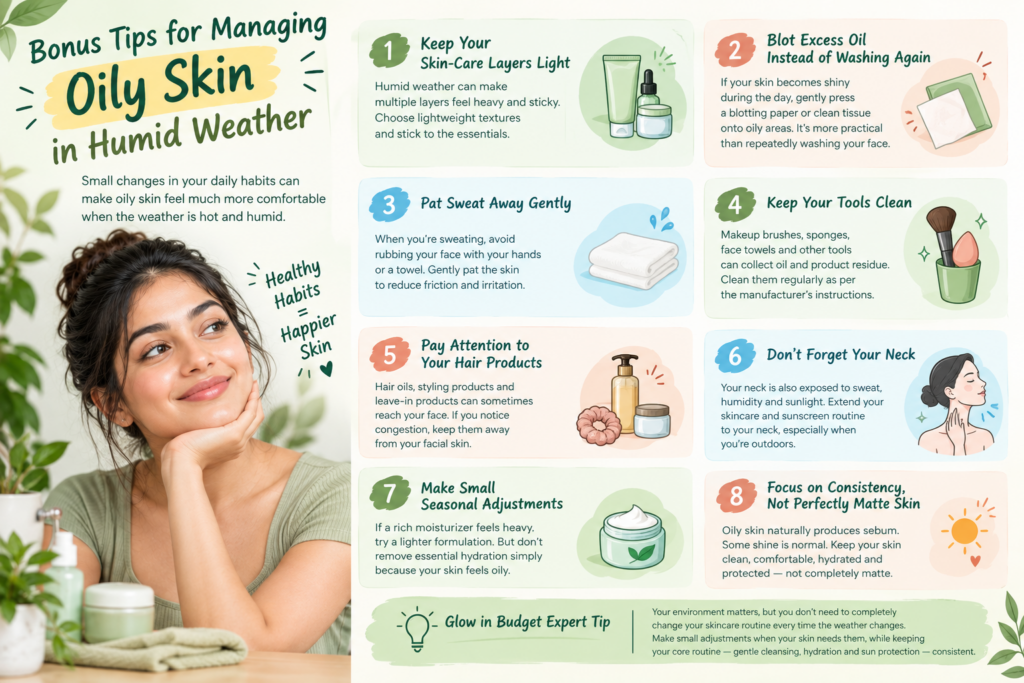
Bonus Tips for Managing Oily Skin in Humid Weather
Along with a consistent skincare routine, a few simple daily habits can make oily skin feel more comfortable during hot and humid weather. These tips won’t eliminate natural oil production, but they can help reduce unnecessary buildup, irritation, and discomfort.
These simple oily skin care tips in humid weather can make your routine easier to manage without adding unnecessary products.
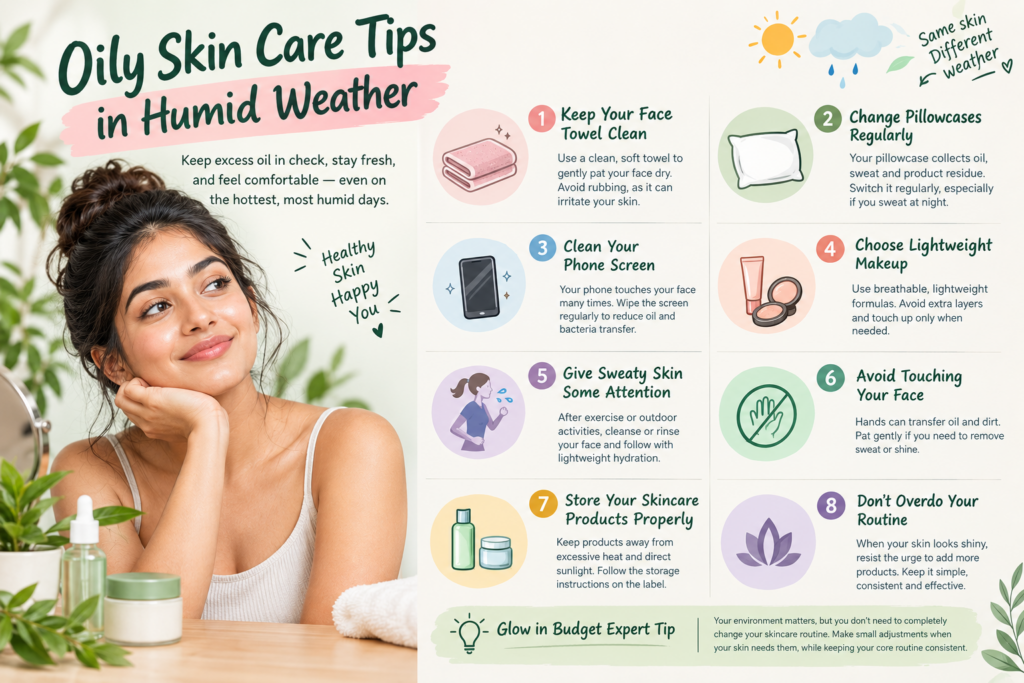
1. Keep Your Face Towel Clean
Use a clean, soft towel to gently pat your face dry after cleansing or washing away sweat.
Avoid rubbing your face aggressively, as repeated friction can irritate the skin.
2. Change Pillowcases Regularly
Your pillowcase can collect sweat, oil, hair products, and other residue over time.
Changing it regularly can be a simple hygiene habit, particularly if you tend to sweat at night.
3. Clean Your Phone Screen
Your phone comes into frequent contact with your hands and face.
Wiping the screen regularly can help reduce the amount of accumulated oil and residue that comes into contact with your skin.
4. Choose Lightweight Makeup
If you wear makeup, lightweight and breathable-feeling formulations may feel more comfortable in humid weather.
Avoid applying more layers simply to cover shine. Instead, use the amount of makeup you actually need and touch up only when necessary.
5. Give Sweaty Skin Some Attention After Exercise
After exercising or spending significant time outdoors, don’t leave sweat and buildup sitting on your skin unnecessarily.
Gently cleanse or rinse your face when appropriate, then follow with lightweight hydration if needed.
6. Avoid Constantly Touching Your Face
Resting your hands on your face, rubbing your forehead, or repeatedly wiping oily areas can transfer oil and other residue to your skin.
If you need to remove sweat or shine, gently pat rather than repeatedly rubbing.
7. Keep Your Skincare Products Stored Properly
Hot weather can affect how some skincare products feel and perform.
Follow the storage instructions on the product packaging and keep products away from excessive heat and direct sunlight unless the manufacturer specifies otherwise.
8. Don’t Let Humidity Make You Overdo Your Routine
This is perhaps the most important bonus tip.
When your skin looks extra shiny, it can be tempting to add another cleanser, mask, scrub, serum, or oil-control product.
Instead, pause and ask whether your skin actually needs another step.
Simple and consistent usually beats complicated and excessive.
Quick Humid-Weather Checklist
- ✔️ Keep towels and pillowcases clean
- ✔️ Clean your phone regularly
- ✔️ Pat sweat instead of aggressively rubbing
- ✔️ Keep makeup layers lightweight
- ✔️ Cleanse appropriately after heavy sweating
- ✔️ Avoid unnecessary face touching
- ✔️ Store skincare according to product instructions
- ✔️ Keep your overall routine simple
✨ Glow In Budget Expert Tip
Your environment matters, but you don’t need to completely change your skincare routine every time the weather changes. Make small adjustments when your skin needs them, while keeping your core routine—gentle cleansing, hydration, and sun protection—consistent.
FAQs About Oily Skin in Humid Weather
Below are some common questions about oily skin care tips in humid weather and how to keep your routine simple.
1. Why does my oily skin get worse in humid weather?
Hot and humid weather can make oily skin feel noticeably shinier and heavier. Increased sweating, slower evaporation of sweat, and naturally higher sebum production can make oil and moisture remain on the skin for longer.
Humidity doesn’t necessarily mean your skin is producing dramatically more oil, but the combination of heat, sweat, and sebum can make excess shine and congestion more noticeable.
2. Should I moisturize oily skin in humid weather?
Yes. Oily skin can still become dehydrated, so skipping moisturizer isn’t usually necessary.
Choose a lightweight moisturizer that feels comfortable on your skin. If your face feels tight, flaky, or uncomfortable after cleansing, that’s a good reason to pay particular attention to hydration.
3. How often should I wash my face if I have oily skin?
For most people, cleansing twice a day—morning and evening—is a reasonable starting point.
You may also need to cleanse after activities that cause significant sweating, such as exercise. However, repeatedly washing your face simply because it looks shiny can lead to irritation and discomfort.
4. Is sunscreen necessary for oily skin in humid weather?
Yes. Oily skin still needs daily sun protection.
Choose a broad-spectrum sunscreen with SPF 30 or higher that feels comfortable enough for regular use. A lightweight or non-comedogenic formulation may be preferable if heavier products make your skin feel greasy or congested.
5. What is the best skincare routine for oily skin in humid weather?
A simple routine is often enough:
Morning:
Gentle cleanser → Lightweight moisturizer → Sunscreen
Night:
Remove makeup/sunscreen → Gentle cleanser → Optional targeted treatment → Lightweight moisturizer
If you have a specific concern such as clogged pores or acne, you can add an appropriate treatment gradually rather than using several active ingredients at once.
6. Can I use salicylic acid if I have oily skin?
Salicylic acid can be useful for some people with oily or congestion-prone skin because it helps exfoliate dead skin cells and can help with clogged pores.
However, using it more frequently isn’t automatically better. Follow the product’s directions and reduce or stop use if your skin becomes excessively dry, irritated, or uncomfortable.
7. Why is my skin oily but still feels dry or tight?
Oily skin can still lack enough water or become irritated by an overly aggressive skincare routine.
If your skin looks shiny but feels tight, flaky, burning, or uncomfortable, consider whether you’re over-cleansing, over-exfoliating, or using too many drying products.
A gentler cleanser and lightweight moisturizer may be more appropriate than adding another oil-control product.
8. What should I do if my oily skin keeps breaking out in humid weather?
Start with a simple, consistent routine focused on gentle cleansing, appropriate hydration, sunscreen, and products that suit your skin.
Avoid repeatedly squeezing pimples or adding multiple acne treatments at once. If breakouts are persistent, painful, severe, or leaving significant marks or scars, consider speaking with a dermatologist for individualized advice.
✨ Glow In Budget Expert Tip
Don’t judge your skincare routine by how matte your skin looks. A healthy routine should leave oily skin feeling comfortable and balanced—not stripped, tight, or irritated. In humid weather, consistency and simplicity can be more useful than constantly adding stronger oil-control products.
Final Thoughts
Managing oily skin in humid weather doesn’t require a complicated skincare routine or a shelf full of oil-control products. The key is to find a balance between controlling excess shine and keeping your skin comfortable, hydrated, and protected.
Focus on the basics: gentle cleansing, lightweight hydration, daily sunscreen, appropriate treatments, and consistent habits. Avoid over-washing, harsh scrubbing, excessive exfoliation, and constantly adding new products whenever your skin looks shiny.
Remember that some shine is completely normal for oily skin. Instead of trying to make your face completely matte all day, aim for skin that feels clean, balanced, comfortable, and healthy.
With the right routine and a few simple adjustments, these oily skin care tips in humid weather can help you manage excess oil and keep your skin feeling fresher throughout hot and humid days.
✨ Glow In Budget Expert Tip
Your skincare routine doesn’t need to be perfect—it needs to be consistent. Start with the essentials, listen to how your skin responds, and make small changes instead of constantly chasing new products.
Follow Glow In Budget
Found this guide helpful?
Follow @glowinbudget for more affordable beauty, skincare, hair care, and self-care tips. We regularly share practical routines, expert-backed advice, and budget-friendly solutions to help you look and feel your best—without overspending.