Introduction
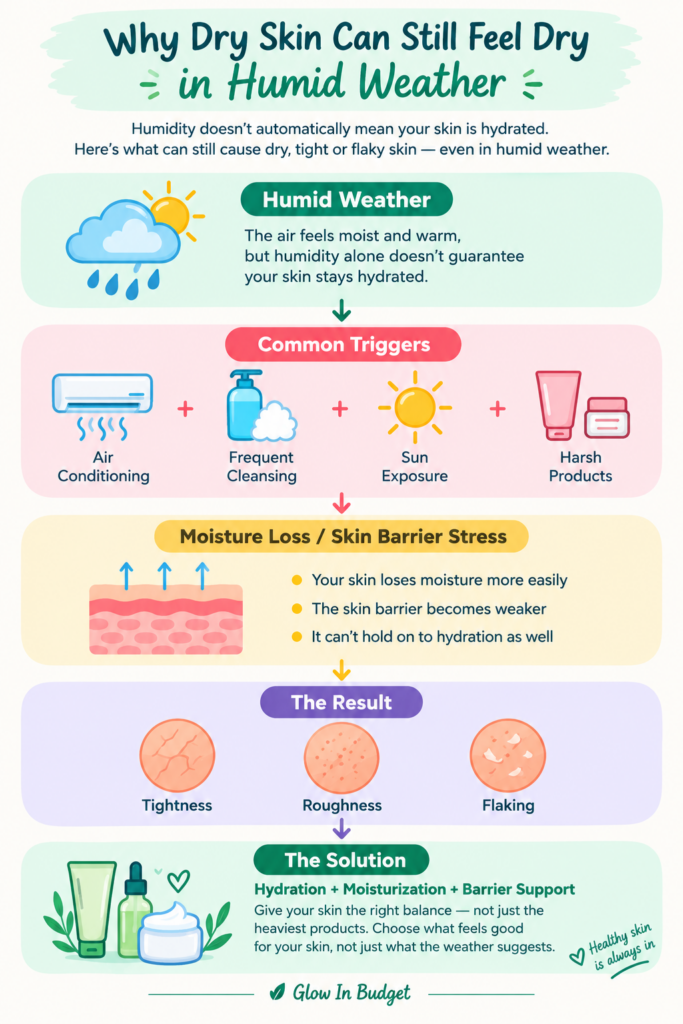
Humid weather can make skincare feel confusing when you have dry skin. The air may feel warm and moist, yet your skin can still feel tight, rough, flaky, or uncomfortable. Humidity alone does not mean your skin is getting all the hydration and moisture it needs.
Your skin can continue to lose moisture or become irritated because of frequent cleansing, hot showers, sun exposure, air conditioning, or skincare products that are too harsh. At the same time, using an extremely rich routine simply because your skin is dry can leave you feeling sticky and uncomfortable when the weather is hot and humid.
That is why dry skin care in humid weather is about finding the right balance—not choosing the heaviest products possible. Your routine should provide enough hydration, support the skin barrier, protect against environmental stress, and still feel comfortable throughout the day.
In this guide, we’ll walk through a simple morning and night skincare routine for dry skin in humid weather, how to choose comfortable moisturizing textures and helpful ingredients, how to adjust your routine during monsoon and very humid days, and the common mistakes that can make dry skin feel worse.
Why Does Dry Skin Still Need Care in Humid Weather?
It is easy to assume that humid weather should automatically make dry skin feel better. After all, humid air contains more moisture. But humidity alone does not guarantee that your skin will stay hydrated or that its protective barrier will remain healthy.
Your skin can still feel tight, rough, flaky, or uncomfortable during hot and humid weather. Things such as frequent cleansing, hot showers, sun exposure, air conditioning, and harsh skincare products can all contribute to moisture loss or irritation.
Even in hot and humid weather, factors such as air conditioning, sun exposure, and swimming can contribute to dry or irritated skin. The American Academy of Dermatology also recommends gentle cleansing, moisturizing, and sun protection for managing dry skin during summer.
That is why dry skin care in humid weather is less about using the richest products possible and more about maintaining a healthy balance between hydration, moisturization, and barrier support.
Humidity Doesn’t Automatically Hydrate Your Skin
Humid air may reduce some moisture loss from the skin compared with very dry air, but that does not mean your skin is fully hydrated.
If your skin barrier is weakened, or if you are frequently washing your face or using irritating products, your skin can still lose moisture and feel dry. Humidity also does not replace the need for a moisturizer.
For dry skin, the goal is to give the skin consistent hydration and help reduce unnecessary moisture loss while choosing products that feel comfortable in a humid climate.
Why Dry Skin Can Still Feel Tight, Rough or Flaky
Dry skin can become uncomfortable when it does not have enough water and lipids to maintain a healthy barrier. You may notice tightness after cleansing, rough patches, visible flaking, or an uncomfortable stretched feeling.
Hot showers, over-cleansing, strong soaps, frequent exfoliation, and products that irritate the skin can make these problems more noticeable—even when the weather itself is humid.
Sometimes skin may also look slightly shiny while still feeling dry or tight. Sweat and surface oil can create shine, but they do not necessarily mean your skin has received enough hydration or moisturization.
How Air Conditioning Can Affect Dry Skin
Air conditioning can be another reason dry skin feels uncomfortable during humid weather.
You may spend part of the day in humid outdoor air and several hours in an air-conditioned room. That change in environment can make your skin feel drier, particularly if you already have a tendency toward dryness.
If your skin feels tight after spending long periods in air conditioning, you may need to focus more consistently on gentle cleansing, hydration, and barrier-supporting moisturization rather than simply applying a very heavy cream.
✨ Glow In Budget Expert Tip
Don’t choose your skincare routine based only on the weather. Choose it based on how your skin is actually behaving.
If your skin feels tight or flaky, give it more hydration and barrier support. If it feels comfortable but heavy or sticky, reduce the amount or choose a lighter texture. The best dry skin routine for humid weather should adapt to your skin—not fight against the climate.
Signs Your Dry Skin Needs Extra Hydration in Humid Weather
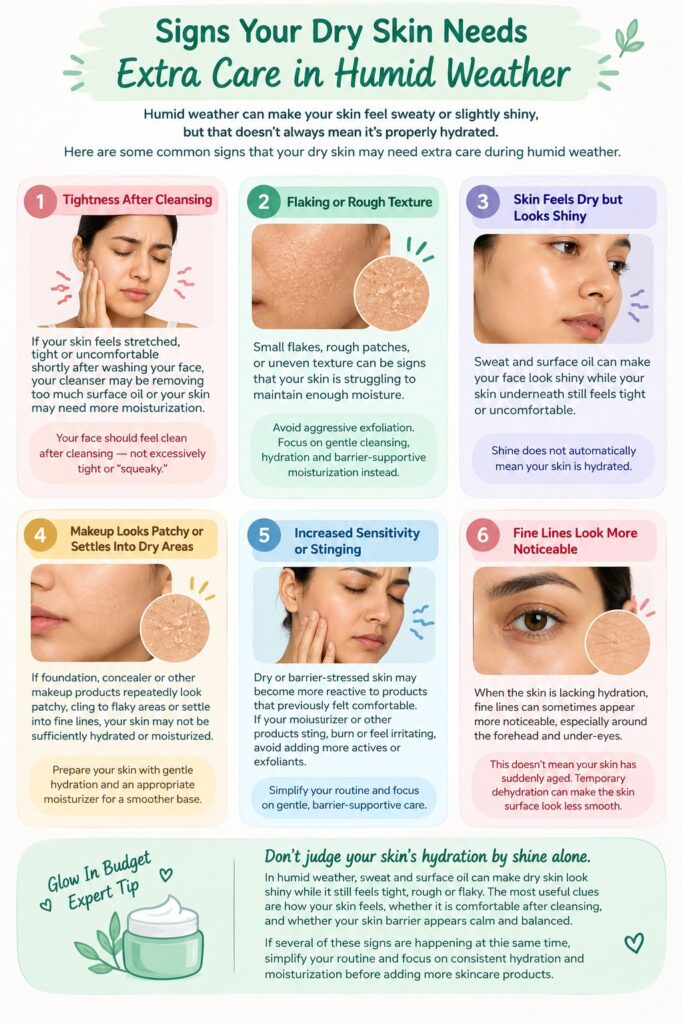
Humid weather can make your skin feel sweaty or slightly shiny, but that does not always mean it is properly hydrated. If you have dry skin, paying attention to how your skin feels and behaves can help you decide when your routine needs more hydration or barrier support.
Here are some common signs that your dry skin may need extra care during humid weather.
Tightness After Cleansing
If your skin feels stretched, tight, or uncomfortable shortly after washing your face, your cleanser may be removing too much surface oil or your skin may need more moisturization.
Your face should feel clean after cleansing—not excessively tight or “squeaky.”
Flaking or Rough Texture
Small flakes, rough patches, or uneven texture can be signs that your skin is struggling to maintain enough moisture.
Although it may be tempting to scrub away the flakes, aggressive exfoliation can make already-dry skin more irritated. Focus first on gentle cleansing, hydration, and barrier-supportive moisturization.
Skin Feels Dry but Looks Shiny
This can be particularly confusing during humid weather.
Sweat and surface oil can make your face look shiny while your skin underneath still feels tight or uncomfortable. Shine does not automatically mean your skin is hydrated.
Instead of removing every bit of shine with harsh cleansing, pay attention to whether your skin feels comfortable and moisturized.
Makeup Looks Patchy or Settles Into Dry Areas
If foundation, concealer, or other makeup products repeatedly look patchy, cling to flaky areas, or settle into fine lines, your skin may not be sufficiently hydrated or moisturized.
Preparing the skin with gentle hydration and an appropriate moisturizer can help create a smoother base.
Increased Sensitivity or Stinging
Dry or barrier-stressed skin may become more reactive to products that previously felt comfortable.
If your moisturizer or other skincare products suddenly sting, burn, or feel irritating, avoid adding more active ingredients or exfoliants. Simplifying your routine and focusing on gentle, barrier-supportive care may be more appropriate.
Fine Lines Look More Noticeable
When the skin is lacking hydration, fine lines can sometimes appear more noticeable, particularly around areas such as the forehead and under-eyes.
This does not necessarily mean your skin has suddenly aged. Temporary dehydration can make the skin surface look less smooth and make existing fine lines more visible.
✨ Glow In Budget Expert Tip
Don’t judge your skin’s hydration by shine alone.
In humid weather, sweat and surface oil can make dry skin look shiny while it still feels tight, rough, or flaky. The most useful clues are how your skin feels, whether it is comfortable after cleansing, and whether your skin barrier appears calm and balanced.
If several of these signs are happening at the same time, simplify your routine and focus on consistent hydration and moisturization before adding more skincare products.
How to Build a Dry Skin Care Routine for Humid Weather
The best dry skin care routine in humid weather should give your skin enough hydration and barrier support without making your face feel excessively heavy, greasy, or uncomfortable.
You do not need to completely change your routine just because the weather becomes humid. Instead, focus on gentle cleansing, lightweight hydration, comfortable moisturization, and daily sun protection. You can also adjust the amount and texture of your products depending on how your skin feels that day.
Step 1: Use a Gentle Cleanser
Start with a gentle cleanser that removes sweat, sunscreen, dirt, and excess buildup without leaving your skin feeling stripped.
If your skin feels tight or uncomfortable immediately after cleansing, that is a sign your cleanser or cleansing routine may be too harsh. Avoid unnecessarily strong cleansers, frequent washing, and very hot water, especially when your skin is already dry.
For most people with dry skin, cleansing gently is more helpful than trying to remove every trace of oil from the skin.
Step 2: Add Lightweight Hydration
After cleansing, apply a hydrating product if your skin benefits from one.
Ingredients such as glycerin and hyaluronic acid can help attract and hold water in the outer layers of the skin. A lightweight hydrating serum, essence, or lotion can be useful when you want extra hydration without adding a very thick layer.
You don’t need several hydrating products. One well-chosen layer is usually enough.
Step 3: Choose the Right Moisturizer
This is where humid-weather skincare becomes different from a typical dry-skin routine.
Dry skin still needs moisturizer, but you don’t necessarily need the heaviest cream all over your face.
Depending on your skin and the weather, you might prefer:
- A lightweight lotion for comfortable daily moisturization
- A gel-cream if you dislike heavy textures
- A light cream when your skin feels noticeably dry
- A richer cream only on particularly dry areas when needed
The goal is to find a moisturizer that leaves your skin comfortable and supported rather than greasy.
Step 4: Don’t Skip Sunscreen
Daily sun protection remains important even when the weather is cloudy, humid, or rainy.
Apply a broad-spectrum sunscreen as the final step of your morning skincare routine and choose a texture that you can comfortably wear every day.
If your moisturizer and sunscreen together feel too heavy, you can adjust the amount and texture of your moisturizer rather than skipping either step.
✨ Glow In Budget Expert Tip
Texture matters more than simply choosing the richest moisturizer.
Your dry skin may need consistent moisturization, but humid weather can make thick layers feel uncomfortable. Start with a comfortable amount, observe how your skin feels, and add more only where or when your skin actually needs it.
Think: hydrate → moisturize → protect, not “use the heaviest products possible.”
Morning Skincare Routine for Dry Skin in Humid Weather
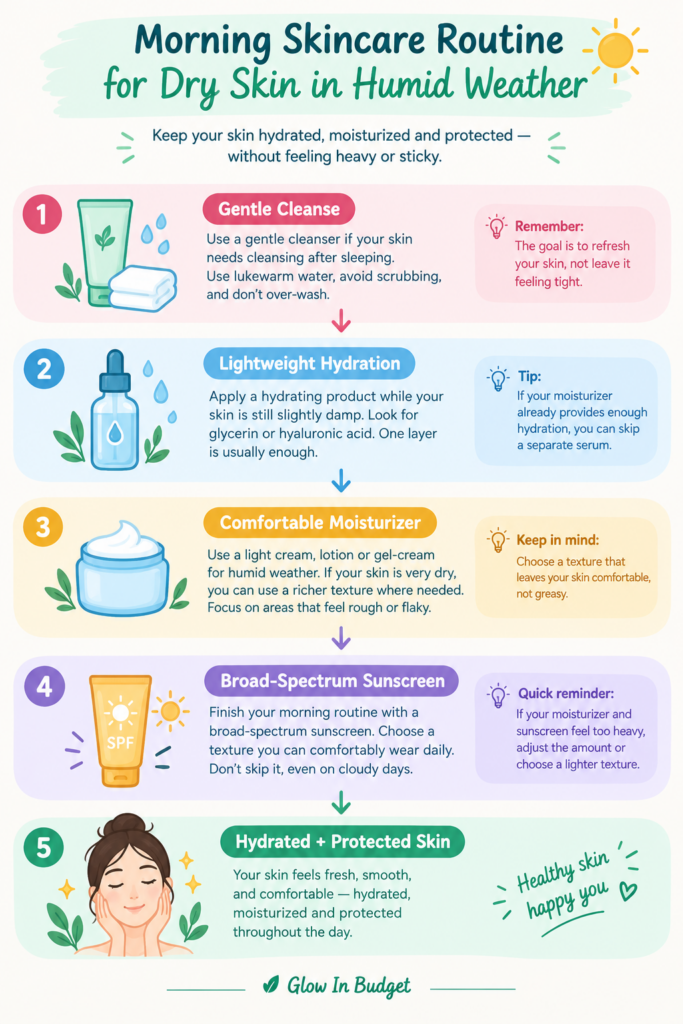
Your morning routine should keep dry skin hydrated, moisturized, and protected from the sun without creating a thick or sticky layer that feels uncomfortable in humid weather.
You don’t need a long list of products. A simple routine with the right textures is often easier to maintain and less likely to make your skin feel overloaded.
Step 1: Gentle Morning Cleanse
Start your morning with a gentle cleanser if your skin needs cleansing after sleeping.
Use lukewarm water rather than hot water, and avoid scrubbing your face. If your skin feels particularly dry and you don’t feel the need for a full cleanse, you can keep your morning cleansing routine very gentle.
The goal is to refresh your skin without leaving it feeling tight.
Step 2: Hydrating Layer
After cleansing, apply a lightweight hydrating product while your skin is still slightly damp.
Look for hydrating ingredients such as glycerin or hyaluronic acid if they work well for your skin. You only need a small amount—adding several layers of hydrating products is not necessary.
If your moisturizer already provides enough hydration, you can also skip a separate serum.
Step 3: Moisturizer
Apply a comfortable moisturizer to help support your skin barrier and reduce moisture loss.
In humid weather, a light cream, lotion, or gel-cream may feel more comfortable than a very thick cream. However, if your skin is genuinely very dry, you can use a richer texture where you need it.
Pay particular attention to areas that tend to become rough or flaky rather than automatically applying a large amount everywhere.
Step 4: Broad-Spectrum Sunscreen
Finish your morning routine with a broad-spectrum sunscreen.
Choose a sunscreen with a texture that feels comfortable enough for daily use. If your skin is dry, avoid choosing a sunscreen solely because it feels matte or drying.
Remember that sunscreen is not just a summer step—it should remain part of your daily routine whenever you have daytime sun exposure.
How to Keep Your Morning Routine Comfortable
If your skin feels greasy or sticky during humid weather, don’t immediately stop moisturizing.
Instead:
- Reduce the amount of moisturizer slightly.
- Choose a lighter moisturizer texture.
- Allow your hydrating layer to absorb before moisturizing.
- Avoid unnecessary multiple serum layers.
- Use richer moisturizer only on areas that actually need it.
- Give each skincare layer a little time before applying the next one.
This allows you to maintain hydration without making your morning routine feel heavy.
✨ Glow In Budget Expert Tip
Your morning routine doesn’t need to feel heavy to be effective.
For dry skin in humid weather, focus on gentle cleansing → hydration → comfortable moisturization → sunscreen. If your skin feels greasy, adjust the texture or amount before removing moisturizer completely.
Night Skincare Routine for Dry Skin in Humid Weather
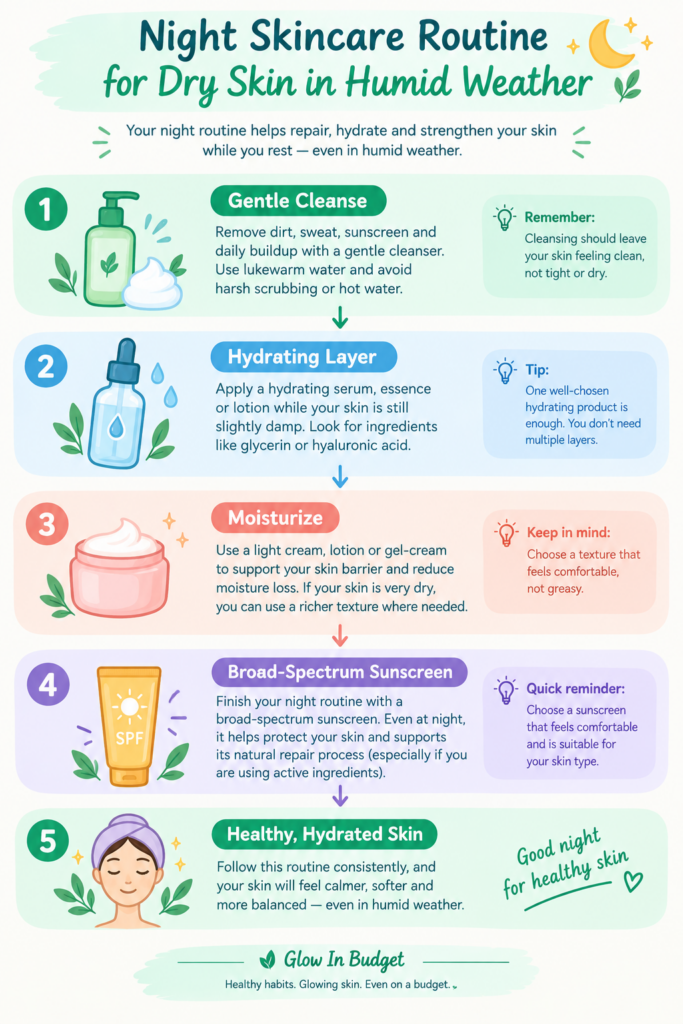
Nighttime is a good opportunity to replenish moisture and support your skin barrier after a day of cleansing, sun exposure, heat, and environmental stress. However, dry skin does not automatically need a thick, multi-layered routine at night, especially when the weather is humid.
The goal is simple: remove the day’s buildup gently, add hydration if needed, and moisturize enough to keep your skin comfortable overnight.
Step 1: Remove Sunscreen and Makeup
If you wore sunscreen or makeup during the day, start by gently removing it before cleansing.
Choose a method that effectively removes the products without excessive rubbing. Avoid repeatedly scrubbing your skin to make sure every trace is gone, as this can leave dry skin feeling irritated.
Step 2: Use a Gentle Cleanser
Follow with a gentle cleanser to remove remaining sunscreen, makeup residue, sweat, and dirt.
Use lukewarm water and keep cleansing gentle. Your skin should feel clean and comfortable afterward—not tight, squeaky, or stripped.
Step 3: Add a Hydrating Product — Optional
If your skin still feels tight or dehydrated after cleansing, you can add a lightweight hydrating serum or lotion.
Ingredients such as glycerin or hyaluronic acid can provide additional hydration.
However, this step is optional. If your moisturizer already keeps your skin comfortable, you don’t need to add another product simply because it is nighttime.
Step 4: Apply Moisturizer
Apply your moisturizer while your skin is slightly damp or after your hydrating layer has settled.
Choose the texture according to how your skin feels that evening. A light cream or lotion may be enough on comfortable nights, while a richer cream can be useful when your skin feels particularly dry.
Step 5: Give Extra Care to Very Dry Areas
If certain areas—such as around the mouth, cheeks, or sides of the nose—become especially dry, you can apply a little more moisturizer to those areas.
You don’t necessarily need to use a heavy product over your entire face.
This targeted approach can help dry areas receive additional support while keeping the rest of your face comfortable in humid weather.
✨ Glow In Budget Expert Tip
Nighttime doesn’t mean “the heavier, the better.”
If your skin feels comfortable, keep your routine simple. When certain areas become dry or flaky, increase moisturization where needed instead of automatically layering several rich products over your entire face.
How to Choose Skincare Ingredients for Dry Skin in Humid Weather
Choosing skincare ingredients for dry skin in humid weather is not about collecting as many hydrating products as possible. What matters more is understanding what each type of ingredient does and choosing a combination that keeps your skin comfortable without creating an unnecessarily heavy routine.
A simple approach is to think about hydration, moisturization, and barrier support rather than focusing on one “best” ingredient.
Humectants
Humectants help attract and hold water in the outer layers of the skin.
Common examples include:
- Glycerin
- Hyaluronic acid
- Urea
These ingredients can be useful when dry skin feels tight or dehydrated. A lightweight hydrating serum or lotion containing one or more humectants can add hydration without necessarily making your routine feel greasy.
However, you don’t need several humectant-rich products layered together. One well-formulated product may be enough.
Emollients
Emollients help soften and smooth the skin by filling in spaces between skin cells.
They can be particularly helpful when dry skin feels rough, flaky, or uncomfortable.
Examples include various plant oils, fatty acids, and other skin-softening ingredients found in moisturizers.
In humid weather, you can still benefit from emollients, but the ideal texture may be lighter than the rich products you might prefer during a very dry winter.
Occlusives
Occlusives help reduce water loss from the skin by forming a protective layer on its surface.
Ingredients in this category can include petrolatum, mineral oil, and certain waxes or silicones.
Occlusive ingredients can be especially useful when your skin is very dry or when certain areas are prone to cracking or flaking. However, you don’t necessarily need a highly occlusive product over your entire face every day in humid weather.
Instead, consider using a richer product only where your skin actually needs extra protection.
Ceramides and Barrier-Supporting Ingredients
Ceramides are lipids naturally found in the skin barrier. Moisturizers containing ceramides and other barrier-supporting ingredients can be useful when dry skin feels rough, tight, or easily irritated.
A healthy skin barrier helps your skin retain moisture and better tolerate everyday environmental exposure.
If your skin is frequently irritated, keeping your routine simple and choosing gentle, barrier-supportive products may be more useful than continuously adding new active ingredients.
✨ Glow In Budget Expert Tip
You don’t need every hydrating ingredient in one routine.
A simple combination such as a humectant + moisturizer with emollient/barrier-supporting ingredients may be enough for many people with dry skin.
In humid weather, focus on what your skin needs and what feels comfortable, rather than building the longest possible skincare routine.
How Often Should You Moisturize Dry Skin in Humid Weather?
Humid weather does not mean you need to stop moisturizing. If you have dry skin, regular moisturization helps keep your skin comfortable and supports its protective barrier.
The right frequency depends on how your skin feels, the products you use, and how much time you spend in environments such as air-conditioned rooms.
Moisturize After Cleansing
A good starting point is to moisturize after cleansing, especially when your skin feels tight or dry afterward.
Applying moisturizer while the skin is slightly damp can help maintain a comfortable level of moisture and reduce that tight feeling after washing.
Moisturize in the Morning
Include moisturizer in your morning routine before sunscreen.
If your skin feels comfortable with a lightweight lotion or gel-cream, you don’t need to use a thick layer. If certain areas remain dry, you can apply a little more moisturizer specifically to those areas.
Moisturize at Night
Nighttime is another important opportunity to moisturize.
After cleansing, apply the moisturizer that suits your skin. If your skin feels comfortable, a moderate amount may be enough. If your cheeks or other areas become particularly dry, you can provide additional moisturization there.
Apply More When Your Skin Actually Needs It
You don’t have to follow a rigid number of applications every day.
If your skin becomes tight, rough, or flaky after cleansing, showering, or spending several hours in air conditioning, an additional application may be helpful.
On the other hand, if your skin feels comfortable and your moisturizer already provides enough support, adding more layers may simply make your skin feel sticky.
✨ Glow In Budget Expert Tip
Think “as needed,” not “as much as possible.”
For many people with dry skin, morning and night moisturization is a practical starting point. Add extra moisturizer when your skin genuinely feels dry, and adjust the amount or texture when humid weather makes your routine feel heavy.
Your skin’s comfort is a better guide than the humidity level alone.
How to Adjust Your Dry Skin Routine During Monsoon and Very Humid Days
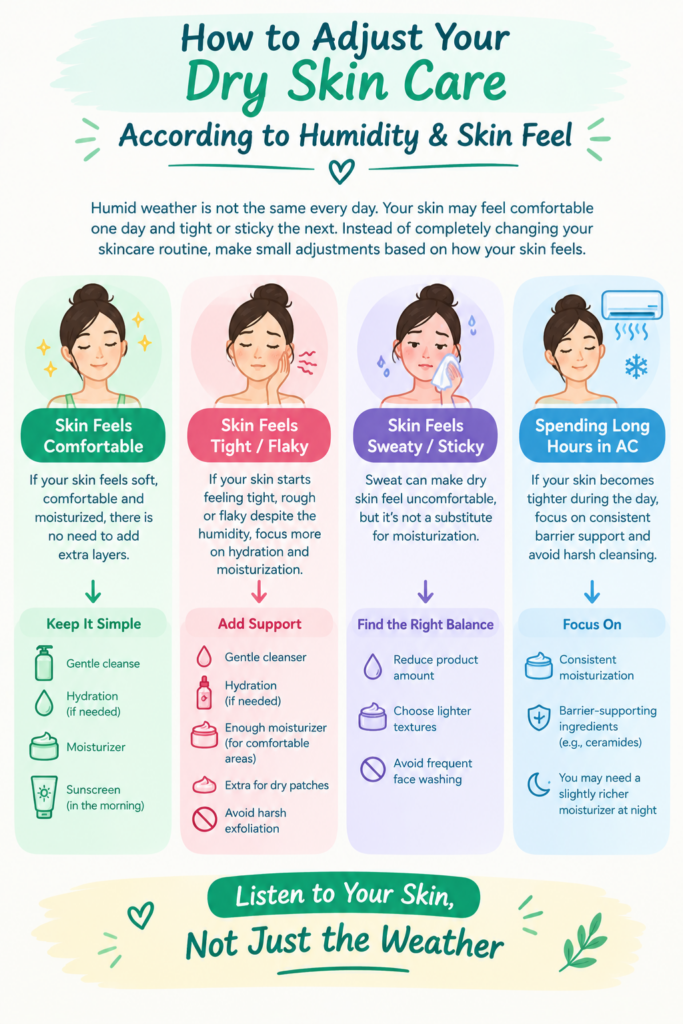
Humid weather is not the same every day. Your skin may feel comfortable one day and tight or sticky the next, especially during the monsoon or when temperatures are high.
Instead of completely changing your skincare routine whenever the weather changes, make small adjustments based on how your skin feels. This helps you maintain hydration without overloading your skin with unnecessary products.
When Your Skin Feels Comfortable
If your skin feels soft, comfortable, and moisturized, there is no need to add extra layers simply because the weather is humid.
Keep your routine simple:
Gentle cleanse → Hydration if needed → Moisturizer → Sunscreen in the morning
Continue using the products that already work well for you.
When Your Skin Feels Tight or Flaky
If your skin starts feeling tight, rough, or flaky despite the humidity, increase your focus on hydration and moisturization.
You can:
- Use a gentle cleanser.
- Add one lightweight hydrating layer if needed.
- Apply enough moisturizer to comfortable areas.
- Give extra moisturizer to visibly dry patches.
- Avoid harsh exfoliation until your skin feels calmer.
You don’t necessarily need to replace your entire routine.
When Your Skin Feels Sweaty or Sticky
Sweat can make dry skin feel uncomfortable, but sweat is not a substitute for moisturization.
If your routine feels too heavy, try reducing the amount of moisturizer or switching to a lighter texture rather than stopping moisturizer completely.
Also avoid repeatedly washing your face just because it feels sweaty. Excessive cleansing can leave dry skin feeling even tighter.
When You Spend Most of the Day in AC
If you regularly move between hot, humid outdoor conditions and air-conditioned rooms, notice whether your skin becomes tighter during the day.
If it does, focus on consistent moisturization and avoid unnecessarily harsh cleansing. You may also find that your skin needs a slightly richer moisturizer at night than during the daytime.
✨ Glow In Budget Expert Tip
Don’t create separate skincare routines for every weather change. Adjust your existing routine instead.
If your skin feels dry → add support.
If it feels comfortable → maintain your routine.
If it feels too heavy or sticky → reduce the amount or choose a lighter texture.
This simple approach makes dry skin care in humid weather easier, more affordable, and more sustainable.
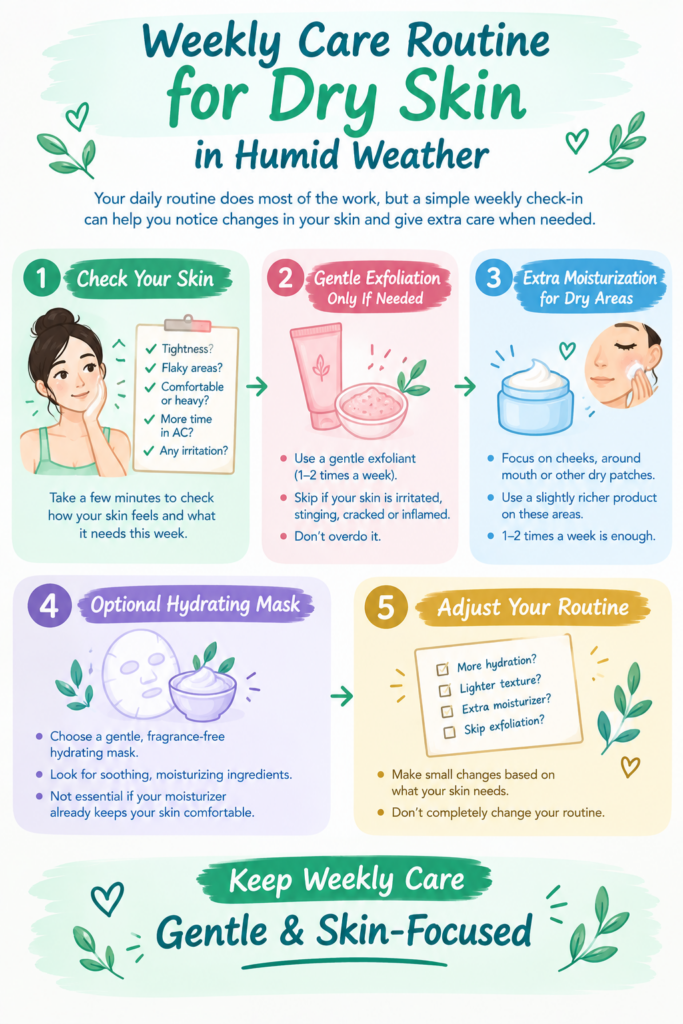
Weekly Care Routine for Dry Skin in Humid Weather
Your daily routine does most of the work, but a simple weekly check-in can help you notice changes in your skin and adjust your care when needed.
The goal of weekly care is not to scrub away every dry patch or use several treatments at once. Instead, focus on maintaining comfort, supporting the skin barrier, and giving extra attention to areas that tend to become dry.
Gentle Exfoliation — Only If Your Skin Needs It
Dry or flaky skin does not automatically mean you need to exfoliate.
If your skin is comfortable and smooth, there may be no reason to add a weekly exfoliation step. If you choose to exfoliate, keep it gentle and avoid aggressive scrubs or frequent exfoliation.
Skip exfoliation completely if your skin is stinging, irritated, cracked, inflamed, or unusually sensitive.
The priority is to calm and moisturize dry skin rather than trying to remove every visible flake.
Extra Moisturization for Dry Areas
Once or twice a week, take a closer look at areas that regularly become dry or rough.
Your cheeks, around the mouth, or other dry patches may benefit from a little extra moisturizer. You can apply a slightly richer product to these areas instead of using a heavy cream over your entire face.
This targeted approach can be especially comfortable during humid weather.
Optional Hydrating Face Mask
A hydrating face mask can be an optional addition to your weekly routine if your skin enjoys it.
Look for a gentle, fragrance-free formula designed to support hydration rather than choosing masks that contain harsh exfoliating ingredients.
A weekly mask is not essential if your regular moisturizer already keeps your skin comfortable.
If your skin needs extra hydration, you can occasionally include a gentle hydrating mask. Explore our guide to DIY face masks for dry skin for more suitable options.
Check Your Skin and Adjust Your Routine
Use your weekly routine as a quick opportunity to reassess your skin.
Ask yourself:
- Does my skin still feel tight after cleansing?
- Am I noticing more flaky or rough areas?
- Does my moisturizer feel comfortable or too heavy?
- Am I spending more time in air conditioning?
- Have any products started causing stinging or irritation?
- Does my skin need more hydration, or simply a lighter texture?
Based on what you notice, make a small adjustment rather than completely changing your routine.
✨ Glow In Budget Expert Tip
Weekly care should support your daily routine—not replace it.
For dry skin in humid weather, consistent gentle cleansing, moisturization, hydration when needed, and daytime sun protection are more important than elaborate weekly treatments.
If your skin is irritated or very dry, skip exfoliation and focus on gentle, barrier-supportive care instead.
Bonus Tips for Managing Dry Skin in Humid Weather
Managing dry skin in humid weather doesn’t have to mean adding more and more products to your routine. Small everyday habits can make a noticeable difference, especially when your skin is already prone to dryness.
- Keep showers comfortably warm rather than very hot. Hot water can leave dry skin feeling more stripped and uncomfortable.
- Avoid washing your face repeatedly. Cleanse when needed instead of trying to remove every trace of sweat or shine.
- Moisturize after cleansing. Applying moisturizer while your skin is slightly damp can help maintain a comfortable level of moisture.
- Don’t confuse sweat with hydration. A sweaty face can still have dry or dehydrated-feeling skin underneath.
- Use sunscreen consistently. Humid or cloudy weather doesn’t mean you can automatically skip daytime sun protection.
- Pay attention to air conditioning. If your skin feels tighter after spending several hours in AC, make sure your moisturizing routine is consistent.
- Avoid an overly complicated routine. More products do not automatically mean more hydration.
- Use richer products only where and when needed. Dry patches may benefit from extra moisturization without requiring a heavy cream over your entire face.
- Prioritize your skin barrier. Gentle cleansing and regular moisturization are more important than constantly adding new active ingredients.
✨ Glow In Budget Expert Tip
The easiest way to manage dry skin in humid weather is to keep your routine consistent and make small adjustments when your skin needs them.
You don’t need to fight humidity with an extremely heavy routine—or fight dryness by layering countless products. Focus on gentle care, hydration, moisturization, and sun protection, then adjust the amount and texture according to your skin’s comfort.
Common Mistakes to Avoid for Dry Skin in Humid Weather
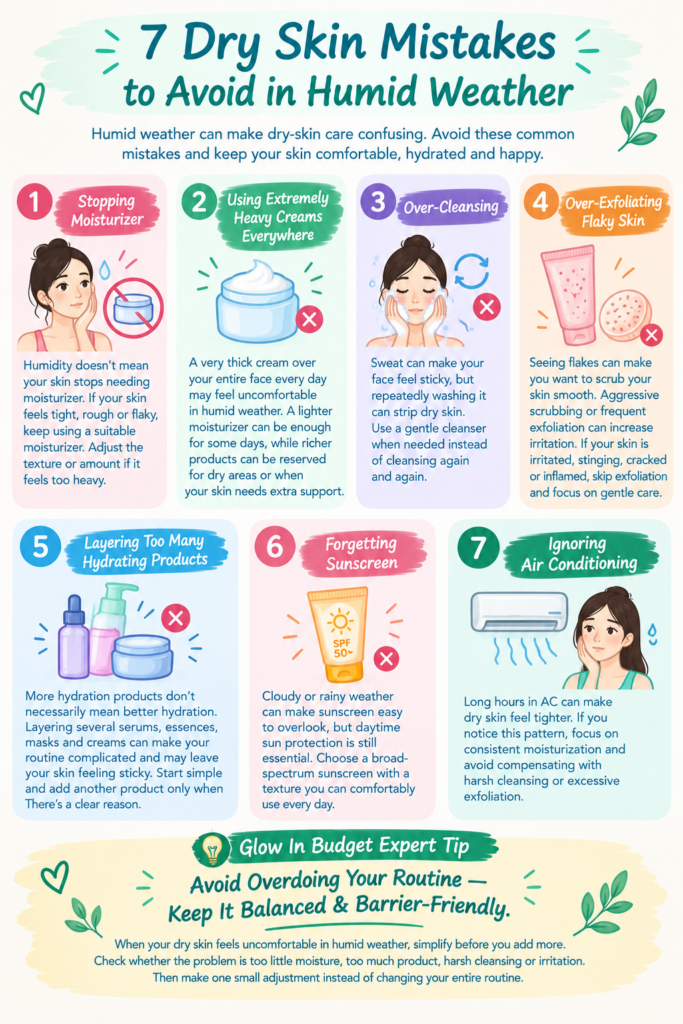
Humid weather can make dry-skin care confusing. You may feel tempted to stop moisturizing because your face feels sweaty, or use stronger products because your skin looks flaky. Both approaches can make your routine less comfortable.
Here are some common mistakes to avoid when caring for dry skin in a humid climate.
Mistake 1 — Stopping Moisturizer Because the Weather Is Humid
Humidity does not mean dry skin suddenly stops needing moisturization.
If your skin feels tight, rough, or flaky, continue using a suitable moisturizer. Instead of skipping it completely, adjust the texture or amount if your routine feels too heavy.
Mistake 2 — Using Extremely Heavy Creams Everywhere
Dry skin needs moisture, but applying a very thick cream over your entire face every day may feel uncomfortable in hot, humid weather.
A lighter moisturizer can be enough for some days, while richer products can be reserved for particularly dry areas or when your skin needs additional support.
Mistake 3 — Over-Cleansing Because Your Skin Feels Sticky
Sweat and humidity can make your face feel sticky, but repeatedly washing it can leave dry skin feeling stripped.
Use a gentle cleanser when needed rather than cleansing repeatedly throughout the day.
Mistake 4 — Over-Exfoliating Flaky Skin
Seeing flakes can make you want to scrub your skin smooth. However, aggressive scrubbing or frequent exfoliation can increase irritation and make compromised dry skin less comfortable.
If your skin is irritated, stinging, cracked, or inflamed, skip exfoliation and focus on gentle care.
If your dry skin is also easily irritated, choose gentle ingredients and avoid harsh DIY treatments. You can also explore our guide to DIY face masks for sensitive skin for gentler options.
Mistake 5 — Layering Too Many Hydrating Products
More hydration products do not necessarily mean better hydration.
Layering several serums, essences, masks, and creams can make your routine unnecessarily complicated and may leave your skin feeling sticky.
Start with a simple routine and add another product only when there is a clear reason.
Mistake 6 — Forgetting Sunscreen
Cloudy or rainy weather can make sunscreen easy to overlook, but daytime sun protection remains an important part of a skincare routine.
Choose a broad-spectrum sunscreen with a texture that you can comfortably use consistently.
Mistake 7 — Ignoring Air Conditioning
Spending long hours in air-conditioned rooms can make dry skin feel tighter.
If you notice this pattern, pay attention to consistent moisturization and avoid compensating with harsh cleansing or excessive exfoliation.
✨ Glow In Budget Expert Tip
When your dry skin feels uncomfortable in humid weather, simplify before you add more.
Check whether the problem is too little moisture, too much product, harsh cleansing, or irritation. Then make one small adjustment instead of changing your entire routine.
When Should You See a Dermatologist for Persistent Dry Skin?
Most mild dryness can often be managed with gentle skincare and regular moisturization. However, if your skin remains very dry despite a consistent routine, it may be worth getting professional advice rather than continuing to add more products.
Dryness That Doesn’t Improve
If your skin remains persistently dry, rough, or flaky even after simplifying your routine and using a suitable moisturizer, consider speaking with a dermatologist.
Persistent dryness can sometimes have causes that require more than basic skincare.
Painful Cracks or Bleeding
Very dry skin can sometimes develop cracks that become painful or bleed. This is more than ordinary seasonal dryness and deserves appropriate care, particularly if it keeps recurring.
Significant Itching, Redness, or Inflammation
If dryness is accompanied by persistent itching, redness, swelling, burning, or inflammation, don’t assume that you simply need a stronger moisturizer.
A dermatologist can assess whether an underlying skin condition or irritation may be contributing to the problem.
Products Suddenly Cause Stinging or Burning
If products that previously felt comfortable begin causing significant stinging or burning, simplify your routine and avoid introducing multiple new products at once.
If the sensitivity continues, professional evaluation can help identify what may be irritating your skin.
✨ Glow In Budget Expert Tip
Persistent or painful dryness shouldn’t be something you simply keep covering with more skincare products.
If your symptoms are severe, recurring, or not improving with gentle care, getting advice from a qualified dermatologist can help you find the appropriate approach.
FAQs About Dry Skin Care in Humid Weather
Can dry skin still be dry in humid weather?
Yes. Humid air does not automatically mean your skin has enough hydration or that its protective barrier is functioning well.
Dryness can still be affected by factors such as frequent cleansing, hot showers, sun exposure, air conditioning, and irritating skincare products.
Should I use moisturizer if the weather is humid?
Yes. If you have dry skin, you generally don’t need to stop moisturizing simply because the weather is humid.
Instead, adjust the amount and texture of your moisturizer. A lighter lotion or cream may feel more comfortable than a very rich product, while particularly dry areas may need extra moisturization.
What type of moisturizer is best for dry skin in humid weather?
There isn’t one texture that works for everyone.
A light cream, lotion, or gel-cream may be comfortable for everyday use, while a richer moisturizer can be useful for very dry areas or when your skin feels particularly uncomfortable.
Look for formulas that support hydration and the skin barrier rather than choosing a product solely because it is the thickest.
Can I use hyaluronic acid on dry skin in humid weather?
Yes. Hyaluronic acid is a humectant that can help attract and retain water in the outer layers of the skin.
However, you don’t need to use it simply because you have dry skin. If your moisturizer already keeps your skin comfortable, an additional hydrating serum may not be necessary.
Why does my dry skin feel oily in humid weather?
Sweat and increased surface moisture can make dry skin appear shiny or feel greasy even when it still needs moisturization.
Instead of repeatedly cleansing your face or stopping moisturizer completely, try using a lighter texture or smaller amount and observe how your skin responds.
How often should I moisturize dry skin in humid weather?
Morning and night are practical starting points for many people with dry skin.
You can also moisturize after cleansing or apply additional moisturizer when your skin genuinely feels tight or dry. If your skin feels comfortable, there is no need to keep adding layers.
Should I use a heavy cream during monsoon?
Not necessarily.
A heavy cream can be useful when your skin is very dry or certain areas need extra protection, but you don’t automatically need a thick cream simply because you have dry skin.
If a heavy moisturizer feels sticky in humid weather, try a lighter texture and reserve richer products for particularly dry areas.
Can air conditioning make dry skin worse?
It can contribute to a drier-feeling environment, particularly when you spend long periods in air-conditioned spaces.
If your skin feels tighter after several hours in AC, focus on consistent gentle cleansing and moisturization rather than compensating with harsh exfoliation or excessive washing.
Should dry skin exfoliate in humid weather?
Exfoliation is optional, not a requirement.
If your skin is comfortable, you may not need to exfoliate. If you do exfoliate, keep it gentle and infrequent.
Avoid exfoliating when your skin is cracked, inflamed, stinging, or irritated. In those situations, prioritize gentle cleansing and barrier-supportive moisturization.
What is the best simple routine for dry skin in humid weather?
A simple routine can be:
Morning:
Gentle cleanse → Lightweight hydration if needed → Moisturizer → Broad-spectrum sunscreen
Night:
Remove sunscreen/makeup → Gentle cleanse → Optional hydration → Moisturizer → Extra moisturizer on very dry areas if needed
Weekly:
Check your skin → Gentle exfoliation only if appropriate → Extra moisturization for dry areas → Optional hydrating mask → Adjust your routine
The goal isn’t to use the most products. It’s to keep your skin hydrated, comfortable, protected, and supported without unnecessary heaviness.
✨ Glow In Budget Expert Tip
Let your skin guide your routine. Humidity is only one part of the equation. If your skin feels tight or flaky, increase hydration and moisturization; if it feels overly heavy or sticky, adjust the texture or amount rather than abandoning moisturization completely.
Final Thoughts
Dry skin doesn’t stop needing hydration just because the weather is humid. In fact, dry skin care in humid weather is about finding the right balance between hydration, moisturization, barrier support, and comfortable textures.
You don’t need to cover your skin with heavy creams or build a complicated routine. A simple approach can work well:
Gentle cleansing → Hydration when needed → Comfortable moisturization → Daily sun protection
Pay attention to how your skin changes throughout the day. If it feels tight or flaky, give it more hydration and moisturization. If it feels sweaty or sticky, adjust the amount or choose a lighter texture rather than stopping moisturizer altogether.
And remember, weekly care should remain gentle. Your everyday routine does most of the work, while weekly adjustments can provide extra support when your skin needs it.
The goal isn’t perfectly matte or perfectly dewy skin—it’s comfortable, hydrated, supported skin that feels good in its climate.
✨ Glow In Budget Expert Tip
Listen to your skin, not just the weather. Humidity is only one part of your skin-care environment. Your routine should adapt to your skin’s actual needs while staying simple enough to follow consistently.
Follow Glow In Budget
Found this guide helpful?
Follow @glowinbudget for more affordable beauty, skincare, hair care, and self-care tips. We regularly share practical routines, expert-backed advice, and budget-friendly solutions to help you look and feel your best—without overspending.